Most guides to learning with a tutor are really guides to finding one. Sign up here, filter by price, watch the intro videos, book a trial. Then the guide stops, at exactly the point where the actual difficulty begins.
Finding a tutor is easy. Tens of thousands of them are a search away, most are competent, and the trial costs a few pounds. What is hard is everything after: knowing whether you needed one yet, working out which of them fits the job you actually have, deciding how often to meet, arriving in a state where the hour is worth something, doing anything with what it produced, judging whether it is working, and knowing when to stop.
That is where the money goes, and almost none of it is written down anywhere.
The lesson is the most expensive hour of your week and the smallest part of the work. People who get a great deal from tutoring and people who quietly waste a year of it are usually booking the same lessons with similar tutors. The difference is in the decisions around the hour rather than inside it.
This guide covers those decisions in the order you face them: whether to hire at all, how to choose, how to build a cycle that compounds, how to judge whether it is working, and the one situation where all the usual advice is overridden. Each section gives the short answer and links to the full treatment.
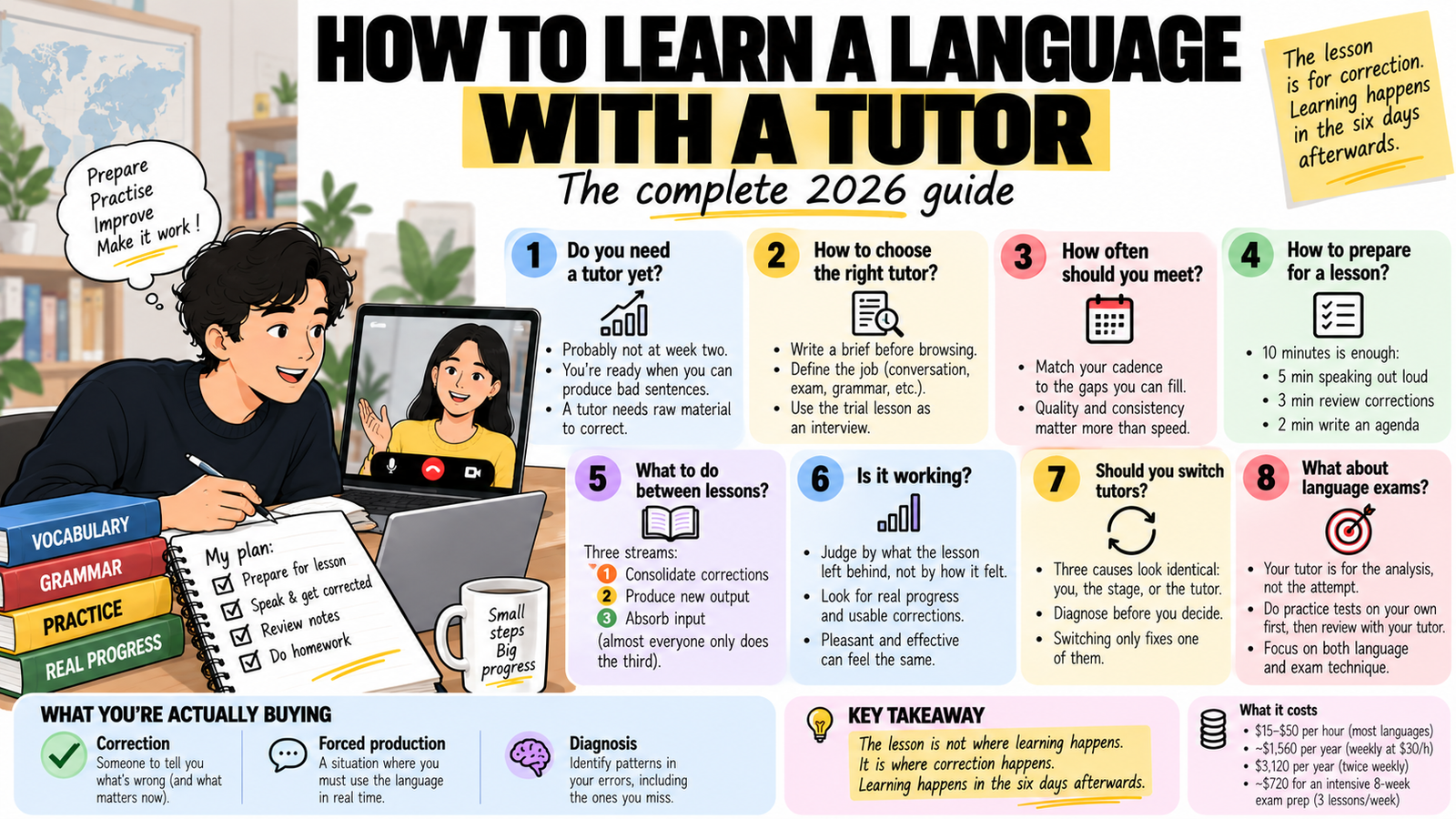
TL;DR. The whole thing in one screen
- Do you need a tutor yet? Probably not at week two. You are ready when you can produce bad sentences, because everything a tutor uniquely does needs raw material to work on.
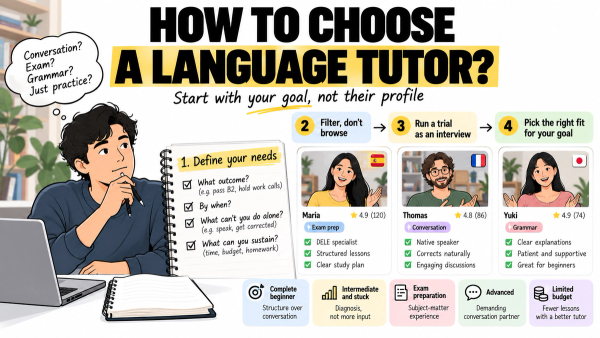
- How do you choose? Write a brief before you browse. Define the job, then evaluate people against it. The trial lesson is an interview and most learners forget to conduct one.
- How often? Match your cadence to the number of gaps you will genuinely fill, not to how fast you want to improve.
- How do you prepare? Ten minutes. Five speaking out loud, three reviewing corrections, two writing an agenda. This one habit changes more than anything else in the guide.
- What happens between lessons? Three streams: consolidate what was corrected, produce new output, absorb input. Almost everyone does only the third.
- Is it working? Judge by what the lesson left behind, not by how it felt. Pleasant and effective feel identical from inside the hour.
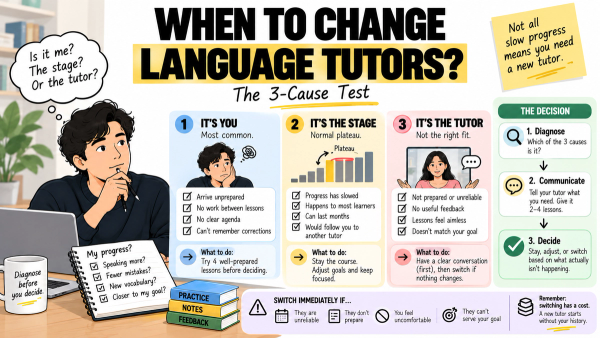
- Should you switch? Three causes produce the same stalling feeling and switching fixes only one of them. Diagnose first.
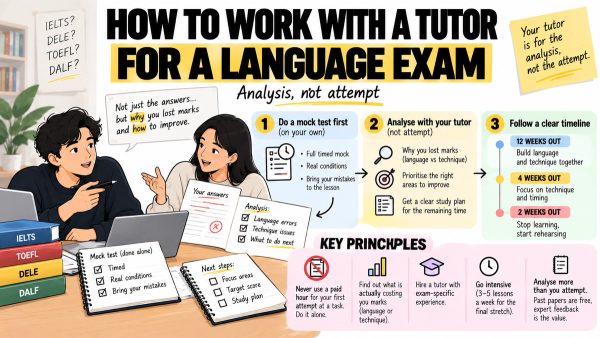
- Exams? The tutor is for the analysis, not the attempt. Never use a paid hour for your first go at a task type.
If you take one thing: the lesson is not where learning happens. It is where correction happens. Learning happens in the six days afterwards.
What you are actually buying
Three things. Everything else that occurs in a lesson is available elsewhere, free.
Correction. Someone hearing what you produce and telling you what is wrong with it, with the judgement to know which errors matter now and which can wait.
Forced production. A situation where you must construct language in real time, under mild social pressure, with no pause button. Almost impossible to manufacture alone, and the reason app streaks do not make people fluent.
Diagnosis. Noticing the pattern behind your errors, including the ones invisible to you. That you avoid a tense by rephrasing. That you have fossilised a pronunciation. That you understand a structure in reading and never produce it.
What is not on that list: vocabulary, grammar explanations, listening practice, reading, cultural background. All valuable, all free, all quietly consuming lesson time when nobody has planned otherwise.
This is the principle the entire guide runs on. The lesson is for what you cannot do alone. Every decision below is some version of moving other things out of it.
What this actually costs
Worth putting numbers on, because almost nobody does and the arithmetic changes how you should think about everything else.
Rates. Online language tutoring sits mostly between $15 and $50 an hour, with wide variation by language and specialism. Rare languages and specialist work run higher; generalist conversation in widely-taught languages runs lower. Specialists in industry-specific language or exam preparation with real credentials sit at the top of that band and beyond.
What a year looks like, at a fairly ordinary $30 an hour:
- Fortnightly: roughly $780 a year
- Weekly: roughly $1,560
- Twice weekly: roughly $3,120
- Intensive exam preparation, three a week for eight weeks: roughly $720 on top of whatever else you are doing
Those are not trivial sums, and they are the reason the rest of this guide exists.
The number that actually matters is cost per unit of progress, not cost per hour. And that number is determined almost entirely by what happens outside the lesson.
Consider two learners. The first pays $1,560 for weekly lessons, prepares for ten minutes, consolidates within two days, and arrives with an agenda. The second pays $3,120 for twice-weekly lessons, arrives cold, does nothing in between, and lets the tutor drive. The second spends twice as much and, over a year, usually has less to show for it.
That is not a marginal difference. It is the difference between tutoring being the best money you spend on a language and being the most expensive way to have a pleasant conversation.
One practical implication. If budget is what limits you, cut frequency rather than quality. Two well-prepared lessons a month with a good tutor beats four unprepared ones with a cheap one. The constraint should hit how often you meet, not who you meet.
Phase 1. Decide whether to hire at all
Most guides skip this, for the obvious reason that most of them are published by someone selling lessons.
The honest answer for someone starting from zero is usually not yet. At week two you have nothing to correct, nothing to diagnose, and very little to produce. A tutor facing a true beginner necessarily spends the hour on vocabulary and explanation, which is real teaching and also the part you could have had from a free video at three in the morning.
The threshold is production, not time or level. You are ready when you can make bad sentences. The moment you can assemble a wrong sentence, you have manufactured the raw material a tutor needs.
Override this when the language has hard pronunciation or a new script, when you have a deadline, when you have repeatedly failed to sustain self-study alone, or when your time is worth more than the lesson.
And watch the opposite error harder, because it is more common and far more expensive. Eighteen months of app streaks and no conversations is the standard failure among people who actually persist. Hiring three months early costs a few hundred pounds. Waiting three years costs the language.
The full argument, including what AI has genuinely changed about this, is in do you actually need a language tutor.
Phase 2. Choose the right person
The standard advice is a checklist of qualities: qualifications, native speaker, good reviews, teaching style. That is the second question.
The first is what you need this person to do. A conversation partner, an exam coach, a grammar fixer, and a weekly accountability structure are four different hires requiring different people, credentials, and prices. Browse before deciding which one you are making and you will pick whoever seemed nicest in thirty minutes.
Write a brief before you browse. Four questions, in writing, fifteen minutes: what outcome specifically, by when, what you genuinely cannot do alone, and what you will actually sustain. Then filter hard and read a short list properly.
Then treat the trial as an interview. Most learners watch a performance. Send your context the day before, ask what they would focus on first with you, ask what a typical lesson looks like, ask how they handle correction. A tutor who has been diagnosing throughout will answer specifically. One who has not will say something general about confidence.
The mistake almost everyone makes is weighting warmth too heavily, because warmth is assessable in five minutes and effectiveness takes five lessons. The fix is one written question after each trial: what specifically would this person fix that I could not fix alone?
Full treatment, including what actually carries signal in a profile and why "matching your learning style" is not a real criterion, in how to choose a language tutor.
Phase 3. Build a cycle that compounds
This is the phase that separates people who get value from tutoring from people who buy it for two years and plateau in month four. Three decisions.
How often
Cadence is an allocation problem, not an ambition problem. You have a budget, not unlimited lessons, and the question is how to divide it.
Set frequency to the number of gaps you will genuinely fill. Three lessons a week with nothing done between them produces three warm-ups and roughly the same progress as one, at triple the cost.
Beginners lean toward more frequent and shorter. Intermediates should almost always fix the gap before adding a lesson, since correction is not their bottleneck and production is. Advanced learners need harder rather than more.
Detail, including what the spacing research does and does not support, in how often should you have language lessons.
The ten minutes before
Arriving cold costs most people a quarter of the lesson, spent reaching for words in front of a paid professional. At a fairly ordinary rate that is around $390 a year on warming up.
Ten minutes fixes it. Five speaking out loud to yourself in the target language, three reviewing last lesson's corrections, two writing down what you want fixed today.
If you do only one thing from this entire guide, speak out loud for five minutes before you log on. It costs nothing and it is the difference between a lesson that starts at minute one and one that starts at minute fifteen.
Also: five minutes immediately after, writing corrections as full sentences while you still remember the context. Full method in how to prepare for a language lesson.
The six days between
Between-lesson work is not a study routine. It is the second half of the lesson, and the test is whether you would be doing it identically if the lesson had never happened.
Three streams, in priority order. Consolidate what was corrected, within forty-eight hours, fifteen to twenty minutes. Produce new output that nobody will correct. Absorb input and vocabulary.
Priority and volume run in opposite directions: consolidation is first in importance and smallest in time, absorption is last in importance and largest in volume.
Almost everyone does only the third, because recognition feels good and production feels bad, and because apps tell you what to do next while consolidation requires finding your own notes. The activity that feels worst is doing the most work.
Full system in what to do between language lessons.
Phase 4. Judge, and adjust
Is it working
You cannot tell from how the lesson felt, because you have one tutor and no reference class, and because pleasant and effective feel the same from inside the hour.
Judge by what it left behind. Did you speak most of the time. Can you name three corrections. Did you get a pattern rather than a list. Was anything difficult. Do you know what to do before next week.
Most weak lessons fail on the same two: you did not speak enough, and nothing was left over. Both are usually fixed by one sentence to your tutor, and most learners never say it.
The five markers, plus a minute-by-minute picture of what a good lesson looks like, in what makes a good language lesson.
Should you switch
Three different problems produce an identical feeling of stalling, and switching fixes exactly one.
It is you (no preparation, no gap work, no agenda), which is the most common and the cheapest to fix. It is the stage (an ordinary plateau that would follow you to any tutor). Or it is the tutor.
Rule out the first two before looking at the third. Four lessons of proper preparation will tell you about the first; comparing against a recording from six months ago will tell you about the second.
If it is the tutor, and it is not one of the immediate-switch categories (unreliability, unpreparedness, discomfort, a goal they cannot serve), have one specific conversation and give it two to four lessons before deciding.
Full diagnostic, and the cost of switching that nobody mentions, in when to change language tutors.
The special case: exams
When there is a date and a score, most of the advice above is overridden.
Cadence goes intensive, because you are buying speed at the cost of efficiency and that is the correct trade. Consolidation matters less than coverage. General language work leaves the plan a month out.
What stays constant, and matters more here than anywhere: the tutor is for the analysis, not the attempt. Past papers are free and infinitely available. Never use a paid hour for your first go at a task type. Do it badly alone, then bring the wreckage.
Two things to sort before your first exam-prep lesson: take a full timed mock, cold, and send it. And work out what proportion of your lost marks is language and what proportion is technique, because a solid B2 speaker can fail a B2 exam on technique alone, and no amount of technique carries a B1 speaker through a C1 paper.
Full method and timeline in working with a tutor for a language exam.
Three learners, three setups
What the guide looks like applied, rather than in the abstract.
Marta, starting Japanese from zero, no deadline. Below the production threshold, and Japanese has both a new script and pronunciation worth getting right early. So: three or four lessons in the first month, focused specifically on sound and script, then stop. Three months of vocabulary, input, and daily attempts at bad sentences on her own. Back to weekly lessons once she can describe her day badly. Total first-year spend well under what most beginners pay, and considerably more progress.
Tom, B1 Spanish, eighteen months in, plateaued. Understands a great deal, speaks in the same six structures every time. Classic intermediate pattern, and his instinct is to add a second weekly lesson. Wrong move: correction is not his bottleneck, production is. He keeps one lesson a week, cuts his app time in half, and spends the recovered forty minutes writing and recording output nobody corrects. His tutor now has material to diagnose from, and the plateau breaks in about two months. Cost: unchanged.
Priya, B2 French, DELF C1 in fourteen weeks for a job application. Everything changes. She takes a full timed mock before booking anything, discovers her losses are two-thirds technique rather than language, and briefs a tutor with exam-specific experience accordingly. Three lessons a week, rising to five in the final month. All attempts happen alone; all lesson time goes to analysis and speaking. She stops learning new material four weeks out and spends the last fortnight rehearsing.
Three people, three completely different correct answers, from the same set of decisions.
What a year with a tutor actually looks like
Compressed, assuming you start at the production threshold with one lesson a week.
Month 1. Awkward. You speak less than you should, the tutor talks more than they should, and you spend the first fifteen minutes of each lesson warming up. Normal, and mostly fixed by the ten-minute protocol.
Months 2 to 3. The rhythm settles. You start arriving with an agenda. Your tutor begins noticing patterns rather than individual errors, which is when their value actually starts.
Month 4. The first plateau. Progress stops being visible. This is where people either add lessons, switch tutors, or fix their gap work. Only the third reliably helps.
Months 5 to 8. The quiet stretch. Real progress happening, very little of it perceptible week to week. The learners who keep going are almost always the ones consolidating within forty-eight hours, because they can see the corrections landing even when fluency feels static.
Months 9 to 12. You notice something in retrospect rather than in the moment. A conversation that would have been impossible in March. A film you followed further than expected. Progress at this stage is only visible by comparison, which is why recording yourself early is worth doing.
Beyond a year. The tutor's role shifts from teaching to diagnosis and stress-testing. Cadence often drops, lessons get harder, and what you need becomes more specific.
Faster happens. Slower is common. Twelve months with no measurable change means something in the cycle is broken, and it is usually the gap.
Five things nobody tells you
The lesson is the least of it. One hour against 167. Everything that determines whether tutoring works happens in the other 167, which is why most of this guide is about them.
Warmth is necessary and not sufficient. A tutor who makes you comfortable enough to speak badly is doing something genuinely important. A tutor who only does that is expensive company.
Being corrected is the product. Learners routinely ask for gentler correction and then wonder why they are not improving. If it is uncomfortable, it is probably working.
Your tutor adjusts to how serious you seem. They can tell within two minutes whether you did the work, and it changes what they attempt. Preparation buys you a better lesson, not just a shorter one.
Nobody will tell you when to change something. Not the platform, not your tutor, not your own sense of progress, which is unreliable by construction. Put a review in your calendar every three months and run the five markers against it.
Who this does not work for
If you are at week two of a new language. Come back when you can make bad sentences. Spend the intervening months on vocabulary and input, both free.
If you will not do anything between lessons. Tutoring still works, considerably less well, and at roughly three times the cost per unit of progress. Be honest about this when setting your cadence rather than booking a schedule you will not support.
If you want the hour to carry everything. It cannot. An hour a week is about 0.6 percent of your waking time, and no teacher is good enough to make that sufficient on its own.
If you are looking for passive progress. Tutoring is the most active form of language learning available. That is the whole point of it, and it is the reason it works better than the alternatives.
None of these are reasons nobody should hire a tutor. They are reasons to go in with the right expectations.
Bottom line
You are not buying lessons. You are buying correction, forced production, and diagnosis, and whether you actually receive them depends almost entirely on decisions made outside the hour.
Wait until you can produce bad sentences. Write a brief before you browse, and interview in the trial. Set your cadence to the gaps you will genuinely fill. Spend ten minutes before each lesson and five after. Consolidate within forty-eight hours. Judge by what the lesson left behind rather than how it felt. And when it stalls, work out whether it is you, the stage, or the tutor before changing anything.
The whole cluster, in reading order:
- Do you actually need a language tutor?
- How to choose a language tutor
- How often should you have language lessons?
- How to prepare for a language lesson
- What to do between language lessons
- What makes a good language lesson?
- When to change language tutors
- How to work with a tutor for a language exam
Ten minutes before. Five minutes after. Fifteen within two days. Everything else is optional by comparison.