Here is the difficulty with judging your own lessons: you have almost no basis for comparison.
You see one tutor. You have never watched somebody else's lesson. You cannot tell whether the way yours corrects you is standard or unusual, whether the amount you speak is normal or low, whether the structure is deliberate or improvised. So you fall back on the only signal available, which is how the hour felt.
And how it felt is the one signal that does not track how well it worked.
Pleasant lessons and effective lessons overlap, but they are not the same thing, and the failure mode is specific: eighteen months of enjoyable conversations with someone you like, steady payment, genuine warmth, and very little measurable change. Nobody in that situation is doing anything wrong. The tutor is being agreeable, and the learner is being agreeable back, and agreeable is not the product.
What follows is a set of checks that do not depend on having a reference class. You can run them on your next lesson.
Search results for this question are almost entirely written for teachers rather than learners, which is part of why it is hard to answer. This is the learner's version.
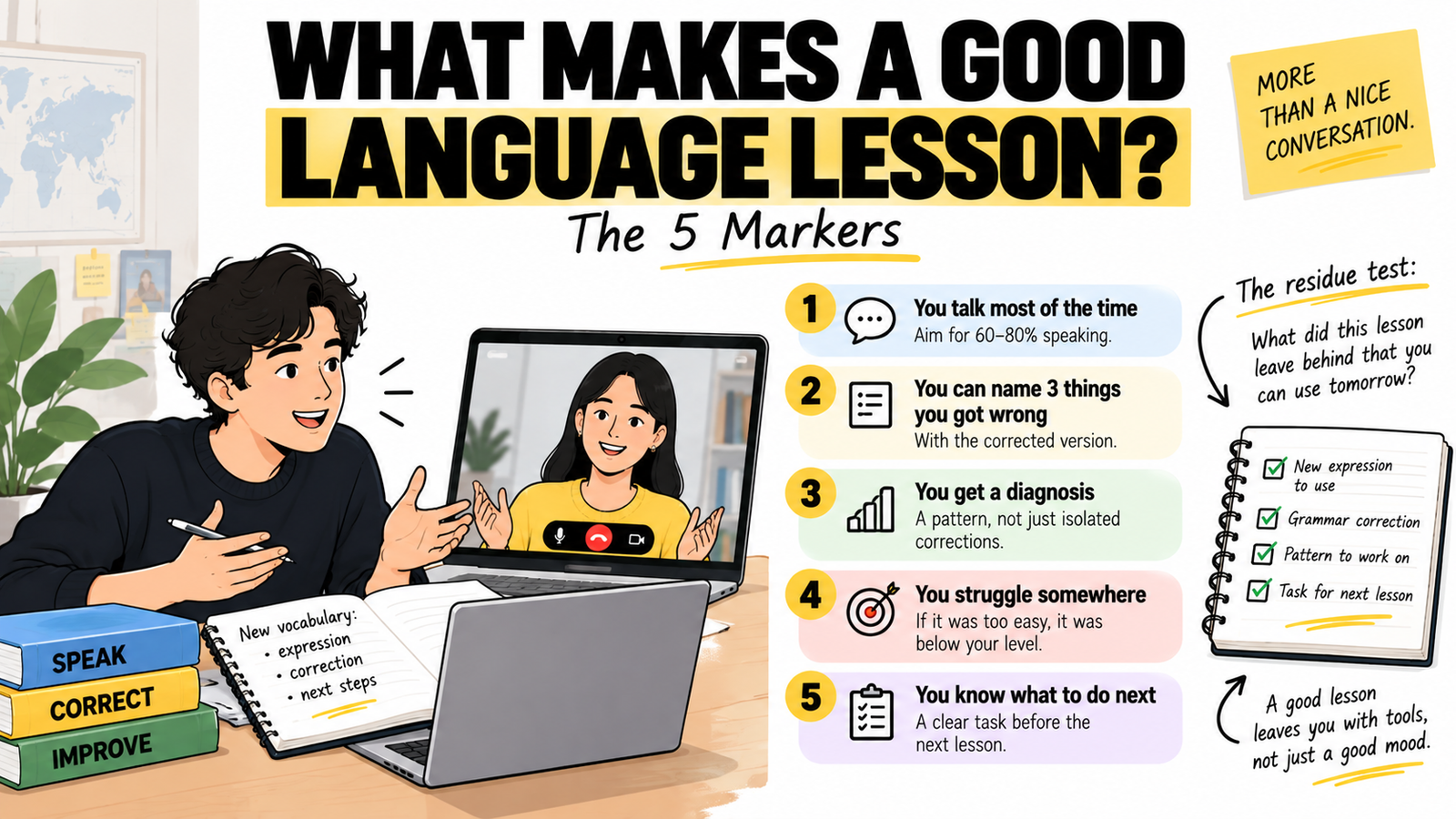
TL;DR. The five markers
After a lesson, you should be able to answer yes to most of these.
- Did you do most of the talking? For almost any goal above absolute beginner, you should be speaking somewhere between sixty and eighty percent of the time.
- Can you name three things you got wrong? Not vaguely. Specifically, with the corrected version.
- Did you get a diagnosis, not just corrections? A pattern named, rather than a list of individual errors.
- Did you struggle somewhere? If nothing was difficult, the lesson was pitched below you.
- Do you know what to do before the next one? A lesson that generates no work is a conversation.
The residue test, underneath all five: what did the lesson leave behind that you can use tomorrow? If the honest answer is a good mood, that was a nice hour and not much else.
Why you cannot tell from the inside
Three things conspire to make self-assessment unreliable.
No reference class. You have one sample. Everything your tutor does looks like what tutors do, because you have never seen an alternative. Learners who switch tutors are often startled by how different a competent lesson can look, which is precisely the information a single-tutor learner never gets.
Pleasantness is confounded. Warmth genuinely helps. A tutor who makes you comfortable enough to speak badly is doing something valuable, because fear of sounding stupid is what silences most adults. So the comfortable feeling is not a false signal; it is an incomplete one, and it is much easier to notice than the things it sits alongside.
Difficulty feels like failure. A lesson that leaves you slightly frustrated, aware of how much you cannot do, is often the better lesson. A lesson where everything went smoothly frequently means you were operating well inside what you already had. Most people read those signals exactly backwards.
Which is why the checks below are deliberately mechanical. They ask what happened, not how it felt.
The residue test
One question, applied after every lesson.
What did this lesson leave behind that I can use tomorrow?
Good lessons leave residue. Corrected sentences you could not have produced alone. A pattern in your errors that you had not noticed. A structure you now half-own and need to practise. A task for the week. Something concrete, portable, and usable outside the hour.
Weak lessons leave a feeling. You enjoyed it, the time passed, you spoke some of the target language, and by Thursday there is nothing you could point to.
This is not a high bar. A single corrected sentence you genuinely could not have built yourself is residue. A tutor telling you that you have been avoiding one tense for a month is residue. Neither requires a remarkable teacher, and both are absent from a surprising number of paid lessons.
If you want a single habit from this article: write the residue down in the five minutes after the lesson, while it still exists. More on that in what to do between language lessons.
The five markers
1. Talk-time ratio
You should be speaking most of the lesson. Roughly sixty to eighty percent for conversation, fluency, and general improvement.
This is the single easiest thing to check and the one that most often fails. Tutors talk too much for understandable reasons: explaining feels like teaching, silence feels like failure, and filling a pause is a reflex. But you do not improve by listening to a fluent person speak. You improve by producing badly and being corrected.
How to check it: record a lesson, or simply notice during one. If your tutor delivered a ten-minute explanation, that was ten minutes you were not speaking, and an explanation is the one thing now freely available elsewhere.
Legitimate exceptions: a first lesson, where diagnosis requires the tutor to ask a lot; a genuinely new grammar point that needs setting up; an absolute beginner who has little to produce yet. All of those are occasional, not weekly.
2. Nameable corrections
You should be able to list three specific things you got wrong, with the correct version.
Not "she corrected my grammar." Something like: I said je suis allé à le magasin, and it should be au magasin, and the reason is contraction.
If you cannot produce three, one of two things happened. Either you were not corrected enough, which means the lesson was too comfortable, or you were corrected, and none of it registered, which means the corrections came too fast, too vaguely, or without being written down.
Both are fixable, and both are worth raising directly with your tutor.
3. A diagnosis, not just corrections
Corrections are individual errors. A diagnosis is the pattern behind them.
"You said that wrong" is a correction. "You have been avoiding the subjunctive by rephrasing every time, for about a month, and it is now the main thing holding your speech back" is a diagnosis.
The difference matters enormously. Corrections are available from a dictionary, a grammar checker, or a language model, all free and all patient. Diagnosis requires someone who has heard you speak repeatedly over time and noticed something you cannot see about yourself. It is the least replaceable thing a human tutor does, and it is the thing most learners never explicitly ask for.
If you are not getting it, ask. "What pattern do you notice in my mistakes?" is a fair question, and a good tutor will have an answer ready.
4. Difficulty
Something in the lesson should have been hard.
You should have reached for a structure and failed. Been asked a question you could not answer cleanly. Had to say something you did not have the words for and been made to find a way around it anyway.
A lesson where everything flowed is usually a lesson conducted entirely inside your existing ability. That is pleasant; it builds fluency in what you already know, and it does not extend anything.
The tutor's job here is calibration: hard enough that you strain, not so hard that you shut down. When it goes wrong, it is almost always too easy rather than too hard, because too easy is comfortable for both parties and nobody complains about it.
5. Something to do next
The lesson should generate work.
Homework, an exercise, a piece of writing, something to record, a structure to practise, material to read. It does not have to be formal and it does not have to be much. It has to exist.
A lesson that produces nothing to do is a lesson that ends when the call ends, which means it never leaves the hour you paid for. Given that most of the conversion from knowledge to ability happens between lessons, a tutor who sets nothing has quietly handed you the least valuable version of their service.
If your tutor does not set work, set it yourself. Take whatever came up and turn it into five sentences. But notice that you had to.
What a good lesson actually looks like
Since the core problem is never having seen anyone else's lesson, here is a plausible shape for a sixty-minute intermediate session. Not the only valid shape, and not a template your tutor should be following. A reference point.
Minutes 0 to 5. Warm-up in the target language. Not "how was your week" as filler, but as a genuine speaking task while the tutor listens for where you are today. A good tutor is already diagnosing here.
Minutes 5 to 10. Checking last week. The correction from last time, the homework if there was any, the structure you were meant to practise. Brief, and it tells the tutor what is possible today.
Minutes 10 to 35. The main work, with you producing. A task, a topic, a scenario, an exercise, whichever fits the goal. You are speaking most of this. The tutor is intervening, correcting selectively, pushing you to rephrase rather than supplying the word.
Minutes 35 to 45. Focus on what broke. The tutor picks one or two things that went wrong repeatedly and works on them directly. This is where the diagnosis surfaces, and it is the part weak lessons skip entirely.
Minutes 45 to 55. Production again, using the thing just worked on. Immediate reuse. Without this, the focus section is an explanation you will forget.
Minutes 55 to 60. Summary and next steps. What came up, what to practise, what to bring next time. Written down, by one of you.
What varies: the proportions, the activities, the materials, the order of the middle sections. What should not vary: that you produce more than the tutor, that something gets targeted rather than everything being skimmed, and that the hour ends with something written down.
If you compare that shape to your own lessons and notice that yours is thirty minutes of chat followed by thirty minutes of a coursebook, you have learned something useful.
What legitimately varies
Not every difference between lessons is a quality difference. Four things vary for good reasons.
Lesson type. An exam-preparation lesson is heavier on drilling and task practice, with more tutor talk-time, and that is correct. A conversation lesson should be almost all you. Do not judge one by the standards of the other.
Level. Beginners need more input, more explanation, and more scaffolding, so the talk-time ratio at A1 is legitimately different from B2. The ratio should shift toward you steadily as you improve, and if it has not in a year, that is a signal.
Teaching style. Some tutors correct in the moment, some at the end, some in writing afterwards. All three work. What matters is that the choice is deliberate and that you know which one you are getting. Ask if you do not.
Materials. Some tutors build everything around your own material, some use a coursebook, some improvise from a news article. None of these is inherently better. What matters is whether it connects to your goal.
What does not legitimately vary: whether you are corrected, whether the lesson has a shape, whether anything is left behind. Those are not style choices.
What your tutor is managing that you cannot see
Worth knowing, because it explains some things that look like weaknesses and are not.
Selective correction is a skill, not laziness. A good tutor deliberately lets errors pass. Correcting everything produces learners who hesitate before every sentence and eventually stop speaking, so a tutor is constantly deciding which error matters now and which can wait until you are ready to hear it. If it feels like your tutor lets things go, that may be judgement rather than inattention. It is fair to ask.
Silence is often deliberate. The pause after a question, where you are visibly struggling, is doing work. A tutor who fills it is being kind and making the lesson worse. If your tutor waits while you flounder, that is usually the correct behaviour rather than awkwardness.
They are pitching to what they think you can take. Tutors calibrate difficulty to the student's apparent tolerance, and most people signal discomfort earlier than they realise. A learner who looks anxious gets an easier lesson. If you want to be pushed harder, say so explicitly; it is one of the most effective sentences you can say to a tutor, and very few people say it.
They can see whether you did the work. Within about two minutes. It changes what they attempt, because there is no point pushing into new territory with someone who has not consolidated the last lot.
When it is you, not the tutor
Honest section, because the five markers can fail for reasons that have nothing to do with teaching quality.
You arrived cold. A lesson that starts with fifteen minutes of warming up is a shorter lesson, and the tutor spends it on retrieval rather than on anything new. Covered in how to prepare for a language lesson.
You did not do the work between. If last week's correction has not landed, this week gets spent re-teaching it. That is the least valuable use of a paid hour and it is not the tutor's doing.
You have no agenda. A tutor with no direction from you will default to pleasant general conversation, because it is the safest thing to do with no information. You get a generic lesson because you gave them nothing specific.
You signalled that you wanted it easy. Wincing at correction, laughing off mistakes, steering away from difficult topics. All normal, all read accurately by an experienced tutor, all resulting in a gentler lesson than you may have wanted.
Before concluding your tutor is weak, run two lessons where you have prepared, done the work, and brought an agenda. If the markers still fail, the problem is upstream of you.
How to say it
Most lesson problems are fixable in one sentence, and most learners never say it. Partly politeness, partly the assumption that the tutor is the professional and knows best, partly that criticising someone you like is unpleasant.
But a tutor cannot read your mind, and the default they are running is the one that works for their average student. Telling them you are not average is genuinely useful information, and experienced tutors receive it as such rather than as a complaint.
Four sentences that cover most situations:
If you are not speaking enough. "I would like to talk more, even if it means covering less. Could you push me to keep going rather than filling in when I get stuck?"
If you want more correction. "I would rather be corrected more, even if it interrupts the flow. I do not mind getting things wrong in front of you."
If nothing is being left behind. "Could we spend the last five minutes writing down the main corrections and one thing for me to practise?"
If you want the diagnosis. "What pattern do you notice in my mistakes? What is the main thing holding my speaking back right now?"
That last one is the highest-value question in this article. Ask it once a month. If your tutor consistently has no substantive answer, that tells you something no checklist will.
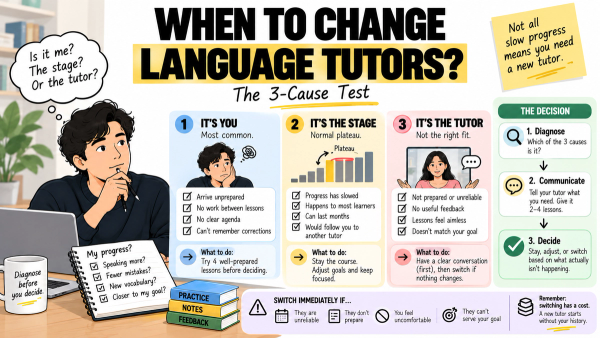
A note on how this lands. Good tutors are relieved by this kind of directness, because most of their students give them nothing to work with. A tutor who reacts badly to being told you want more correction has given you useful information of a different kind. If nothing changes after that conversation, when to change language tutors covers the decision properly.
Bottom line
You cannot judge a lesson by how it felt, because you have no reference class and because pleasantness and effectiveness feel the same from inside the hour.
Judge it by what it left behind. Did you speak most of the time? Can you name three corrections? Did you get a pattern and not just a list? Was anything hard? Do you know what to do before next week?
Most weak lessons fail on the same two markers: you did not speak enough, and nothing was left over. Both are fixable by saying something, and the sentence that fixes more of them than any other is simply: I would like to talk more and be corrected more, even if it slows the conversation down.
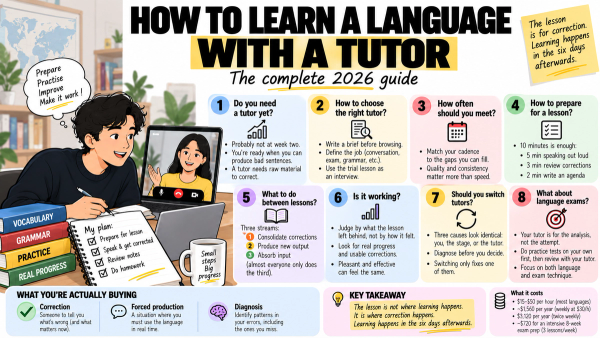
For choosing a tutor in the first place, and for why "matching your learning style" is not a real criterion, see how to choose a language tutor. For arriving in a state where a good lesson is possible, see how to prepare for a language lesson. For what happens to the residue afterwards, see what to do between language lessons. For how all of this fits together, see the complete guide to learning a language with a tutor.
Run the five markers on your next lesson. Most people find one of them fails, and it is usually the same one.