Search this question, and you will mostly find instructions for transferring your money. How to move remaining credits to a new tutor, what happens to your package discount, which support article to read. Useful if you have already decided. Silent on the decision itself.
That gap is not an accident. Platforms have every reason to help you switch smoothly inside their system and no reason at all to help you work out whether you should. Tutors, understandably, do not write about when to leave them. So the question that actually matters, is this working or not, has almost nothing written about it.
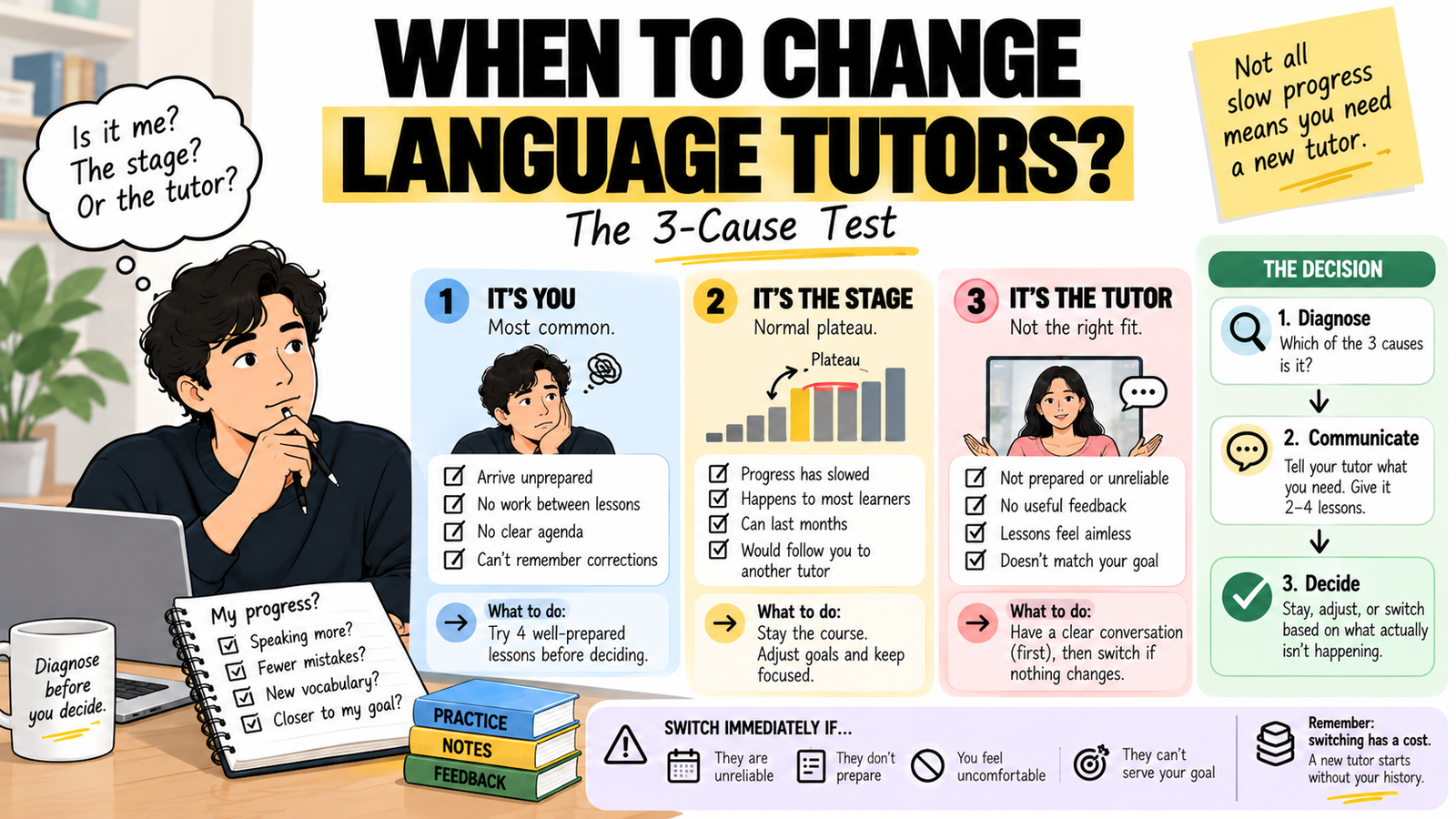
Here is the difficulty. Three completely different problems produce the identical feeling of stalling, and from inside your own lessons they are indistinguishable.
Sometimes the tutor is genuinely not delivering. Sometimes you have hit an ordinary plateau that would appear with any tutor alive. And sometimes, most often, the constraint is you: no preparation, no work between lessons, no agenda, and a tutor doing their best with nothing to work from.
Switching fixes exactly one of those three. Get the diagnosis wrong, and you either spend another year with the wrong person or you spend three years cycling through tutors while the actual problem follows you from one to the next.
We run a tutoring marketplace, so the commercially convenient version of this article would encourage switching, since a learner who changes tutor usually stays on the platform. The honest version starts with the possibility that switching would not help at all.
TL;DR. The decision in one screen
- Three causes look identical. It is you, it is the stage, or it is the tutor. Diagnose before you decide.
- Most often it is you. No preparation, nothing done between lessons, no agenda. Free to fix, and switching will not touch it.
- Sometimes it is the stage. Intermediate plateaus are normal, they last months, and they follow you to the next tutor.
- Have the conversation first. Almost always. Say specifically what you want changed, then give it two to four lessons.
- Switch immediately, no conversation needed, for unreliability, unpreparedness, discomfort, or a goal your tutor genuinely cannot serve.
- Switching has a real cost: a tutor who knows you has months of accumulated diagnosis that a new one starts without.
- Serial switching is its own failure. If you have left three tutors in a year, the variable that has not changed is you.
The question to answer before anything else is not "is this tutor good" but "what exactly is not happening that should be."
Why this decision is unusually hard
Four things make it harder than it should be.
It feels like a breakup. You have spent hours with this person. They know about your job and your holiday plans. Ending it feels personal in a way that cancelling a gym membership does not, and that feeling has nothing to do with whether the lessons work.
Sunk cost. Twenty lessons in, leaving feels like wasting twenty lessons. It is not. The twenty lessons already happened, and their value does not change based on what you do next. The only question is what the next twenty are worth.
No reference class. You have one tutor and no idea what a better one would look like, which is the same problem covered in what makes a good language lesson. Without a comparison, "this is fine" and "this is mediocre" feel the same.
The guilt is one-directional. Learners routinely feel they are letting a tutor down. Tutors, generally, do not experience a student leaving as a betrayal. It is a normal feature of the work, it happens constantly, and most experienced tutors think about it far less than the student imagines.
The three-cause test
Before deciding anything, work out which of three things is happening. Be honest, because the whole decision turns on this.
Cause 1: it is you
The signs. You arrive at lessons cold. You have not looked at last week's notes since last week. You cannot remember what you were corrected on. You have no agenda and wait for the tutor to decide what happens. You have done nothing in the gap.
Why this is the most common answer. A tutor with nothing to work from defaults to pleasant general conversation, because that is the only safe option when you have given them no material. The lesson feels aimless because it is, and the aimlessness originated with you.
How to test it. Run four lessons where you prepare properly, do consolidation within two days, and arrive with two specific things you want fixed. If the lessons transform, you have your answer and it cost you nothing. If they do not, you have ruled out the most likely cause and can trust the rest of this article.
This is the single most useful month you can spend before switching, and skipping it is how people end up switching twice.
Cause 2: it is the stage
The signs. You are somewhere around intermediate. You understand far more than you can say. Progress was obvious for the first year and now it is not. Nothing specific is wrong with the lessons; they are simply not producing the visible jumps they used to.
Why this is not the tutor. Plateaus are structural. Early progress is fast because everything is new and gains are large relative to a small base. Later progress is slow because gains are small relative to a large base, and because the remaining work is consolidation rather than acquisition. This happens with every tutor, in every language, to nearly everyone.
How to test it. Compare against something recorded rather than against how you feel. A recording of yourself from six months ago, an old piece of writing, a text you could not read then. Plateau-feeling with measurable improvement is a stage. Plateau-feeling with no measurable improvement over six months is something else.
What to change instead of the tutor. Usually the work between lessons, sometimes the cadence, occasionally the type of lesson. See what to do between language lessons and how often should you have language lessons.
Cause 3: it is the tutor
The signs are in the next section, and they are specific. The important discipline is arriving here by elimination rather than by starting here, because starting here is what produces serial switchers.
Signs it is genuinely the tutor
Two groups, and the difference matters.
Switch immediately, no conversation required
Unreliability. Repeated lateness, cancellations at short notice, rescheduling that always runs in their favour. You are paying for a professional service.
Visible unpreparedness. Arriving without having looked at what you did last time, week after week. Improvising every lesson from nothing.
Discomfort of any kind. Anything that makes you feel belittled, uneasy, or uncomfortable. No amount of teaching skill compensates, and you owe no explanation.
A goal they cannot serve. You need DELE C1 preparation and they have never prepared anyone for it. This is not a failing on their part and there is nothing to discuss. Some jobs need a different person.
Raise it first, then switch if nothing changes
No correction, or indiscriminate correction. Either extreme, persisting after you have asked.
No diagnosis. You ask what pattern they see in your mistakes and get nothing substantive, repeatedly. This is the most important single signal in the article, because diagnosis is the least replaceable thing a tutor provides.
They talk more than you do. Consistently, at any level above beginner, after you have raised it.
No structure. Every lesson is a conversation with no shape, no targeting, and nothing written down at the end.
You have outgrown them. Common, awkward, and nobody's fault. A tutor who was excellent at A2 may have little to offer at C1, particularly on register and nuance. A tutor who tells you this themselves is demonstrating unusual professionalism.
Signs it is not the tutor
Four things that feel like tutor problems and usually are not.
"The lessons are boring." Sometimes fair. More often a sign that you have no goal, since a lesson without a target has nothing to be interesting about. Try bringing an agenda for a month before concluding the tutor is dull.
"I am not progressing as fast as I expected." Check the expectation before checking the tutor. Adult language learning is slower than almost everyone assumes, and the second year always feels slower than the first.
"They correct me too much and it is discouraging." Worth raising, and worth noticing that being corrected is the thing you are paying for. The fix is calibration, not a new tutor.
"We do not have chemistry." Occasionally real and sufficient on its own. But warmth is the easiest thing to assess and the least connected to effectiveness, as covered in how to choose a language tutor. Someone you find slightly dry but who corrects precisely is usually the better hire.
The serial-switching trap. If you have changed tutors three times in a year and each one was exciting for three lessons before feeling flat again, the pattern is not about tutors. Every new tutor produces novelty, novelty feels like progress, novelty wears off in a month. Underneath, the plateau is untouched because the plateau was never the tutor's doing.
Have the conversation first
Unless you are in the switch-immediately group, one conversation comes before any decision. It resolves more situations than people expect, and it costs one message.
Be specific about behaviour, not about quality. Not "I do not feel like I am improving," which gives a tutor nothing to act on. Something like: "I would like to speak more of the lesson, I would like to be corrected more even when it interrupts, and I would like us to spend the last five minutes writing down what to practise."
The scripts in what makes a good language lesson cover the common cases.
Then give it two to four lessons. One is not enough to change a habit. Four is enough to see whether change is possible.
What the outcomes mean. A tutor who adjusts immediately and visibly was simply running their default and had no idea you wanted something else, which is extremely common and easily fixed. A tutor who agrees and changes nothing has told you something. A tutor who becomes defensive has told you more.
Why this step matters even if you are already sure. If you switch without it, you carry your unstated expectations to the next tutor, who will also not read your mind. People who cannot articulate what they want tend to be disappointed by everyone.
What switching actually costs
Rarely mentioned, and worth weighing.
You lose accumulated diagnosis. A tutor who has taught you for six months knows which errors are fossilised, which structures you avoid, what you were like before you improved, and where you go wrong under pressure. None of that transfers. A new tutor begins with a blank sheet and will spend several lessons rebuilding a picture the old one already had.
You lose calibration. Your tutor has learned how hard to push you and when to let an error pass. That judgement takes time to develop with a new person.
You spend lessons on setup. Expect two or three lessons of a new tutor getting oriented, which is real money for work already done once.
None of this outweighs a genuinely wrong tutor. But it does mean switching is not free, and it is a strong argument for the conversation first. Fixing the tutor you have is almost always cheaper than replacing them, when fixing is possible.
How to actually leave
The mechanics, briefly, because they are the easy part.
You do not owe a reason. "I have decided to work with a different tutor, thank you for your help" is complete. Adding a critique is optional and rarely useful to anybody.
If you want to say more, say it about your needs rather than their teaching. "I am focusing on exam preparation and want someone who specialises in it" is graceful, usually true, and leaves the door open.
Do not ghost. Booking nothing further and not replying is common and unkind, and it leaves the tutor guessing. One message costs nothing.
Check what happens to money and packages first. Platforms differ. Some let you move remaining credit to another tutor, usually recalculated at the new rate and often losing any package discount. Some hold funds against a specific tutor. Work this out before you decide, not after.
Consider overlapping rather than cutting. Booking a trial with someone new while still with your current tutor is entirely normal and it gives you the reference class you have been missing. Whether to mention it is your call; there is no obligation either way.
Consider keeping both. Underused. Some learners keep a long-standing conversation tutor and add a specialist for a particular goal. Switching is not the only option available.
Making the next one work
The most useful thing about switching is not the new tutor. It is the chance to set up the relationship properly, which almost nobody does the first time because they did not know what to ask for.
Say what you want in the first message. Not after six lessons of quiet dissatisfaction. Everything you wished your last tutor did differently goes in the opening note: how much you want to speak, how you want to be corrected, whether you want homework, what you are working toward. A tutor given that on day one will simply do it. The same tutor left to guess will run their default and you will end up in the same place.
Bring the specific failure with you. "My last tutor and I mostly chatted and I stopped improving" is genuinely useful information for a new tutor, and it is not disloyal to say it. It tells them exactly what to avoid.
Give the new tutor four to six lessons before judging. The first two are diagnosis and orientation, which look unimpressive and are not. A new tutor who seems slightly less good than your old one in lesson two is almost certainly just newer to you. Judge from lesson four, using the markers in what makes a good language lesson, rather than on the feeling of unfamiliarity.
Watch for the novelty effect. The first few lessons with anyone new feel energising. That is the change itself, not the tutor's quality, and it fades in about a month. If you have switched before, you will recognise the pattern. Do not read the initial lift as proof you made the right call, and do not read its fading as proof you did not.
Set a review date. Three months out, in your calendar. Ask then whether the five markers hold. A scheduled review is what stops the next drift from lasting a year, and it turns the decision into a routine check rather than a moment of crisis every time you feel stuck.
Bottom line
Three causes produce the same feeling, and only one of them is fixed by switching.
Start by ruling out yourself, because it is the most likely and the cheapest to fix. Four lessons of proper preparation and real work between them will tell you. Then rule out the stage, by comparing against something recorded rather than against how you feel. Only then look at the tutor.
If it is the tutor, and it is not one of the immediate-switch categories, have one specific conversation and give it two to four lessons. Most situations resolve there, and the ones that do not have told you something clear.
And if you have left three tutors in a year, the variable worth examining is the one that has been present in all three sets of lessons.
For choosing the next one, see how to choose a language tutor. For judging whether lessons are working at all, see what makes a good language lesson. For the work that fixes most stalls without changing anything else, see what to do between language lessons. For how all of this fits together, see the complete guide to learning a language with a tutor.
Diagnose first. Switching is a solution to exactly one of three problems.