Ask this question online, and you get two kinds of answers. Language schools tell you to study as intensively as possible. Individual tutors tell you once or twice a week is ideal. Both are giving you a number without asking the one thing that determines it.
Neither answer is dishonest. A school that sells course blocks genuinely believes intensity works, and it often does. A tutor with a full calendar genuinely finds that weekly students progress steadily. But both are answering "what is optimal in principle" when almost nobody is asking that. What people actually want to know is how to spend a fixed amount of money and a fixed amount of time to get the most language out of it.
That is a different question, and it has a different answer.
Cadence is an allocation problem, not an ambition problem. You do not have unlimited lessons. You have a monthly budget, a number of hours you will realistically give this, and a certain amount of energy. The question is how to divide that, and the right division changes depending on your level and on one variable almost nobody mentions.
This article covers that variable, what cadence to run at each level, how to arrange the same budget three different ways, why lesson length matters less than you think, and when to change.
TL;DR. Cadence in one screen
- The rule underneath everything. Your cadence should match how much work you will actually do between lessons. More lessons with no gap work is worse than fewer lessons with real gap work.
- Beginner, first six months. Higher frequency helps. Two shorter lessons a week beats one long one, because you need habit and exposure more than you need consolidation time.
- Intermediate. The most common mistake in the whole article. More lessons rarely fixes an intermediate plateau. One lesson a week with serious work in between usually beats three with none.
- Advanced. Lower frequency, higher intensity. Fortnightly can work well, because you can self-direct and you need harder rather than more.
- With a deadline. Intensive, and accept that you will consolidate less per lesson. Density beats spacing when there is a date.
- On a tight budget. Fewer lessons, held consistently, with the gaps filled. Two a month you actually prepare for beats four a month you turn up to cold.
If you take one thing: do not raise your frequency to fix slow progress. Fill the gaps first.
The variable everyone leaves out
Lessons do not teach you a language. They correct, push, and diagnose. What actually converts that into ability is what happens in the days between, when you use the thing you were shown, get it wrong privately, and slowly make it automatic.
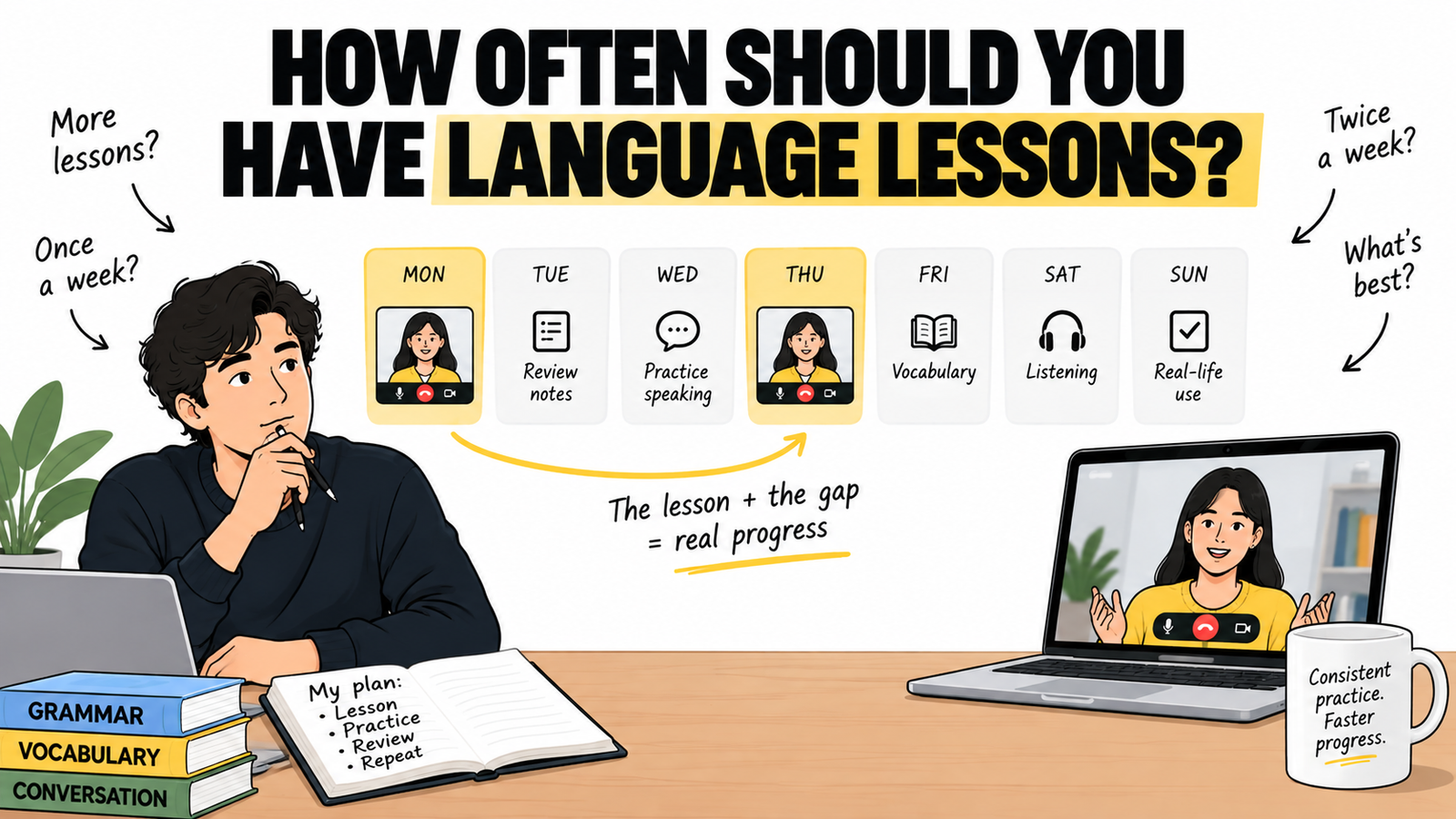
Which means the lesson is not the unit of learning. The lesson plus the gap is the unit of learning. A lesson with an empty gap after it is half a unit.
This is why frequency advice given without reference to the gap is meaningless. Three lessons a week sounds better than one. It is better if you fill the two gaps between them. If you do nothing in between, three lessons a week produces three warm-ups, three pleasant conversations, and roughly the same rate of progress as one, at triple the cost.
The gap rule: set your cadence to the number of gaps you will genuinely fill.
That sounds obvious written down. In practice, almost everyone sets cadence by ambition instead, books a frequency that matches how much they want to improve, discovers they cannot keep up with the between-work, and ends up doing more lessons and less learning.
Two practical consequences.
If you are not doing between-lesson work at all, lower your frequency and use the money you save to buy time. One lesson a fortnight with two weeks of real work beats weekly lessons you arrive at cold. This is counterintuitive, and it is usually right.
If you are doing serious between-lesson work and running out of material before the next lesson, raise your frequency. Running dry is the signal that you have capacity for more.
For what filling a gap actually involves, see how to prepare for a language lesson and what to do between language lessons.
What the evidence actually says
Most advice on this question is someone's experience. There is real research underneath part of it, and it is worth knowing exactly how far it goes, because it supports less than people usually claim.
The spacing effect is about as solid as findings in psychology get. First documented by Ebbinghaus in 1885, it holds that the same total study time produces better long-term retention when spread across sessions than when crammed into one. A 2006 meta-analysis covering 317 experiments across 184 articles established the effect at scale, and it has been replicated repeatedly since.
In real classrooms, the effect is moderate rather than dramatic. A 2025 meta-analytic review of classroom studies (22 reports, more than 3,000 participants) found distributed practice outperforming massed practice with an effect size of d = 0.54. That is meaningfully smaller than the roughly d = 0.85 typically found in laboratory conditions, which is what you would expect once motivation, competing demands, and ordinary life get involved. The classroom number is the honest one.
Language learning showed among the most consistent effects in that review, which is encouraging for this particular application.
Now the limits, which matter. Most spacing research tests vocabulary recall. The evidence base for spacing effects on grammar and, especially, on speaking fluency is considerably thinner, and what exists suggests the dynamics differ. A vocabulary item is either retrieved, or it is not. Speaking is a procedural skill, and for procedural skills the frequency of practice and the variety of tasks may matter more than the precise interval between sessions.
So here is what the evidence does and does not support.
It supports spreading your contact with the language across time rather than concentrating it, doing review in the gaps rather than only in lessons, and being sceptical of intensive bursts as a repeating pattern.
It does not settle the optimal number of lessons per week. Nobody has run that trial, the variables are not controllable, and anyone quoting you a number as though it were a research finding is extrapolating well past the data.
Which returns you to the gap rule, not because research proves it, but because it is the version of this question you can actually answer for yourself.
Cadence by level
The gap rule sets the ceiling. Your level sets where inside that ceiling you should sit, because the bottleneck moves as you improve.
Beginner, roughly the first six months
Default: two shorter lessons a week, or one lesson a week plus daily self-study.
At the start, your bottleneck is exposure and habit. You have almost nothing to consolidate, because you have almost nothing yet. What you need is contact with the language often enough that it stops feeling foreign, and a routine that survives the first motivation dip.
Frequency helps here more than at any other stage. Two thirty-minute lessons beat one sixty-minute lesson for most beginners, because attention degrades fast when everything is unfamiliar, and because twice-weekly contact builds the habit that once-weekly does not.
The caveat is budget. Beginners are also the people most likely to quit, so spending heavily in month one is a bet on a version of yourself you have not met yet. Starting lighter and increasing once the habit holds is the more sensible order, and it is the opposite of what most people do.
Intermediate
Default: one lesson a week, with real work between.
This is where the article earns its keep, because intermediate is where people reach for more lessons, and it usually does not work.
The intermediate plateau is not caused by insufficient instruction. It is caused by a gap between what you understand and what you can produce, and that gap closes through repeated effortful production, most of which has to happen outside a lesson. Adding a second weekly lesson gives you more correction, but correction is not your bottleneck. Production is.
Most intermediate learners who feel stuck would get more from keeping one lesson a week and doubling their between-lesson output than from adding a second lesson. It is also half the price.
The exception is if your between-lesson work is already substantial and you are arriving with more material than one hour can handle. Then add the second lesson.
Advanced
Default: one lesson every one to two weeks, longer and harder.
By advanced, you can self-direct. You know what you need to work on, you can find your own material, and you can practise without supervision. What you cannot do is notice your own remaining errors, which have by now become subtle and stable.
That makes the lesson less about instruction and more about diagnosis and stress-testing, which does not need to happen weekly. Fortnightly sessions of ninety minutes, well prepared, often outperform weekly hours at this level.
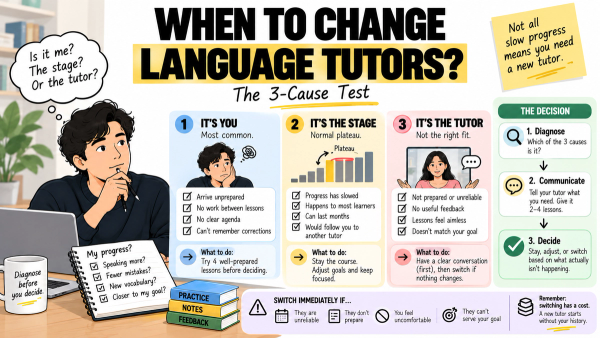
The failure mode at advanced is not too little frequency. It is lessons that have quietly become comfortable conversations with someone who has run out of things to correct. That is a signal about the tutor rather than the cadence, and it is covered in when to change language tutors.
With a deadline
Default: as intensive as you can sustain and afford.
Everything above assumes you are optimising for learning per pound over an open-ended period. A deadline changes the objective to learning per week, and the answers change with it.
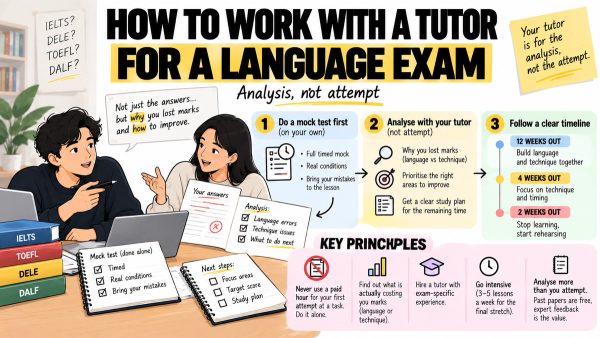
Three to five lessons a week for eight weeks before an exam is a reasonable shape. You will consolidate less per lesson than you would at a slower pace, and that is the correct trade when there is a date. Accept the inefficiency; you are buying speed. For a full exam timeline, see working with a tutor for a language exam.
The same budget, three ways
Here is what allocation actually looks like. Take a fixed budget of four lessons a month and arrange it three ways.
Four lessons, one per week. The default, and the right choice for most intermediate learners. Steady rhythm, a full week to work between each, easy to sustain for years. The risk is that it becomes routine and stops being demanding.
Four lessons, two per week for two weeks, then two weeks off. Better than it sounds for specific purposes. The dense fortnight gives you momentum and lets you work on one thing properly across consecutive sessions. The two weeks off are for consolidation and for the material you were given to actually settle. Works well for project-shaped goals: a presentation, a trip, one grammar area you keep failing at.
Four lessons in a single week. An intensive burst. Genuinely effective before a deadline or after a long break, when you need to force a jump rather than maintain a rhythm. Poor as a repeating pattern, because the three empty weeks afterwards undo much of it.
Most people never consider anything except the first. The second is underused, and the third is a specialist tool. The point is that the same money produces different outcomes depending on how you arrange it, and the arrangement should follow the goal.
Lesson length matters less than you think
A brief note, because the question usually arrives attached to the frequency one.
Thirty, forty-five, sixty, ninety. The differences matter less than the number of sessions and far less than the gap work. Two rules cover most cases.
Shorter and more often beats longer and less often, at lower levels. Attention is the constraint. A beginner in minute fifty of a sixty-minute lesson has usually stopped absorbing.
Longer sessions start paying off at the advanced level and for specific work. Ninety minutes makes sense when you are doing extended production, exam simulation, or work that needs a run-up. It rarely makes sense for general practice.
If you are choosing between one ninety-minute lesson and two forty-five-minute lessons at the same price, take the two, unless you are advanced or preparing for something long-form.
The lever most people ignore: group lessons
If budget is what is capping your cadence, and for most people it is, there is an option that sits between one-to-one and nothing.
A group class costs a fraction of a private lesson per session, which means the same monthly spend buys considerably more contact. Four private lessons a month might become eight or ten group sessions. For the specific job of frequent contact and forced production, that trade is often worth making.
What you give up is real. Less airtime, correction spread across several people, and no curriculum shaped around you. What you gain is frequency, peers to speak with rather than only a teacher, and the particular usefulness of hearing other learners make mistakes you recognise.
The arrangement that works best for most people is a mix rather than a choice. One private lesson a fortnight for diagnosis and targeted correction, plus a weekly group session for volume and speaking practice. You get the thing only a one-to-one can do, at a frequency only a group can afford.
This is underused mainly because learners think of the two as competing products. They are not. They do different jobs at very different price points.
When to change cadence
Four signals, each pointing a specific direction.
You arrive at lessons with nothing to say about the week. Lower frequency or raise gap work. You are running on empty.
You run out of material before the next lesson. Raise frequency. You have capacity.
You have been at the same cadence for six months, and progress has flattened. Change something, but change the gap work first. Frequency is the expensive lever and usually not the broken one.
You start cancelling. This is the most important one, and people misread it. Cancellations are rarely a scheduling problem. They are usually the signal that your cadence is above what your life supports, and the right response is to cut frequency to a level you will actually keep rather than to keep booking a schedule you will keep missing. Consistency at a lower frequency beats an ambitious schedule you abandon in month three.
What tutors see
Worth knowing, because tutors watch this pattern across dozens of students and learners only ever see their own.
The students who progress most are almost never the ones booking the most lessons. They are the ones whose lessons are consistent and whose between-work is visible. A tutor can tell within two minutes whether the gap was filled, and the difference across a year is not subtle.
Tutors also see the classic collapse repeatedly. A student books three lessons a week with real enthusiasm, sustains it for a month, starts arriving unprepared in week five, begins cancelling in week seven, and disappears by week ten. The same student at one lesson a week would very likely still be learning two years later.
One thing worth knowing about packages. Buying a block of ten lessons is usually good value, and it also quietly commits you to a cadence, because a package with an expiry date creates pressure to use lessons faster than you can absorb them. That is fine if the cadence was right. It is expensive if you bought the package as a motivation device and it turns out the constraint was time rather than commitment.
Bottom line
Cadence is an allocation question. You are dividing a fixed budget, not choosing how fast you want to improve, and the two feel identical while producing very different decisions.
Set frequency to the number of gaps you will genuinely fill. Beginners lean toward more frequent and shorter. Intermediates should almost always fix the gap before adding a lesson. Advanced learners need harder rather than more. Deadlines override all of it.
And if progress has stalled, resist the obvious move. Adding lessons is the expensive response to a problem that is usually sitting in the six days between them.
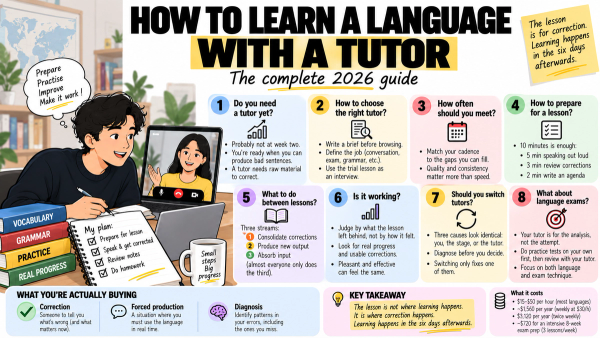
For whether you should be booking lessons at all yet, see do you actually need a language tutor. For choosing the person you will be booking, see how to choose a language tutor. For filling the gap, see how to prepare for a language lesson and what to do between language lessons. For how all of this fits together, see the complete guide to learning a language with a tutor.
Fill the gaps. Then buy more lessons.