Your lesson is the most expensive hour of your language-learning week, and most people spend the first fifteen minutes of it warming up.
You log on cold. Your tutor asks how your week was. You grope for words you had fluent access to eight months ago, apologise for being rusty, and gradually get your mouth working again. By the time you are actually speaking properly, a quarter of the lesson is gone. Then it ends, you close the tab, and the language goes back in its box until next week.
That is not a scheduling problem or a motivation problem. It is a preparation problem, and it is almost entirely fixable in ten minutes.
The reason it matters is what a lesson actually is. You can get vocabulary alone. You can get grammar explanations alone, from a textbook or a video or a chatbot, for free, at three in the morning. You can get input alone, endlessly. What you cannot get alone is someone listening to you produce the language in real time and telling you precisely what is wrong with it. That is the entire product. Every minute of a lesson spent on something you could have done by yourself is money spent on the wrong thing.
This article covers what you are actually buying, what arriving cold really costs, the three jobs preparation has to do, a ten-minute protocol you can run before any lesson, how it changes by lesson type, and the over-preparation trap that catches conscientious people.
TL;DR. Preparation in one screen
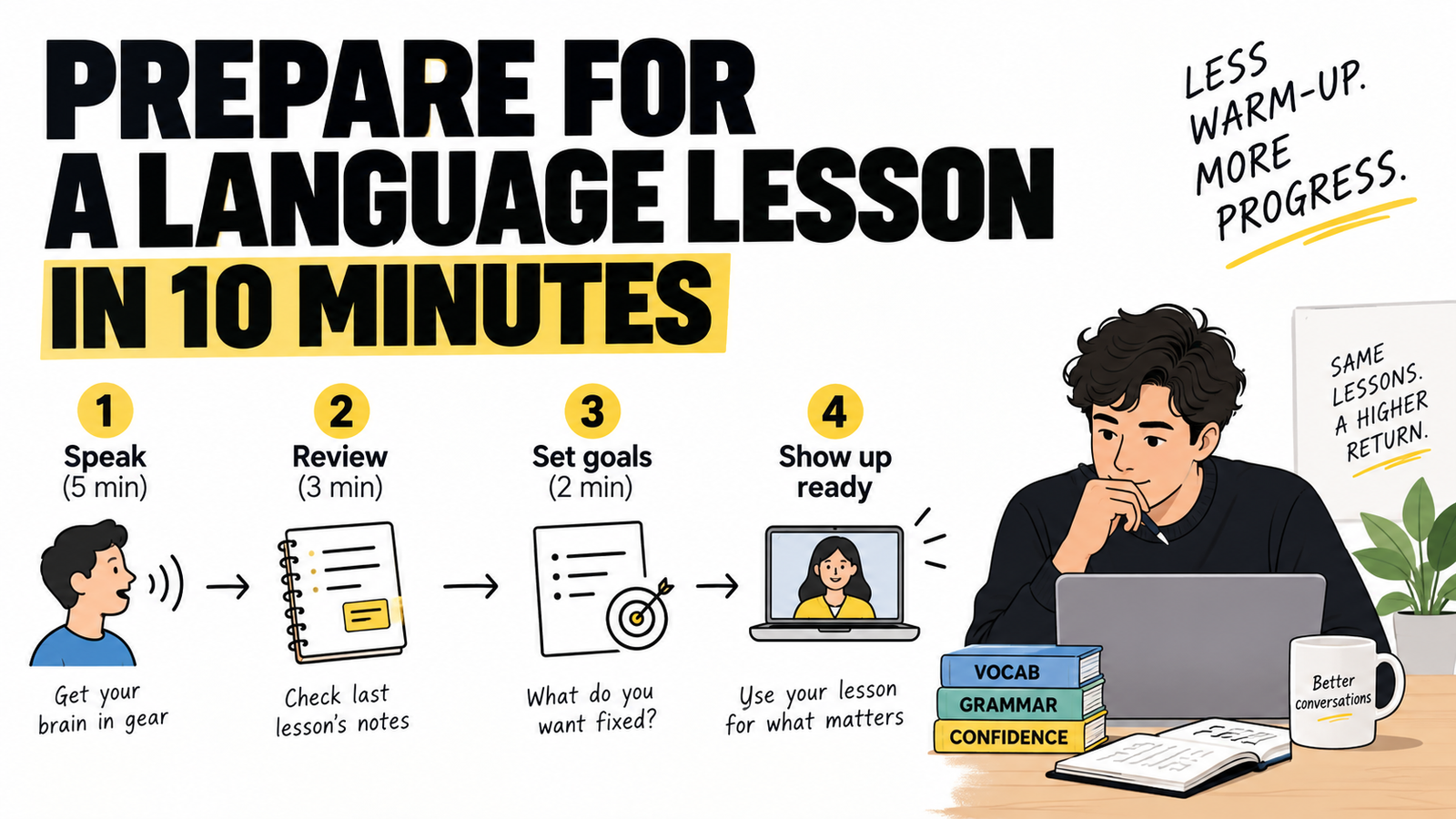
- The minimum, every lesson. Ten minutes: five speaking out loud to yourself, three reviewing last lesson's notes, two writing down what you want fixed. Nothing else matters as much as these three.
- If you only do one thing. Speak out loud for five minutes before you log on. Anything, badly, to yourself. It moves the warm-up out of paid time and it is the single highest-return habit in this article.
- Arrive with an agenda. Two or three specific things you want worked on. A tutor with an agenda teaches; a tutor without one entertains.
- Close the loop. Bring back whatever you were given last time, done. This is what turns a series of lessons into a curriculum instead of a series of conversations.
- Do not script. Writing out what you plan to say converts a speaking lesson into a reading-aloud lesson. Prepare topics, never sentences.
The test for any preparation: does it move something out of the lesson that did not need to be in it?
What you are actually paying for
Three things, and only three.
Correction. Someone hearing what you produce and telling you what is wrong with it, in real time, with the judgement to know which errors matter. No app does this properly yet. It is the core of the product.
Forced production. You will not speak for fifty minutes alone. You will not push through the discomfort of a sentence you cannot quite build unless someone is waiting for it. The lesson manufactures a situation where you have to produce, and that pressure is most of the value.
Diagnosis. A good tutor notices the pattern behind your mistakes. Not "you got that wrong" but "you avoid the subjunctive by rephrasing, and you have been doing it for months." You cannot see your own avoidance strategies. That is what a second pair of ears is for.
Notice what is not on that list. Vocabulary. Grammar rules. Listening practice. Reading. Cultural background. All valuable, all free, all available without a tutor, and all things that quietly consume lesson time when nobody has planned otherwise.
This is the whole principle: the lesson is for what you cannot do alone. Preparation is simply the work of moving everything else out of it.
What arriving cold actually costs
Run the numbers once, because they are more uncomfortable than they sound.
A typical lesson runs fifty or sixty minutes. Arriving cold costs most people ten to fifteen of those, spent reaching for words, re-finding your rhythm, and settling in. Call it a quarter of the lesson.
At a fairly ordinary rate of $30 an hour, that quarter is about $7.50. Once a week for a year, that is roughly $390 spent on warming up in front of a paid professional. Two lessons a week and you are near $780. You could have done the same warm-up in your kitchen, for free, with nobody listening.
Rates vary widely and the structure behind tutor pricing explains why, but the shape of the arithmetic holds at any price point. The higher your rate, the more expensive your warm-up.
The cost is not only money. Lessons that begin in a fog tend to stay shallow, because a tutor who can hear you struggling with basic sentences will not push into difficult territory. You get an easier lesson than you needed, and easier lessons feel fine while producing less.
The three jobs of preparation
Preparation is not one activity. It is three, and they are easy to remember because each fixes a different failure.
1. Warm the engine
Your goal is to arrive already speaking. Not fluent, not eloquent, just switched on.
Five minutes of speaking out loud to yourself, in the target language, immediately before the lesson. Describe your day. Argue with something you read. Narrate what you are looking at. Quality is irrelevant. You are not practising, you are booting up the system, and the difference between a learner who has said two hundred words before logging on and one who has said none is visible in the first thirty seconds.
This is the single highest-return habit in the article, it costs nothing, and almost nobody does it.
2. Load the agenda
Arrive knowing what you want fixed.
Two or three specific items, written down. Not "I want to improve my speaking." Something like: I keep hesitating before past-tense verbs. I do not know how to disagree politely. I need to be able to explain what my company does in two minutes.
An agenda changes what the tutor can do. Without one they must guess, and the safest guess is always a pleasant conversation about your week. With one, they can target, and targeting is what produces the diagnosis you are paying for.
Where the items come from: things that went wrong during the week, moments you avoided saying something, anything your tutor flagged last time that you have not fixed.
3. Close the loop
Bring back what you were given, done.
If your tutor set homework, arrive having done it. If they did not set any, invent some: write a paragraph using the structure you worked on, record yourself for two minutes, review the vocabulary that came up. Send it in advance if the format allows.
This is the difference between a series of lessons and a curriculum. Without it, every lesson starts from roughly where the last one started, which is why some people take lessons for two years and plateau in month four.
A spaced repetition system is the usual tool for the review half of this, whether that is Anki, the flashcard tools now built into some tutoring platforms including Jynio, or a notebook you actually reopen. The tool matters far less than whether the material from last lesson gets seen again before the next one. The full system for the days between is in what to do between language lessons.
The ten-minute protocol
Concrete version, immediately before the lesson.
Minutes 1 to 5: speak. Out loud, in the target language, to nobody. Narrate, describe, argue. Do not stop to look words up. If you get stuck, say the sentence badly and move on. You are warming up, not performing.
Minutes 6 to 8: review. Open last lesson's notes. Read the corrections. Say the corrected versions out loud once each. This is also when you notice you never did the homework, which is useful information about ten minutes before it becomes visible to someone else.
Minutes 9 to 10: write the agenda. Two or three things you want worked on today. Put them somewhere you can see during the lesson, because you will forget them the moment the call connects.
That is the whole protocol. Ten minutes, no materials, no preparation for the preparation.
If you have only two minutes, speak for two minutes. Warming the engine beats everything else on the list.
If you have thirty, add a short piece of input in the target language: a podcast segment, a couple of pages, a video. Then run the ten-minute protocol. Do not extend the protocol itself; it does not improve with more time.
The five minutes after
The ten minutes before a lesson get all the attention. The five minutes after are worth nearly as much, and almost nobody uses them.
Lesson notes decay fast. During the hour you understood exactly why the tutor rephrased that sentence; four days later you are looking at a fragment that says "word order, be careful" and it means nothing. The context is gone and the note is now archaeology.
Immediately after the call, while it is still fresh, spend five minutes doing three things.
Rewrite the corrections into full sentences. Not "past tense of venir" but the whole corrected sentence you actually got wrong. Future-you needs the sentence, not the label.
Write one line on what the lesson revealed. What was the pattern behind the corrections? This is the diagnosis, and it is the most valuable thing in the lesson, and it is the first thing to evaporate.
Decide what you will do about it before the next lesson. One concrete action. Not "review vocabulary." Something like: write five sentences using the structure I kept getting wrong, and bring them.
That last item is what becomes your agenda item next week, which means the loop closes itself. The learners who improve fastest are almost never the ones taking the most lessons. They are the ones who do these five minutes.
The first lesson is different
Your first lesson with a new tutor has a different job from every lesson after it, and preparing for it as though it were a normal lesson wastes it.
Its purpose is diagnosis. The tutor needs to establish where you actually are, what you are trying to achieve, and how you learn under pressure. Everything they do for the next six months is shaped by what they conclude in that hour.
So prepare to be diagnosed accurately rather than to look good.
Send your context in advance. Your real level, your goal, your deadline if you have one, what you have already tried and what did not work. Three or four lines.
Do not study specially for it. The temptation is to revise hard so you perform well. Resist it. A tutor who forms an inflated picture of your level will pitch the next twenty lessons wrong, and you will spend months quietly out of your depth rather than productively stretched.
Come with the thing you find hardest. Volunteer your worst area in the first ten minutes. It feels counterproductive and it is the fastest way to a useful curriculum.
Speak more than feels comfortable. A tutor cannot diagnose from your answers to their questions. They need continuous speech, including the parts where it falls apart, because the parts where it falls apart are the diagnosis.
What changes by lesson type
The three jobs stay constant. Their weighting does not.
Conversation lessons. Warming the engine is almost everything. Agenda matters less, though arriving with two topics you actually want to discuss prevents the drift into weather and weekends. Bring an opinion about something; opinions generate more language than facts do.
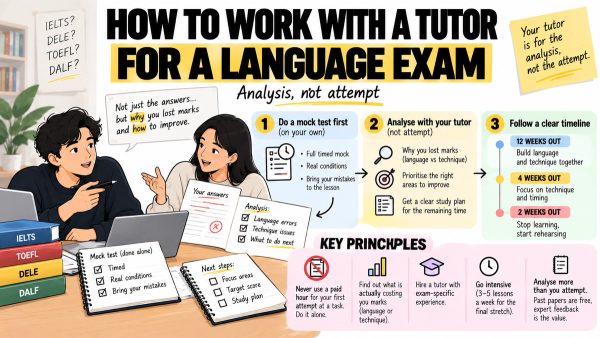
Exam preparation. Agenda dominates. Arrive having attempted the task type under something like real conditions, so the lesson is spent on what went wrong rather than on doing the task for the first time. Never use a paid hour for your first attempt at a question format. Do it badly alone, then bring the wreckage. The full exam method is in working with a tutor for a language exam.
Grammar and accuracy work. Closing the loop dominates. Grammar is consolidated by repetition across sessions, not explained once. The work between lessons is where it actually lands.
Business or professional language. Bring real material: the email you need to send, the deck you have to present, the meeting that went badly. Authentic material outperforms textbook scenarios by a wide margin, and it is the one preparation step that genuinely takes more than ten minutes.
What your tutor does when you arrive cold
Worth knowing, because it explains why preparation improves lessons more than it shortens them.
A tutor facing a student who arrives with nothing has limited options. They cannot target problems they have not been shown. They cannot check work that was not done. So they fall back on the reliable default: a warm, pleasant, low-risk conversation. How was your week. Let us read this short article. Tell me about your holiday.
None of that is bad teaching. It is the correct response to having nothing to work with, and a good tutor will still extract useful correction from it. But it is a general lesson delivered to a specific person, and you are paying for the specific one.
The same tutor, handed two concrete problems and a piece of completed homework, does something different. They target. They push into territory they would not risk with a student who seems unwarmed. They notice patterns because they have evidence to notice patterns in.
There is also a quieter effect. Tutors form an impression of who is serious, and serious students tend to get more: more preparation from the tutor's side, more candid correction, more willingness to say the difficult thing about your accent or your avoidance habits. That is not favouritism. It is a reasonable response to evidence that the feedback will be used.
What not to do
Do not script. Writing out what you intend to say, then delivering it, converts a speaking lesson into a reading-aloud lesson. You practise exactly the skill you do not need. Prepare topics, never sentences.
Do not over-prepare the content. Studying hard for a lesson so you can perform well in it is a subtle trap. The lesson is where your weaknesses are supposed to become visible. Concealing them wastes the hour.
Do not arrive with a list of twenty questions. Three is an agenda. Twenty is a seminar, and you will spend the lesson listening to explanations rather than speaking.
Do not prepare in your native language. Planning your lesson in English, in your head, in English, then switching at the last second, defeats the warm-up entirely.
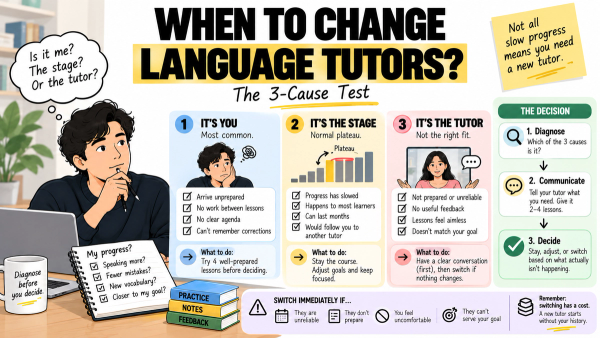
Do not skip preparation because you did not do the homework. The most common way people turn one missed week into three. Arriving without the homework but with a warm engine and an agenda still produces a good lesson. Arriving apologetic and cold produces a bad one.
Bottom line
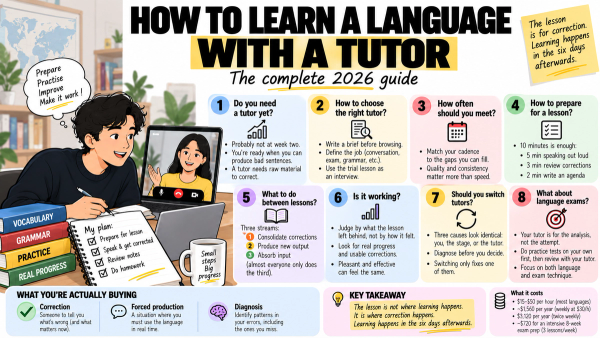
The lesson is for what you cannot do alone: correction, forced production, and diagnosis. Everything else in a lesson is something you could have had for free, and preparation is the work of moving it out.
Three jobs. Warm the engine so you arrive already speaking. Load the agenda so your tutor can target rather than guess. Close the loop so the lessons compound instead of resetting. Ten minutes covers all three.
If you do only one of them, speak out loud for five minutes before you log on. It costs nothing, it takes the warm-up out of paid time, and it is the difference between a lesson that starts at minute one and a lesson that starts at minute fifteen.
For choosing the tutor you are preparing for in the first place, see how to choose a language tutor. For judging whether the lesson you arrive at is any good, see what makes a good language lesson. For how all of this fits together, see the complete guide to learning a language with a tutor.
Ten minutes before. The hour will not be the same.