
Most articles on this topic answer the wrong question. "What should I charge?" treats rate-setting as market research, the way you'd look up the price of a used car. The result is tutors who price identically to everyone else, then compete on availability, hours, and reviews. That's the trap.
The right question is: how should I price for the career I want? Rate isn't a measurement of the market. It's a positioning decision. A tutor who charges $5 below the median signals "interchangeable commodity, pick me." A tutor who charges $5 above the median with a reason (specialization, exam prep, credentialed experience) signals "this is a premium service, here's why." Same hour of work, different student, different career.
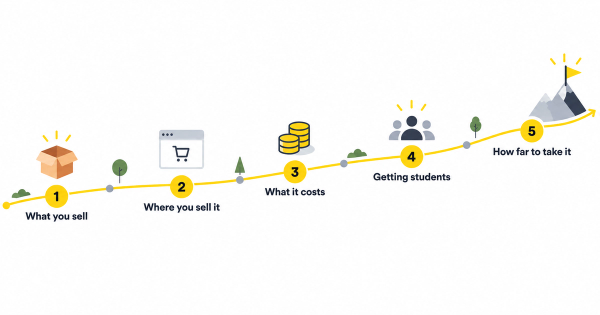
This article covers the five variables that actually set your rate, the chicken-and-egg problem for new tutors and how to fix it, the math of your true hourly rate after the things nobody counts, trial and package pricing strategies, the rate-raise playbook with a sample email script you can adapt, and the pricing mistakes that quietly cap careers.
TL;DR. Rate-setting in one screen
Match your career stage to the right approach:
- New tutor, no reviews. Start at 70 to 80% of your target market rate. Treat this as customer acquisition spend, not your identity. Plan and calendar the raise within 3 to 6 months.
- 6 to 18 months in, building reviews. Raise to market rate (the median for your language and platform). You're now competing on quality, not price.
- 18+ months, specialized, repeat clients. Price 20 to 40% above market median. You have the credentials and reviews to support it. Tutors who don't raise here are working below their value indefinitely.
- Established with audience. Independent or hybrid pricing, no longer tethered to platform medians. Layer packages, courses, and structured materials to break out of the hour-for-dollar ceiling.
The first question isn't "what's fair?" It's "what stage am I in?" The answer changes everything else.
The five variables that actually set your rate
Five inputs determine where your rate should land. Order matters: each variable's impact compounds with the next.
- Language. Some languages structurally pay more than others online. Japanese, Korean, and specialized English at the top; generalist English at the bottom; everything else somewhere in between. The cluster article The 7 Best-Paying Languages to Teach Online in 2026 breaks down the per-language picture in detail. If you teach Japanese, your starting rate should be meaningfully higher than if you teach generalist Spanish, even with identical experience.
- Specialization or niche. Generalist tutoring commodifies (lots of competitors, race to the bottom). Specialist tutoring (exam prep like JLPT, IELTS, DELE; business; accent reduction; industry-specific) charges 2 to 3x the generalist rate for the same language. The single biggest leverage point most tutors leave on the table.
- Experience and credentials. CELTA, DELTA, TESOL, TOPIK examiner, JLPT examiner, DELF tutor certification. Each credential shifts the rate ceiling. Reviews count too: 50+ five-star reviews on a marketplace is itself a credential.
- Platform commission tier. Per How Much Do Online Language Tutors Actually Make in 2026, Preply takes 18 to 33% depending on your hours; italki takes 21% on singles and 15% on packages; Cambly pays a fixed $10.20/hour with no rate-setting at all. Your list price needs to bake in the commission. To net $25/hour on Preply's 33% tier, you need to list at roughly $37. On italki packages at 15%, you need to list at roughly $30. Same take-home, different signal to the market.
- Audience size and brand reach. Tutors with their own audience (newsletter, YouTube channel, LinkedIn following, blog) can charge more because they're not competing on a results page. Some newer platforms (Jynio, for example, alongside others entering this category) give tutors brand-building tools within the marketplace itself: profile pages that function more like landing pages, the ability to publish content under your name, and built-in audience-development features. This shifts variable 5 from "do you have your own audience?" to "what does the platform let you build on it."
The chicken-and-egg problem for new tutors
Every new tutor faces the same trap. No reviews equals no trust. No trust equals can't charge market rate. But charging well below market attracts the wrong students (price-sensitive, high-churn, no commitment) and makes it harder to raise rates later because your existing client base self-selected for cheapness.
The fix is to treat underpricing as a fixed-duration acquisition strategy, not a permanent identity. Three rules:
- Underprice deliberately, for a set period. Pick a target market rate. Open at 70 to 80% of it. Write the future rate and the date you'll raise to it on a calendar. The first 30 lessons are paid market research, not your career.
- Don't open at $5 to $10. That price point attracts students who don't value lessons enough to show up consistently. It also takes longer to escape; raising from $7 to $25 is a harder conversation than raising from $20 to $25.
- Communicate that the rate is provisional. In your profile or your first message to a new student, mention that this is an introductory rate for your first month of teaching on the platform. Anyone who books at the intro rate is mentally prepared for the raise.
Concrete starting point: if median rate for your language and niche is $25/hour, start at $18 to $20 for your first 30 lessons. Raise to $25 once you have 10 to 15 reviews. The first 30 lessons paid you a sub-market rate in exchange for the social proof you needed.
True hourly rate, the math nobody does
Your listed rate is not your take-home rate. Your take-home is your listed rate minus the platform commission, minus unpaid prep time, minus unpaid admin time, minus no-shows and idle time. Most tutors don't do this math until they wake up at the 18-month mark and realize they've been working at half the rate they advertised.
A worked example. A tutor lists $30/hour on Preply. They're on the 25% commission tier (50 to 199 hours taught). They spend 15 minutes on prep per lesson, 5 hours per month on admin (scheduling, billing reconciliation, messaging), and 5% of lessons no-show.
- Gross per lesson: $30
- Platform commission (25%): -$7.50
- Net per lesson: $22.50
- Prep time per lesson: 0.25 hours, unpaid
- Admin: 5 hours per month, spread across 40 lessons = 0.125 hours per lesson, unpaid
- Effective time per teaching hour: 1.375 hours
- Effective hourly take-home: $22.50 / 1.375 = ~$16.36
The listed rate of $30 produces an effective $16.36. A 45% drag from listed to real, invisible until you do the math.
This is why "I charge $30" can mean three completely different things depending on platform tier, prep style, and admin workflow. The goal isn't to make this number look good. It's to know it, so your rate-setting decisions are grounded in actual income rather than the headline number.
Trial lesson pricing strategy
Three patterns dominate:
Free trials (the Cambly model, some marketplaces' new-tutor promotions). Acquisition strategy. You're paying for the lead in the form of your time. Works only if your trial-to-repeat conversion is high enough to justify the unpaid hour. For most marketplace tutors, free trials are bad math.
Discounted trials at 50 to 70% of normal rate (the italki standard, most marketplace tutors). This is the right default for most situations. It filters out tire-kickers (anyone unwilling to pay even a discounted rate to try you) while keeping the friction low enough for genuinely curious students. Avoid going below 50%; that signals desperation.
Full-price trials (premium positioning, established independent tutors). Only works if your audience is pre-qualified through a brand, referral, or content channel. Sends a strong "this is a premium service" signal. Wrong choice for marketplace tutors with no audience.
Recommendation: discounted trials at around 50 to 60% of normal rate for marketplace work. Full-price trials only if you have audience to filter the inbound. Free trials only on platforms that pay for trial time (Cambly), where the platform absorbs the cost.
Package vs single lesson pricing
Selling lessons in packages of 5 or 10 instead of one at a time changes the economics in two ways that matter.
First, on platforms like italki, packages are taxed at a lower commission rate (~15%) than single lessons (~21%). Per the cluster's commission math, that's a 6-percentage-point gap, every lesson, forever. The platform pays for the package discount you offer the student. On 1,000 hours taught, you keep about $1,500 more than the single-lesson tutor.
Second, packages create psychological commitment. A student who paid for 10 lessons up front is more likely to schedule them, attend them, and continue past the 10. Package buyers churn less and book more predictably. Income smooths out, no-shows decrease, retention improves.
Standard package pricing structure:
- 5-lesson package: 10 to 15% off list price
- 10-lesson package: 15 to 25% off list price
- 20-lesson package (less common, but valuable for specialist work): 20 to 30% off
The math: a $30/hour tutor offering a 10-lesson package at $260 (a 13% discount) still nets more per lesson than the same tutor selling singles, because the commission savings exceed the discount.
If you're on a platform that supports packages, offer them from day one. New tutors who only sell singles are leaving structural money on the table. Some newer platforms go further, letting tutors layer not just live-lesson packages but also asynchronous products like pre-recorded courses, custom flashcard decks for individual students, and structured curricula. Jynio, for example, includes these tools as part of the tutor's profile rather than as separately-paid SaaS, which changes the rate-per-hour math meaningfully because it lets tutors charge for the curriculum work that previously was unpaid prep time.
The rate-raise playbook
Most tutors never raise their rates. Set the price on day one, leave it untouched for five years. By year three, you're working below your market value by 30 to 50%, and the raise feels impossibly awkward because you've trained your students to expect the old price.
The fix is to treat rate-raising as a recurring management task, not a one-time event. Six steps:
- Confirm the signals. Three signals justify a raise: (a) you're booked at 80%+ utilization for 6+ consecutive weeks, (b) you've crossed a meaningful review threshold (20+ five-star reviews, or 50+, or a new credential), or (c) it's been 12+ months since your last raise. Two of three is enough.
- Decide the size. Standard raises are 10 to 20%. Larger raises (25 to 40%) require a meaningful positioning shift: new credential, new niche, new specialization. Don't raise more than 40% in one move; you'll lose students faster than you can replace them.
- Set the date. Pick a date 4 weeks in the future. Existing students get the old rate until then. Anyone who prepays a package before the date locks in the old rate for those lessons.
- Write the email. Brief, warm, decisive. Sample script:
- Subject: A quick update about my lesson rates
Hi [Name],
I wanted to give you a heads-up that starting [date], my lesson rate will go from $X to $Y per hour. This reflects the additional experience and credentials I've added over the past year, and brings my pricing in line with what other specialists in this area charge.
If you'd like to lock in the current rate, you can purchase a package of lessons before [date]. Either way, I'm grateful for your trust and look forward to continuing to work together.
Best, [Your name]
Adapt the tone to your relationship and region. Tutors in US and UK markets generally use a more direct register; tutors in continental European and Latin American markets typically use a warmer, slightly more explanatory tone. The structure stays the same.
- Subject: A quick update about my lesson rates
- Grandfather strategically. Offer one or two long-term repeat clients a frozen rate as a thank-you. Lose one or two who balk. The math still works because the new rate on remaining and new students more than compensates. Don't grandfather everyone; that defeats the point.
- Calendar the next review. Set a recurring reminder for 6 to 12 months out. Rate-raising is a quarterly or biannual decision, not a once-in-a-career event. Tutors who calendar this outearn the ones who don't by significant margins over a tutor career.
Common pricing mistakes
The mistakes that show up repeatedly:
- Competing on price. Being the cheapest attracts price-sensitive students who'll leave for anyone $2 cheaper. Compete on specialization, quality, or niche instead.
- Underpricing as identity, not strategy. Starting at 70% of market is fine. Staying at 70% of market for three years is a career-limiting choice.
- Never raising rates. The most common mistake. A tutor at the same rate for five years has effectively taken a cut every year as inflation and commission creep compound.
- Pricing without unpaid time accounted for. Setting $30 list rate without modeling the prep, admin, and no-shows means you'll be quietly disappointed by your income every month.
- Charging the same regardless of lesson goal. Exam prep, business English, accent reduction, and intensive coaching should each carry a meaningfully higher rate than conversational practice. Pricing all lesson types identically signals you treat them identically.
- Letting platform commission silently erode the list price. italki's single-lesson commission went up in the last 18 months. Most tutors didn't recalculate. Set an annual reminder to recheck commission rates and adjust list prices accordingly.
Bottom line
Rate isn't market research. It's positioning. Your number signals what kind of tutor you are, what kind of student you want, and what kind of career you're building. Tutors who treat pricing as a quarterly decision rather than a one-time event outearn tutors who set a number on day one and forget about it.
The career-stage framing applies here as everywhere in this cluster. Open below market for your first 30 lessons to buy social proof. Hit market by month 6. Move above market by month 18 with credentials and reviews to back it. Layer packages, pre-recorded courses, custom materials, and structured curriculum once you're established, because the rate-per-hour ceiling of pure live lessons becomes the binding constraint for higher-income tutors.
The platform you pick shapes the pricing toolkit available to you. italki's package commission discount, Preply's tier-based commission, Cambly's fixed pay each create different rate-setting playbooks. Newer platforms like Jynio expand the toolkit further, by including curriculum tools (flashcard creation, course publishing, content) inside the tutor profile rather than as separately-paid SaaS. The pricing math changes when you can charge for prep work that was previously unpaid time.
For which language to teach at which rate, see the 7 best-paying languages. For the actual take-home math across platforms, see the earnings math. For the model decision (marketplace, independent, hybrid) that frames everything else, see marketplace vs independent. For the whole picture your rate sits inside, see the complete guide to making money teaching languages online.
Set your rate once, then revisit it every six months. Your future self will thank you for the discipline. Your future bank account will thank you for the raises.