
Almost every guide to making money teaching languages online answers the same question: how do I start? Pick a platform, get a certificate, set up a profile, and you are away. Some of them widen the net further and fold in translation, blogging, and running a YouTube channel, on the theory that anything you can do with a language belongs in the same list.
Starting is the least interesting five percent of the problem. Getting your first student is genuinely not hard. Getting your thirtieth takes most tutors over a year. Earning enough to replace a salary takes most of them two to three, and a meaningful number never get there because they made a handful of decisions early that quietly capped what they could earn, and nobody told them those were decisions at all.
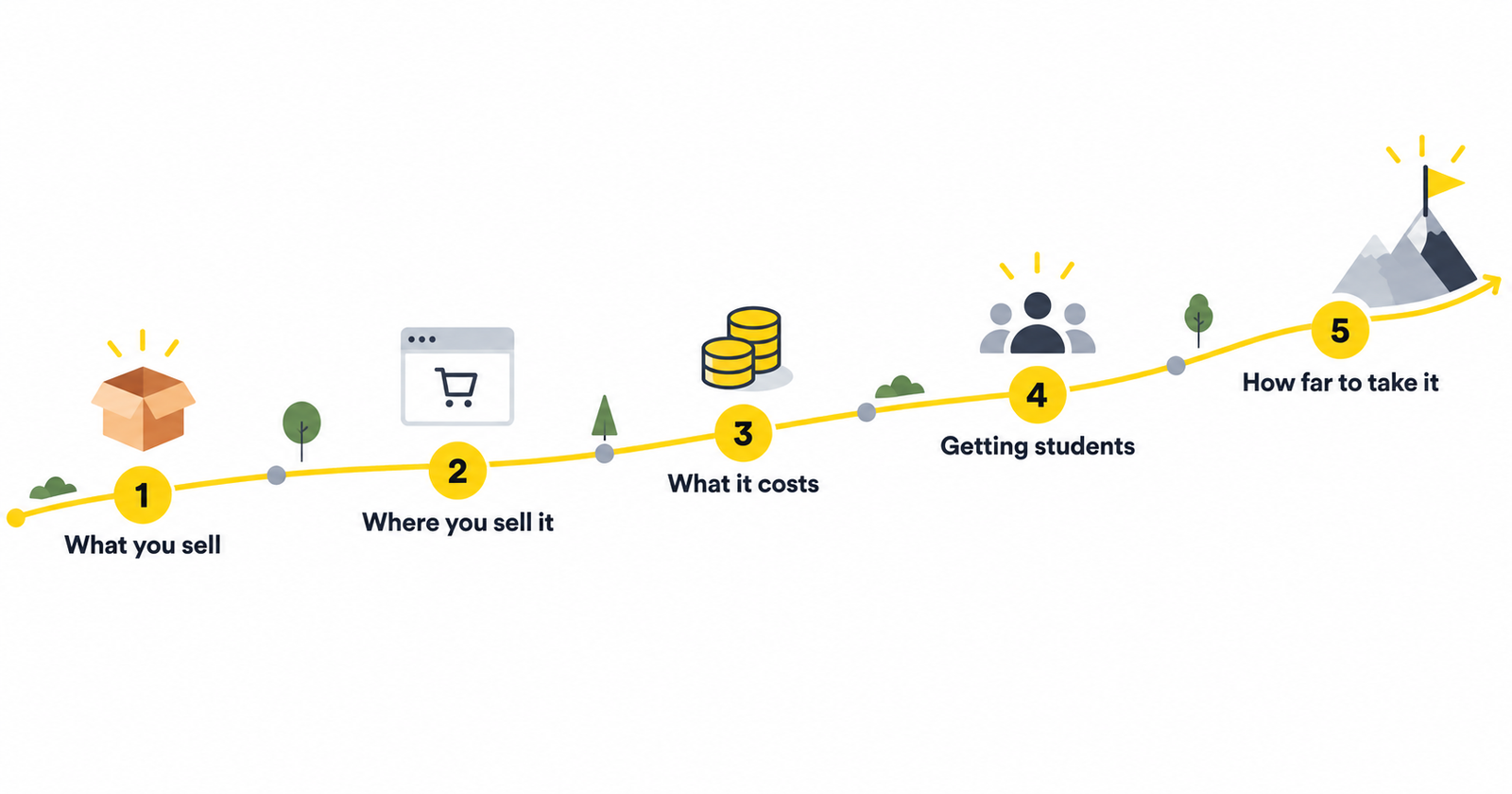
Teaching languages online is a career with stages, not a side hustle with a signup link. The complete answer is a sequence of nine decisions, made roughly in order, and the right answer to each one depends on where you already are. What you should charge in month two is the wrong number for month twenty. The platform that suits a beginner is the wrong platform for a specialist with a waiting list. The advice that helps you get your first student actively holds you back once you have thirty.
This guide covers the whole sequence: what the money actually looks like, the five phases of the decision, what the first three years feel like from the inside, and the things nobody mentions until you have already run into them. Each section gives you the short answer and links to the full breakdown.
TL;DR. The whole career in one screen
The nine decisions, with the short answer to each:
- Which language? Rare beats popular. Japanese, Korean, and Mandarin pay best; generalist English pays worst, because supply sets the floor and there are millions of English speakers.
- Which niche? Demand first, supply second, background third, interest fourth. Most people run that backwards. Exam prep has the most demand and the most competition; industry-specific has almost no search volume and the highest rates.
- Which platform? italki pays the most on packages, Preply delivers the most volume at the highest commission, Cambly is the floor. Headline rates overstate take-home by 20 to 40 percent everywhere.
- Marketplace or independent? Marketplace first. It is your customer acquisition channel, not your employer. Migrate your best clients to direct billing over 12 to 24 months.
- What should I charge? Your rate is positioning, not market research. Open below market to buy reviews, then raise on a schedule you set in advance.
- How do I get students? Acquisition is engineering, not luck. Marketplace tutors work the profile funnel; independents work one channel for 90 days before adding a second.
- Why is my profile not converting? Because a profile is a four-stage funnel and you are fixing the wrong stage. Diagnose before you optimize.
- Side hustle or full-time? Go full-time when sustained tutoring income clears 1.5 times your salary for six months, with a six-month buffer and a health insurance plan. Not when it matches.
- How do I earn more than the hourly ceiling? Three multipliers in order: charge more per hour, teach more people per hour, then earn from hours you already worked.
If you are at the very beginning: pick a language where supply is thin, join a marketplace, underprice deliberately for thirty lessons, and raise your rate on a date you have already written down.
The honest income picture
Before any of the advice, the numbers, because most guides on this topic quietly skip them.
Gross rates are not take-home. Every platform takes a commission, and the headline hourly rate you see on a tutor profile overstates what that tutor actually banks by roughly 20 to 40 percent once commission, unpaid trial lessons, and unfilled slots are accounted for. A tutor advertising $30 an hour on Preply at the mid-tier commission, with fifteen minutes of prep per lesson and a normal rate of no-shows, is earning closer to $16. The full cross-platform math runs the calculation for four platforms and three tutor profiles.
The realistic trajectory:
- Side hustle, sustainable: $800 to $3,000 a month for 8 to 15 teaching hours a week. There is a real ceiling around $3,000 to $3,500 for most people holding a day job, set by energy rather than by demand.
- Full-time, generalist: roughly $40,000 a year.
- Full-time, specialist: $60,000 to $80,000, which is where pure one-to-one teaching tops out for almost everyone.
- Above $100,000: possible, and never from live lessons alone. Every tutor at this level layers products or groups on top of premium one-to-one.
The ceiling is real and it is built from three things: there are only so many billable hours in a week once prep and admin take their cut, rates have a soft ceiling on every marketplace because students filter by budget before they filter by quality, and teaching is cognitively expensive enough that most people degrade past thirty live hours a week.
None of this makes tutoring a bad career. It makes it a career with a shape, and knowing the shape early is what lets you plan around it rather than discover it at month eighteen.
Phase 1. Decide what you are selling
Two decisions, and they compound. Get them right and everything downstream is easier. Get them wrong and you spend years competing on price.
Which language. The instinct is to teach the language most people want to learn. That instinct is wrong, because it ignores the other half of the equation. What sets your rate is not demand alone but the gap between learners looking for a tutor and qualified people willing to teach them.
English has the most learners in the world and pays the worst, because it also has millions of potential tutors. Cambly's floor rate sets expectations across the entire generalist English market. Japanese, Korean, and Mandarin pay well because demand is strong and the pool of native speakers teaching online in Western time zones is thin. The full ranking of the seven best-paying languages covers where each one sits and why.
If you only have English, this is not a dead end. It is an instruction to specialize, because specialized English is simultaneously among the best-paid teaching work available and generalist English is among the worst.
Which niche. The single highest-leverage decision in this guide, and the one most people make last and by accident.
The standard advice is to start with your interests. That is the wrong order. Ask demand first, supply second, credible background third, and interest fourth, where interest functions as a sustainability filter rather than a starting point. Run it backwards and you end up with a profile that is authentic to you and invisible to the market.
There is a counterintuitive result buried in the rate data. The most-demanded niche is not the best-paid one. Exam preparation is the most searched-for specialty in language tutoring and runs $18 to $40 an hour, because supply is enormous. Industry-specific language work, medical or legal or aviation, has a fraction of the search volume and charges $60 or more, because almost nobody can credibly do it. Demand brings students to the category. Supply decides what you get paid inside it. The demand-first framework and the seven niches that reliably work covers how to choose and how to validate the choice in thirty days.
Phase 2. Decide where you are selling it
Which platform. The three major marketplaces are genuinely different businesses and the right one depends on your stage.
italki takes roughly 21 percent on single lessons and 15 percent on packages, does not require unpaid trials, and produces the highest take-home for most established tutors, particularly those who sell packages. Preply runs a sliding commission from 33 percent down to 18 percent as you accumulate hours, and takes 100 percent of every first lesson with a new student, which is a real cost that compounds if your students churn. Cambly pays a flat rate with no rate-setting at all, which makes it predictable, capped, and viable mainly as time-zone arbitrage from a lower-cost country.
Marketplace or independent. The more consequential decision, and the one with the most misleading conventional wisdom.
The usual framing treats these as competing paths: stay on a platform and pay commission forever, or go independent and keep everything. That framing is wrong because it treats two career stages as two career paths.
The better frame: a marketplace is your customer acquisition channel, not your forever home. Platforms spend millions bringing students to your profile. In the beginning that is worth far more than the commission costs you, because the alternative is six to twelve months of building an audience from nothing while earning nothing. Later, when a student has taken forty lessons with you and no longer needs the platform to find you, the same commission is pure cost.
Which is why most successful independent tutors were not independent on day one. They built on a marketplace for 12 to 24 months, then migrated their best repeat clients to direct billing while keeping the platform for new acquisition. The six-step migration playbook and the ethics of running it is worth reading before you commit to either extreme.
A note on where this is heading: the marketplace-versus-independent binary is loosening. Traditional marketplaces handle live lessons and nothing else, which is why independent tutors assemble their own stack of hosting and payment tools to sell anything asynchronous. Newer platforms, Jynio among them, put course publishing, curriculum materials, and written content inside the tutor profile itself, which changes the calculation for tutors who want platform discovery without giving up the ability to build something of their own.
Phase 3. Decide what it costs
Your rate is the most reversible decision in this guide and the one people agonize over most.
The reframe that matters: a rate is positioning, not market research. Most advice tells you to research your market and price at the going rate, which produces a tutor who looks exactly like every other tutor and therefore competes on availability and price. Pricing slightly below the median signals "interchangeable, pick me." Pricing above it with a reason attached signals "specialist, here is why." Same hour of work, different student, different career.
Five things set the number: your language, your specialization, your credentials, your platform's commission, and whether you have an audience of your own. The commission piece is the one people forget. To net $25 an hour on Preply's highest commission tier you need to list at roughly $37. On italki packages you need roughly $30. Same take-home, very different price tag facing the market.
The chicken-and-egg problem catches every new tutor. No reviews means no trust means you cannot charge market rate, but charging far below market attracts price-sensitive students who churn and makes raising rates harder later.
The fix is to treat underpricing as a fixed-duration purchase rather than an identity. Open at 70 to 80 percent of your target rate, write the future rate and the date on a calendar before you take your first booking, and raise on that date. The first thirty lessons are paid market research. After that you are buying nothing and the discount is just a discount.
The other half is raising rates on a schedule rather than never. Most tutors set a price once and leave it for years, which is a pay cut every year once inflation and commission changes compound. The five rate variables, the true-hourly-rate calculation, and a rate-raise email you can adapt covers the mechanics.
Phase 4. Get students
This is where most tutors stall, and where the most damaging myth lives: that acquisition is luck, or charisma, or being discovered.
It is neither. Acquisition is engineering. There are predictable levers that compound on a marketplace and predictable channels that compound independently, and the tutors who reach thirty students worked the system while the ones who stopped at five treated it as chance.
The shape of the curve matters more than any single tactic. Most tutors get their first student within a few weeks and their thirtieth somewhere in year two. After roughly thirty, the curve bends: reviews drive ranking, ranking drives discovery, students start referring, and the calendar fills with less active effort. The long quiet stretch between student five and student thirty is where almost everyone quits, usually concluding that it is not working when in fact it is working exactly as it always does. Knowing where the inflection sits is most of what gets people through it. The first-30-students paradigm, with eight marketplace levers and six independent channels lays out the system.
If you are independent, the rule is one channel for ninety days. Referrals, then content, then communities, in roughly that order of difficulty. Tutors who launch three channels simultaneously get traction in none.
If you are on a marketplace, your profile is the whole game, and it is probably failing at a stage you have not identified. A profile is a four-stage funnel: students have to find you, click you, watch your video, then book. It can perform well at three of those and fail at one, and the generic advice to improve your photo and video helps only if the video is actually the problem. Both major platforms now publish the data to tell you which stage is leaking.
There is also a trap worth knowing before it costs you: both platforms can hide your profile from search automatically, Preply after 24 hours of unanswered messages from new students, and your existing lessons continue as normal the whole time, so it can run for weeks unnoticed. Diagnosing the funnel and the 30-minute profile audit covers both.
Phase 5. Decide how far to take it
Side hustle or full-time. The comparison almost everyone makes is hourly rate against hourly rate, which is the wrong comparison. It ignores everything that makes employment financially different: employer contributions, health insurance, paid time off, retirement matching, and the quiet insurance of being paid on a week you take off sick.
Run it properly and the bar is higher than it looks. The 1.5x rule: go full-time when sustained tutoring income clears roughly 1.5 times your day-job salary for six consecutive months, with a six-month savings buffer and a health insurance plan already sourced. Not when it matches. The 0.5x premium covers the benefits you are giving up and the volatility you are taking on, because tutors do not get paid for bench time, holidays, or the month three students all pause at once. The full math and the six-step transition framework is worth running before you hand in notice.
Side hustle is also a legitimate destination rather than a failed attempt at full-time. For many tutors the math genuinely does not justify going full-time, and the framing that everyone is on their way there serves platform recruitment more than it serves tutors.
Scaling past the ceiling. If you do go full-time and hit the $60,000 to $80,000 wall, the standard advice is to hire. For most language tutors that is the wrong move, because hiring does not scale your teaching, it replaces it with a management business, and it compresses margins while putting your reputation in someone else's hands.
Three multipliers come first, in order. Price: more money for the same hour. Room: more students in the same hour, where four learners at a lower per-head price can double what the hour earns. Clock: money from hours you already worked, through recorded courses, materials, or memberships. Each compounds on the one before it, and the order is the advice, because most tutors jump straight to building a course while still underpricing their live lessons. The three multipliers, with the group economics and the honest truth about course sales covers the sequence.
What the first three years actually look like
Compressed, from the inside.
Month 1. Profile up, first student within two to six weeks. Rate deliberately below market. Mostly you are learning how much prep a lesson really takes.
Months 2 to 6. Slow. Five to ten students, inconsistent bookings, quiet weeks that feel like failure. Reviews start accumulating. This is the stretch that decides who continues, and nothing is wrong.
Month 6. Raise your rate to market, on the date you set in month one. Some early students leave. This is fine and expected.
Year 1. Fifteen to twenty-five students, income somewhere in the $1,000 to $2,500 a month range part-time. The algorithm knows you exist. Referrals begin. You have opinions about your niche now, based on evidence rather than guesswork.
Year 2. The curve bends. Thirty-plus students, a waiting list forming in your best slots, and rates well above where you started. This is the year the full-time question becomes a real decision rather than a fantasy, and the year to start building an audience quietly, with nothing to sell it yet.
Year 3. Premium one-to-one at the core. If you want more, groups on top and products alongside. Some of your income no longer comes from hours you personally teach. The people earning six figures are almost all here, and almost none of them got here by adding hours.
Faster than this happens. Slower is common. Anything past three years without traction usually means a system is broken rather than that you need more patience.
Five things nobody tells you
The first thirty students take longer than the next hundred. Compounding is real and it starts later than you expect. Plan your finances around the slow part, not the fast part.
Your rate is a filter, not a price. Cheap attracts students who leave for anyone cheaper. The students you actually want are choosing on fit, and a price that is too low reads as a signal about quality rather than a bargain.
Marketplace reputation is not portable. Five years and four hundred reviews on one platform transfer nowhere. Everything you build inside a marketplace stays inside it, which is the real argument for building something of your own alongside, well before you think you need it.
Unpaid work is most of the job at the start. Prep, admin, messaging, scheduling, and marketing eat ten to fifteen hours of a forty-hour week. A tutor teaching thirty hours is working full-time, not part-time.
Nobody will tell you to raise your rates. Not the platform, whose incentive is volume, and not your students, whose incentive is obvious. Rate raises only happen if you schedule them. Put the next one in your calendar today.
Who this does not work for
Worth saying plainly, because almost nobody in this SERP will.
If you need reliable income in the next three months, this is the wrong plan. The ramp is real and the early months are thin. Keep the day job.
If you only speak generalist English and refuse to specialize, the economics are genuinely poor. You are competing with the global supply of English speakers and the floor is set by platforms paying around $10 an hour.
If you dislike selling yourself, parts of this will be uncomfortable permanently. Profile positioning, rate conversations, and asking for referrals are the job, not distractions from it.
If you want passive income, teaching is not it, and neither are the products, which need an audience you do not have yet and maintenance you have not budgeted for.
None of these are reasons nobody should do this. They are reasons to go in with the right expectations rather than the ones the internet sells.
Bottom line
Making money teaching languages online is not one decision. It is nine, made in roughly this order, and the answer to each depends on where you already are.
Pick a language where supply is thin relative to demand. Specialize inside it, choosing on demand and supply before interest. Start on a marketplace and treat the commission as the cost of customer acquisition rather than a tax. Price deliberately, below market at first and on a schedule after that. Work the acquisition system rather than waiting to be found, and expect the stretch between student five and student thirty to be long and quiet. Decide about full-time using total compensation and a 1.5x bar, not hourly rates. And when you hit the ceiling, raise your price and fill the room before you ever consider building a course or hiring anyone.
The whole cluster, in reading order:
- The 7 best-paying languages to teach online
- The 7 reliable tutor niches, and how to choose yours
- How much online language tutors actually make
- Marketplace vs independent tutoring
- How to set your rates
- How to get your first students
- Profile optimization: the four-stage funnel
- Side hustle vs full-time
- How to scale beyond live lessons
Start with the language and the niche. Everything else is downstream of those two.