Every article about choosing a tutoring niche opens the same way: think about your interests, consider your background, find what you're passionate about. That advice isn't wrong. It's in the wrong order, and the order is what decides whether your niche earns money.
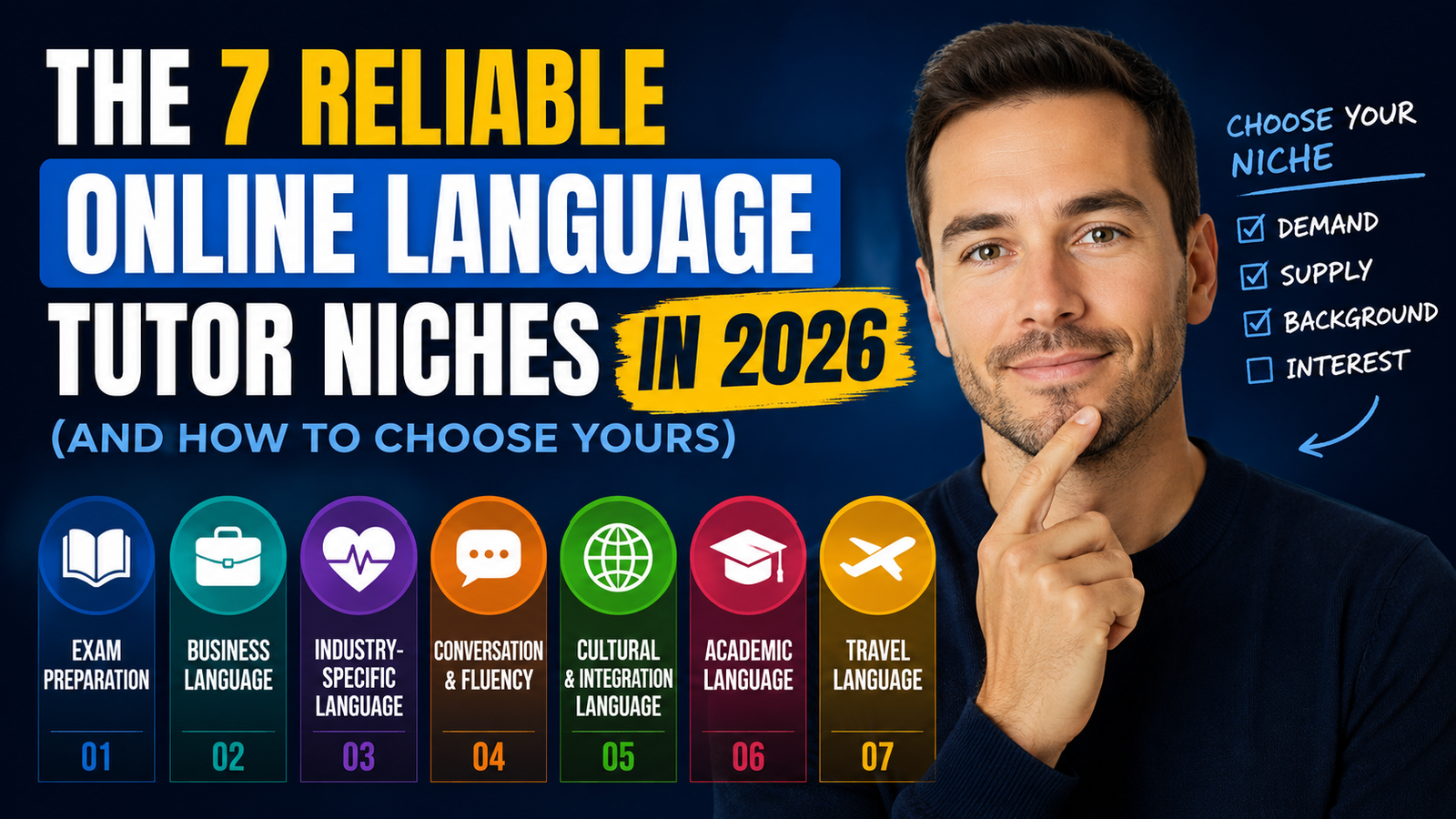
The right sequence starts with demand. Are students actively searching for this and paying real money? Then supply. How many credible tutors are already competing, and can you get discovered against them? Then background. Do you have a believable angle? Only then interest, which functions as a sustainability filter rather than a starting point. Tutors who lead with interest end up specializing in something authentic to them and invisible to the market.
There's a second thing almost nobody tells you, and the rate data makes it obvious. The niche with the most demand is not the niche with the best rates. IELTS preparation is the most searched-for tutoring specialty in the language world, and published market data puts online IELTS tutor rates at $18 to $40 per hour. Industry-specific language tutoring (medical, legal, aviation, engineering) has a fraction of that search volume, and tutors charge $60 or more per hour. Demand pulls students in. Supply decides what you get paid. You need to read both.
This article covers the demand-first framework, the seven niches that reliably work, how to validate a niche in 30 days before committing, and when to switch.
TL;DR. Niche selection in one screen
Match your situation to the right approach:
- New tutor with broad language skills, no credentials. Pick the niche with the biggest demand-to-supply gap in your specific language. In most languages other than English, that's exam prep or business.
- Experienced tutor with credentials. Pick the niche your credentials unlock most distinctively. A TOPIK examiner should teach TOPIK prep. A former nurse should teach medical language. Credentials are the cheapest competitive moat you'll ever have.
- Generalist tutor stuck at the commodification ceiling. Pick anything specific. The cost of indecision is higher than the cost of picking the wrong niche. You can re-niche after 12 months.
- Tutor with an existing audience. Pick the niche your audience already signals demand for, even if it's small. An engaged audience of 500 in a narrow niche outperforms invisibility in a large one.
The first question isn't "what do I love teaching?" It's "where is there demand I can credibly serve and actually get discovered in?"
The demand-first framework
Four questions, in this order:
- Demand. Are students actively searching, and paying? Search volume is the proxy. A niche with real demand shows commercial results competing for the keyword: tutor listings, course pages, coaching offers. If the only results for your niche idea are blog posts and Wikipedia, there's no market yet.
- Supply. How many credible tutors are competing? This is the question most tutors skip entirely, and it's the one that determines your rate. High demand plus high supply equals visible but cheap. Moderate demand plus low supply equals harder to find students, much better rates. The best niches sit where demand is adequate and supply is thin.
- Background. Do you have a credible angle? Background doesn't require a degree. Six years working in hospitality is a credible angle for hospitality language tutoring. Living in Seoul for four years is a credible angle for cultural-integration tutoring. Credibility means a student reading your profile thinks "this person actually knows this world," not "this person has a certificate."
- Interest. Can you sustain this for three years? Interest is the filter you apply last, to the shortlist the first three questions produced. It answers whether you'll still be doing this in year three, which matters enormously because per the cluster's first-30-students paradigm, niche returns compound slowly.
Most tutors run this backwards, starting at question four and never checking questions one and two. That's how you end up with a beautifully authentic profile that nobody books.
The 7 reliable niches
Ordered by demand strength, with the supply and rate reality for each.
1. Exam preparation
IELTS, TOEFL, Cambridge, JLPT, DELE, DELF, TOPIK, HSK. The highest-demand niche in language tutoring, driven by hard deadlines: university admissions, visa applications, immigration requirements, job qualifications. Students with an exam date in eight weeks are the least price-sensitive customers in this entire market.
Demand: very high. Supply: also very high, which is the catch. Published market data puts online IELTS tutor rates at $18 to $40 per hour, with experienced specialists at the top of that band. Preply lists IELTS tutors from $3 per hour with an average around $17. The exam-prep premium is real but compressed by competition, particularly in English.
The move that works: specialize inside the exam rather than across it. "IELTS tutor" competes with thousands. "IELTS Writing Task 2 for band 7+" competes with dozens, and the students who need that specific help will pay for it. In non-English languages (JLPT, TOPIK, HSK, DELE), supply is dramatically thinner and the same specialization discipline produces even better returns.
Best path: marketplace early for discovery, hybrid later. Credentials that help: examiner experience, verified student score outcomes.
2. Business and corporate language
Meetings, presentations, negotiation, email, industry vocabulary for working professionals. Tutors specializing in business language typically charge $25 to $60 per hour, meaningfully above the general-tutoring band.
Demand: high and structurally durable. Supply: moderate. The premium comes from two sources. First, employers frequently reimburse language training, so the person choosing is not always the person paying. Second, business students value outcome over price because the return is a promotion or a closed deal.
The move that works: name the specific business situation. "Business English" is a category. "English for technical sales calls with US clients" is a service, and the second one commands the higher rate.
Best path: hybrid or independent. LinkedIn is the natural acquisition channel here, per the acquisition playbook. Credentials that help: corporate work history in the field you're teaching to.
3. Kids and young learners
High volume, parent-mediated purchasing, lower per-hour rates but strong retention. Parents who find a tutor their child likes stay for years.
Demand: high, especially in East Asian and Latin American markets. Supply: high, and heavily platform-mediated. Rates typically sit below the adult market, but lifetime value per student is often higher because of retention.
Teaching kids is a genuinely different skill from teaching adults, not an easier version of it. Energy, pacing, visual materials, and parent communication all matter more than grammar depth. Tutors who move into this niche because they think it's simpler usually leave quickly.
Best path: marketplace almost exclusively. Independent kids tutoring requires parent trust that platforms manufacture more efficiently than individuals can. Credentials that help: child-safety certification, young-learner teaching qualifications, background checks.
4. Conversational fluency and personal interest
The default niche. Travel, hobby learners, heritage speakers reconnecting with a family language, people who simply want to talk.
Demand: the largest absolute market in language tutoring. Supply: the highest, which compresses rates hard. This is the generalist trap that rate-setting strategy warns about, and most tutors who stay here permanently stay near the bottom of their language's rate range.
The move that works: differentiate inside conversation rather than competing on price. Conversational Korean for K-drama fans. Spanish for people who cook. Japanese for people planning to live in Japan. The conversation is the product; the interest is the positioning.
Best path: marketplace, with a sharply differentiated profile. Credentials that help: less than in other niches. Personality, warmth, and a distinctive angle matter more.
5. Accent and pronunciation coaching
Professional adults who speak fluently but want to be understood more easily or sound closer to a target accent. Demand: moderate and growing, concentrated among working professionals. Supply: genuinely low, because it requires specific phonetics skill most language tutors don't have.
This niche rewards evidence. Before-and-after audio clips convert better than any profile description, because the result is audible in thirty seconds. Rates sit well above conversational tutoring and near the business band.
One caution worth stating: frame this work as intelligibility and confidence rather than accent elimination. Students are best served by clarity goals, and the tutors who position around "sounding clearer in meetings" attract better clients than those promising to erase an accent.
Best path: independent, portfolio-driven. Credentials that help: phonetics training, speech coaching background.
6. Industry-specific language
Medical, legal, aviation, engineering, hospitality, IT. Tutors charge $60 or more per hour for specialized tutoring in professional fields that rely on industry-specific terminology.
Demand: low in absolute volume. Supply: very low, and that's the entire point. This is the clearest illustration of the article's core lesson. A niche with a hundredth of exam prep's search volume pays two to three times the rate, because there are almost no credible competitors.
The barrier is real: you need actual domain knowledge. You cannot teach medical Spanish credibly without understanding clinical vocabulary and how it's used under pressure. But if you have that background from a previous career, this is the highest-leverage niche available to you, and it's the one most former professionals overlook because they assume their old job is irrelevant to teaching.
Best path: independent or referral-driven. Marketplaces surface these niches poorly. Credentials that help: prior work in the industry, professional certifications.
7. Cultural integration and language for living abroad
Students who have moved or are about to move: navigating bureaucracy, workplace norms, housing, healthcare, social codes, alongside the language itself.
Demand: moderate, growing with remote work and international mobility. Supply: low, because it requires lived experience in the destination country plus teaching skill. Rates sit above conversational and below industry-specific.
The move that works: pair a specific language with a specific destination and a specific mover profile. French for professionals relocating to Paris. Japanese for people starting jobs in Tokyo. The specificity is the product.
Best path: independent, audience-driven. Expat communities, relocation forums, and LinkedIn are where these students gather. Credentials that help: years lived in the country, direct experience with the systems you're explaining.
How to validate a niche in 30 days
Before committing a year to a niche, run three tests.
The search test. Search your niche with commercial modifiers: "tutor," "online lessons," "coaching," "course." Real demand produces competing commercial results. If page one is blog posts and dictionary entries, there is no market yet. If page one is dense with tutor listings and course pages, there's demand and you need to check whether you can differentiate within it.
The community test. Find where this niche's students gather: a subreddit, a Discord, a Facebook group, an expat forum, a professional association. If you can't find a place where these people talk to each other, acquisition will be extremely hard, because there's nowhere to reach them.
The 30-day first-student test. Reposition your profile around the niche and give it 30 days. One paying student, from any channel, is a pass. Zero students after 30 days of real effort means either the niche or your positioning is wrong. This maps to the 8-weeks-no-progress rule but runs tighter, because niche validation should be faster than channel validation.
The multi-niche mistake
"I teach Business English and IELTS and conversational and kids" reads exactly like "I practice all areas of law." It signals no real specialty, which defeats the purpose of specializing at all.
Pick one. Be known for one thing before adding a second. Multi-niche positioning fails because the profile has to speak to four different students at once, which means it speaks convincingly to none of them, and because the specialization rate premium only materializes when a student believes you are the specific answer to their specific problem.
The exception: two tightly related niches that share an audience. IELTS plus academic writing share a student. Business language plus industry-specific share a professional. Cultural integration plus conversational share an expat. Two compatible niches can coexist on one profile. Three never do.
When to switch niches
Three signals that your niche isn't working:
Eight weeks of consistent effort with zero or single-digit inbound. Consistent means real work: profile fully repositioned, weekly content or outreach, availability maintained. Not "I updated my headline and waited."
You've come to dislike the work. This is where interest earns its place in the framework. A niche you resent is a niche you'll abandon in year two, after absorbing all the cost of building it and none of the compounding.
The market shifted. Exam formats change. Industry demand moves. A niche that worked in 2023 may be thinner now. Re-check demand annually.
The switch playbook: stay adjacent where possible. Business language to industry-specific is a short move that keeps your audience. Business language to kids is a full restart. Reposition the profile, headline, and intro video together rather than piecemeal, and refresh your acquisition channels for the new audience.
Bottom line
Demand first, supply second, background third, interest fourth. Run in that order, niche selection becomes a research task with an answer. Run it backwards, and it becomes an introspective exercise that produces a profile nobody books.
The rate data across these seven niches carries the lesson worth remembering: the most-searched niche is not the best-paid one. Exam prep has the demand and the competition. Industry-specific language has almost no search volume and the highest rates in this article. Where you land between those poles should be a deliberate choice, not an accident of which niche occurred to you first.
Pick one niche. Validate it in 30 days. Commit for 12 months. Re-evaluate annually.
One structural note for niche-focused tutors: specialization pays off most when you can build depth around it rather than just repeating live lessons. A niche tutor with a packaged course, a curriculum, and published expertise in their specialty compounds in a way an hourly generalist never does. Platforms have started supporting this directly. Jynio bundles custom flashcard decks, pre-recorded course publishing, and content publishing into the tutor profile, which means an IELTS Writing specialist can sell a packaged Writing Task 2 course alongside live lessons and publish under their own name in the same place students discover them. That changes the economics of going narrow, because the depth you build in a niche becomes a product rather than just a talking point, and scaling beyond live lessons covers how to build it. For how exam candidates are told to evaluate a prep tutor, see working with a tutor for a language exam.
For which language pays best before you layer a niche on top, see the best-paying languages. For pricing your specialization, see setting your rates. For the marketplace-versus-independent fit noted in each niche above, see marketplace vs independent. For acquisition mechanics, see the acquisition playbook. For whether your niche supports full-time income, see side hustle vs full-time. For how the niche decision connects to everything downstream of it, see the complete guide to making money teaching languages online.
Go narrow. It's the highest-return decision available to you.