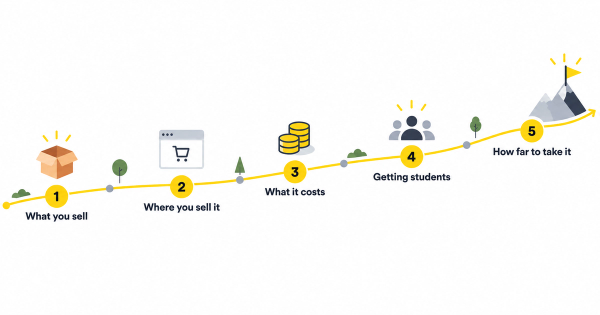

Almost every article on this topic asks the wrong question. "Marketplace or independent?" treats two career stages as if they were two career paths. They aren't. The right answer at month 1 of an online tutoring career is almost never the right answer at month 24. Most successful independent language tutors did not start independent. They graduated to it.
The useful question is: where am I in my tutor career, and which model fits this stage? Once that's framed correctly, the decision becomes obvious and stops feeling like a binary commitment for the rest of your professional life.
A second reframe matters at least as much. A marketplace is your customer acquisition channel, not your forever home. Tutors who treat italki or Preply as a permanent employer leave money on the table every year of their career. Tutors who treat the platform commission as the cost of new student acquisition (and migrate top repeat clients over 12 to 24 months) build a real business with portable equity. The framing shift is most of the work.
This article walks through the actual decision: how to know which model fits you today, when to switch, and exactly how to execute either path.
TL;DR. The decision framework in one screen
Match your career stage to the right model:
- Brand new, no audience, fast income required. Marketplace. Don't waste six months trying to acquire students from scratch when a platform delivers them in week one for a commission you'll one day think of as customer acquisition cost.
- 6 to 18 months in, growing repeat client base. Stay on the marketplace, but start branding yourself outside it. Build a LinkedIn presence, run a tiny newsletter, collect testimonials, ask for referrals. Begin the migration prep.
- 18+ months, established repeat clients, $30+ hourly rate. Start the hybrid play. Migrate your top 3 to 5 repeat students to direct billing, keep the marketplace for new acquisition. This is when the math starts to work for splitting attention.
- 3+ years, strong personal brand, $40+ hourly rate. Independent or hybrid. Marketplaces at this stage are mostly a tax on customers you'd have anyway.
If you're trying to choose right now, your first question shouldn't be "which is better?" It should be "which stage am I in?"
What marketplace actually means
Definition: a platform that handles discovery, billing, payment processing, trust signals, refund handling, and dispute resolution in exchange for a commission on every lesson. The exact percentages vary (italki packages 15%, Preply 18 to 33%, others between) and we covered the math in detail in the earnings math.
What you get on a marketplace:
- Volume. The platform pours millions into student acquisition that arrives at your profile for free
- Plug-and-play infrastructure. Scheduling, billing, video, dispute resolution, all of it
- Immediate trust signals through reviews, badges, hours-taught counters
- No marketing required. You build a profile and lessons appear
- Zero admin overhead. The platform handles the unsexy parts of running a business
What you give up:
- 15 to 33% of every lesson, indefinitely, including on long-term repeat clients who no longer need the platform's acquisition help
- A direct relationship with the student. Many marketplaces explicitly restrict in-app exchange of contact details
- A commodified profile that's easy to compare against the next tutor on the page
- Brand-on-the-platform rather than brand-of-your-own
The hidden cost is the one almost nobody talks about. Marketplace profiles are interchangeable. A tutor who spends five years building a 5-star profile on italki cannot move that reputation to another platform. Five years of work builds zero portable equity. The reviews, the rank, the badges, the student relationships, none of it leaves with you.
This is starting to change. A small but growing group of newer platforms is experimenting with letting tutors keep portable brand assets, build audience that travels with them, and publish their own content within the platform itself. We'll come back to that in the bottom section.
What independent actually means
Definition: you set your rate, you find your students, you handle billing, you own the brand and the client relationships. The only cost on top of your time is payment processing (around 2.9% plus $0.30 per transaction on Stripe in the US, similar in the EU), plus the small SaaS costs for scheduling and your landing page.
What you get going independent:
- Full margin. The 15 to 33% that used to go to a platform stays with you
- Full control of the student relationship. You have their email, you can send them resources, you can run a newsletter, you can offer them new products
- Brand equity that compounds. Every student becomes a referral source, every testimonial a marketing asset
- Pricing power. You can raise rates without an algorithm punishing your visibility
- Product flexibility. You can sell intensive packages, group classes, pre-recorded courses, and async products that platforms either prohibit or take an outsized cut on
What you give up:
- The marketing machine. No more free students arriving in your inbox
- The trust shortcut. New students can't just look up your 200 reviews; you have to build credibility from scratch
- Billing, scheduling, admin overhead. The unsexy 5 to 10 hours a week of business operations
- Six to twelve months of ramp time with little revenue. Possibly longer without a pre-existing audience
The hidden upside is the inverse of the marketplace's hidden cost. Every student you keep direct is a long-term asset. A two-year recurring student at $35/hour is $3,600 in annual revenue and worth multiples of that if they refer one friend a year. On a marketplace, the platform captures commission on that compounding value indefinitely. Independent, it's all yours.
The five trade-offs that actually matter
Beyond money, five trade-offs decide which model fits a given tutor at a given moment.
Time-to-revenue. Marketplace produces revenue in week one. Independent produces meaningful revenue in month six to twelve at the earliest, and only with a deliberate acquisition strategy. For a tutor who needs income now, this is the single largest variable.
Control. On a marketplace, the platform can change commission rates, ranking algorithms, payout policies, or your account status without warning. This is not theoretical. italki's commission structure has shifted in the last 18 months. Preply's tier system has been re-tuned. Tutor accounts get deactivated for opaque reasons. Going independent eliminates this risk entirely. The trade-off is you're now solely responsible for problems platforms previously absorbed.
Brand equity. Marketplaces produce minimal portable equity. Independents produce maximum portable equity. A blog post you wrote, a YouTube channel you built, a newsletter list you grew, a course you published: all of these survive the closure of any platform. None of them survive the closure of your italki account.
Scalability. Marketplaces are capped by the platform's pricing dynamics. There's a soft ceiling on what most tutors can charge before discovery suffers. Independent has no ceiling. The best-paid independent tutors layer live lessons with pre-recorded courses, group classes, certification programs, and content products that compound beyond the hour-for-dollar ceiling of pure live tutoring.
Risk profile. Marketplace produces predictable income but single-platform dependency. Independent produces variable income but no single point of failure. Most tutors don't think about this until something breaks. The tutor whose Preply account gets flagged for vague "policy violation" reasons and loses their entire income overnight wishes they'd diversified earlier.
The hybrid path. The most important section of this article
Here is the path almost nobody describes clearly: most "independent" language tutors weren't independent on day one. They built on italki, Preply, or Verbling for 12 to 24 months. Then they migrated their best repeat clients to direct billing while keeping the marketplace for new acquisition. The transition was gradual, the income never dropped, and by year three they were running 70% direct, 30% marketplace, with annual earnings that neither pure model could have produced.
The playbook in six concrete steps:
- Identify your top 5 to 10 repeat students. The ones who've booked 10+ lessons with you. These are your migration candidates, the students who already trust you and don't need the platform's acquisition machinery anymore.
- Build a simple landing page. Carrd, Notion, or basic WordPress is more than enough. You're not building a brand from scratch; you're giving your existing students a place to book directly. Under $20/month all-in.
- Set up direct billing infrastructure. Stripe for most countries, Wise if cross-border, PayPal as a fallback. Add a scheduling tool (Calendly or TidyCal at around $10/month) and a video link (Zoom or Google Meet).
- Propose direct booking to those clients. A short message offering them direct lessons at a 10 to 20% lower rate because there's no platform commission to fund. Most accept. The few who don't, leave on the platform without resentment.
- Keep the marketplace profile active. Treat new students arriving from the platform as marketplace-acquired until they convert to repeat. Then offer them the same migration option at month 3 or 6.
- Shift the income mix gradually. Over 12 to 24 months, your earnings split moves from 100% marketplace toward 70/30 direct/marketplace or higher. You stop fighting the commission and start using the platform for what it's genuinely good at: surfacing new students.
The economics at a typical mid-career rate of $30/hour with 30 working hours per week split 20 marketplace, 10 direct: hybrid take-home meaningfully beats either pure model. The platform commission on 20 hours costs maybe $90 to $180 per week depending on tier; you keep almost all of the 10 direct hours.
The ethical question some tutors ask: is it acceptable to migrate clients off a platform? Honest answer: yes, with caveats. Platforms know this happens and structurally accept it as the cost of being a marketplace. Don't violate explicit terms (some platforms restrict in-lesson sharing of contact details until lessons have been completed). Don't poach students during their trial phase. Once a recurring relationship is established and the student has freely chosen to continue with you, both parties are entitled to negotiate the booking arrangement that works for them.
Six steps to go independent (for tutors who decide to make the move)
For tutors ready to commit to independent, or transition out of hybrid into fully direct, six steps in order:
- Pick a niche. Generalist tutoring loses to marketplaces on commodification. Specialize: a specific language for a specific exam, a business niche, accent reduction, kids, or a specific certification. The narrower the better at first. See the best-paying languages and [the niches breakdown for which combinations pay best.
- Set up infrastructure. Landing page (Carrd or Notion), scheduling (Calendly or TidyCal), billing (Stripe or Wise), video (Zoom or Google Meet). Total cost under $30/month. Don't over-engineer this. The first 12 months are about getting students, not perfecting the stack.
- Decide on the legal structure. Sole proprietor or freelancer status in most jurisdictions is fine to start. LLC, SAS, or equivalent once revenue justifies the additional paperwork. Tax obligations vary wildly by country. Consult a local accountant or tax advisor before assuming anything you read online applies to your situation.
- Build acquisition channels. Three legitimate options: content (LinkedIn, blog, YouTube), referrals (incentivize existing students with discounts), or paid ads (only at meaningful scale where the math works). Pick one channel to start. Tutors who try to start three at once typically launch zero.
- Set rates 10 to 20% above marketplace. You're offering something a marketplace can't: continuity, personalization, no platform middleman, the ability to design a long-term curriculum across many lessons. Price like that's true, because it is.
- Plan for the first-six-months drought. Have savings or other income to cover the ramp. Revenue at month 1 to 3 will be 10 to 30% of what the marketplace was producing. By month 9 to 12, well-executed independent should match or beat platform earnings. Tutors who quit too early are mostly tutors who didn't financially plan for the six-month gap.
Common mistakes in both directions
Marketplace mistakes:
- Treating the platform as a forever home rather than an acquisition channel. The longer you stay 100% marketplace, the more total commission you pay over a career.
- Not building any brand assets outside the platform. No LinkedIn, no website, no testimonials saved offline. When the algorithm changes, you have nothing to fall back on.
- Accepting commission creep. Platforms quietly adjust rates over the years. Most tutors don't recalculate. Set a reminder to do the math every 12 months.
Independent mistakes:
- Going independent on day one with no audience. The single most expensive mistake in this space. Six months of zero income while you "build your brand" is what kills most attempts.
- Underpricing to compete with marketplaces. You're not the same product. Pricing equal to a marketplace tutor signals you're the same thing, when your actual offer is more.
- Neglecting admin until it breaks. Invoicing, tax reporting, contract templates. Set this up in month one, not month twelve.
- Picking too broad a niche. "I teach Spanish" is a marketplace product. "I teach Mexican Spanish for healthcare professionals preparing for DELE B2" is an independent product.
Bottom line
The right model depends on where you are in your career, not which model is objectively better. Marketplace is the right answer at month 1. Independent is the right answer at month 36 for most tutors. The hybrid path is what bridges them.
One reframe worth holding for the next few years: the marketplace-vs-independent binary is starting to dissolve. A new category of platform is emerging that gives tutors the things they used to have to leave a marketplace to get. Audience-building tools that let your followers travel with you across platforms. Asynchronous product creation, so you can sell pre-recorded courses alongside live lessons. Curriculum tools like flashcards you build for your students, included in the platform instead of as a separate paid SaaS. Content publishing for tutors who want to write about their craft and grow a personal brand. These platforms still handle discovery and billing like marketplaces, but they treat the tutor as someone building a business, not someone renting an audience. If you're 12 to 24 months into your tutor career and reading this trying to choose between sticking with italki and starting your own website, watch this space. The decision tree gets simpler when there's a third option that compounds your equity instead of consuming it.
For the take-home math on each major platform, see the earnings math. For which language and niche to pair with which model, see the 7 best-paying languages. For where this decision sits in the full career sequence, see the complete guide to making money teaching languages online.