Most articles ranking for "best-paying languages" don't actually answer the question online tutors are asking. They tell you which languages help your career, which ones translators charge the most for, or which ones boost a corporate salary. Those are different questions with different answers. The one most current or aspiring tutors actually want answered is: if I teach this language online, what hourly rate can I command?
That answer doesn't depend on global demand alone. It depends on the gap between learners actively looking for a tutor and qualified native speakers willing to teach them. Where that gap is wide, rates climb. Where it's narrow, rates collapse. This piece ranks the seven languages where the gap currently favors the tutor, using observable rate data on the major platforms, not aspirational averages.
A surprise sits at the top of the rankings, and a bigger surprise sits at the bottom. The world's most-learned language, English, is one of the worst-paying to teach. We'll get to why.
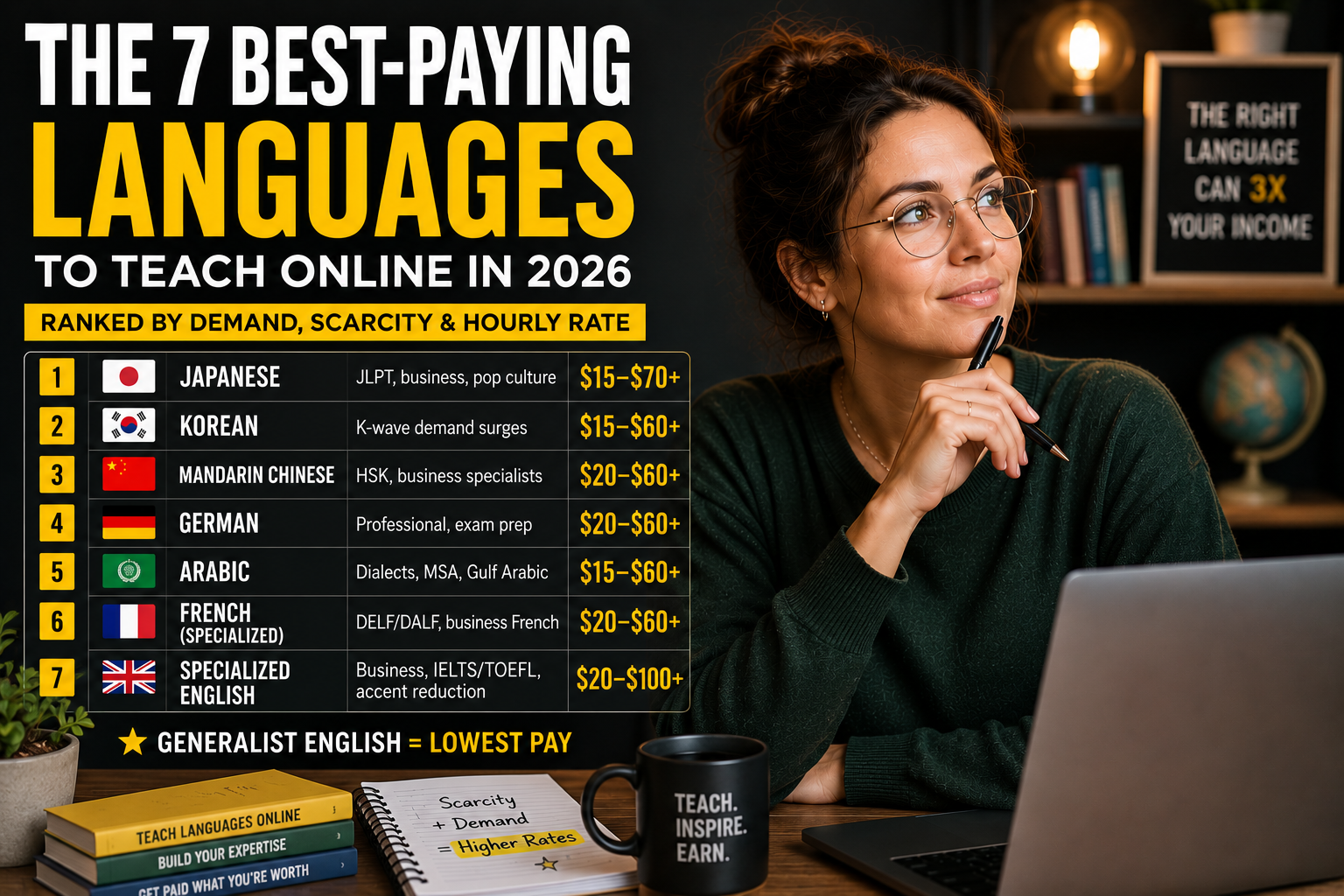
TL;DR. The 7 best-paying languages to teach online in 2026
- Japanese. Strongest combination of demand (JLPT, business, pop culture) and limited online tutor supply.
- Korean. K-wave demand has outpaced tutor recruitment; rates are climbing fast.
- Mandarin Chinese. Huge demand; rates concentrate at the top for HSK and business specialists.
- German. Steady professional demand, limited native-speaker supply willing to teach online.
- Arabic. High demand variance by dialect; specialists in Modern Standard and Gulf Arabic command premiums.
- French (specialized). DELF/DALF exam prep and Business French outpace generalist French rates.
- Specialized English. Business English, IELTS/TOEFL prep, accent reduction. Generalist English is the worst-paying language to teach. Specialized English is among the best.
How we ranked them
Three factors:
Average hourly rate observed across italki, Preply, Verbling, and Cambly tutor profiles in 2026. Range matters more than the midpoint. A language where the top quartile tutors charge $50+ has more upside for serious teachers than one where the average is $20 but the ceiling is $25.
Supply scarcity. A proxy for how many qualified tutors compete for each active learner. italki has more than 20,000 teachers across 190 countries, but they aren't evenly distributed. Languages with fewer native speakers willing to work online command higher rates regardless of total demand.
Demand strength. Active learner counts and search trends. Demand without scarcity gives you English's race-to-the-bottom problem. Scarcity without demand gives you Esperanto. The valuable languages have both.
These rates reflect what tutors charge, not what they take home. Platforms keep a cut. italki takes roughly 21% on single lessons and 15% on packages; Preply keeps 18 to 33% depending on tutor tier. We list gross rates here. For the full take-home math across every major platform, see how much online language tutors actually make. Net earnings also depend on the platform-versus-independent decision, covered in marketplace vs independent tutoring.
1. Japanese
The clearest combination of demand and scarcity in 2026. Japanese tutor rates run from $10 to over $80 per hour depending on lessons format, tutor's background, learner level, and goals. Online private lessons typically sit at $15 to $50/hr, with JLPT preparation tutors approximately at $25 to $70/hr depending on exam level and credentials. N3 to N1 prep concentrates at the higher end.
Why it pays well: Japanese has a global learner base (anime, gaming, business, JET program candidates) but a relatively small population of native speakers actively teaching online, especially in Western time zones. The shortage is most acute for JLPT-specialized tutors, where exam knowledge is non-negotiable.
Ideal tutor profile: native Japanese speaker with JLPT examiner experience or business Japanese background. Where to teach: italki has the deepest demand pool; Preply is competitive for higher-volume tutors who want subscription stability.
2. Korean
The K-wave fundamentally changed Korean tutoring economics. Professional Korean teachers on italki typically charge $15 to $40 per hour, with community tutors at $8 to $20. Real top-tier profiles on the platform sit at $24 to $30/hr with thousands of completed lessons; specialists in TOPIK exam prep push higher.
Why it pays well: demand from K-pop fans, K-drama viewers, and learners motivated by Korean media has surged faster than the platform's tutor base could grow. Korea also has tighter native-speaker availability than larger language markets. There are simply fewer Koreans online and willing to teach than there are Spanish or French speakers.
Ideal tutor profile: native speaker with structured curriculum experience, ideally TOPIK preparation or business Korean specialization. Where to teach: italki dominates for serious learners; Preply works well for tutors who can build a regular subscription roster.
3. Mandarin Chinese
Massive demand, rapidly growing supply. Online Mandarin classes on italki range from $10 to $40 per hour on average, with experienced specialists higher. Top-tier credentialed tutors, those holding the Confucius Institute's CTCSOL certification or with university teaching experience, charge $40 to $60+/hr, and a small group of brand-name teachers sit above that.
Why it pays well at the top: HSK exam preparation, business Mandarin, and structured curriculum delivery all command premiums. The mass of tutors clusters around $10 to $25 (where Mandarin is intensely competitive), but specialists who can teach exam prep or business contexts have stayed scarce. The bifurcation is the opportunity.
Ideal tutor profile: CTCSOL or equivalent certification, plus a niche (HSK, Business Mandarin, kids, technical industries). Generalist conversational Mandarin tutoring is now a low-margin segment. Where to teach: italki for credentialed tutors; Mandarin-specific platforms like LingoLessons exist but are smaller.
4. German
A quietly strong market. German tutors on italki and Preply typically command $20 to $60/hr for online lessons, with Business German and exam prep (Goethe-Zertifikat, TestDaF) at the upper end.
Why it pays well: corporate demand in Europe (especially for engineering, automotive, and pharmaceutical contexts) plus a thinner online tutor pool than English or Spanish. Native German speakers are less likely to teach online as a primary income source than tutors from many other regions, which keeps supply constrained.
Ideal tutor profile: native speaker with Goethe-Institut affiliation or business background. Industry-specific German (engineering, finance) commands the highest rates. Where to teach: italki for both professional and conversational tiers; Preply works well for steady-schedule learners.
5. Arabic
The widest rate variance of any major language on this list. italki Arabic classes range from $5 to $50 per hour, with specialized classes higher; Preply Arabic averages around $11/hr with a wide range from $2 minimum upward.
The variance comes from dialect fragmentation. Modern Standard Arabic (MSA), Egyptian, Gulf, Levantine, and Maghrebi are functionally separate teaching markets. MSA specialists serving academic and professional learners charge $25 to $50/hr; Gulf Arabic for business expatriates pushes $30 to $60/hr; conversational Levantine or Egyptian sits closer to $10 to $20/hr because supply is more abundant.
Ideal tutor profile: clear dialect specialization, ideally with professional credentials (university teaching, Quranic Arabic certification, business background). Where to teach: italki has the deepest pool of dialect-specialized tutors; Preply has more volume but less differentiation.
6. French (specialized)
Generalist French is competitive. Rates cluster around $10 to $30/hr on both italki and Preply, with the high end at $40+. The opportunity is in specialization. French tutors with FLE certification, DAEFLE, or Alliance Française credentials for DELF/DALF exam prep or Business French command $35 to $60+/hr.
Why specialized French pays well: African business demand (French is the operating language of much of West and Central Africa), DELF/DALF requirements for university admissions and immigration in francophone countries, and a steady pipeline of corporate clients in Europe. Generalist conversational French has too much supply; the specialist tracks have not.
Ideal tutor profile: FLE-certified native speaker with exam prep or industry experience. Where to teach: italki for credentialed teachers; specialized platforms like Frantastique exist for the higher end.
7. Specialized English
This entry is the most important on the list, and the most counterintuitive. English tutor rates run from $15 to well over $100 per hour depending on whether lessons are online or in-person, the tutor's qualifications, your level, and what you need help with. The range is wider than any other language because English contains within it both the lowest-paid and the highest-paid online language tutoring work in the world.
The high end:
- Business English specialists charge $25 to $60/hr and often have professional backgrounds in finance, law, or corporate environments
- IELTS tutors charge $18 to $40/hr for online sessions, with experienced specialist tutors at the higher end; TOEFL specialists track similarly
- Accent reduction coaches with speech pathology or theater backgrounds charge $50 to $100+/hr
If you teach English and you don't specialize, you are competing with the entire global supply of English speakers willing to teach. Specialize, and you compete with a far smaller pool of qualified specialists.
The English paradox
Here is the part of the article that should be uncomfortable for anyone planning to "teach English online" as a generic income strategy.
Cambly pays $10.20 per hour for regular classes and $12 per hour for Cambly Kids, and even that figure is misleading, because given the gaps between calls, the effective hourly rate might be between $5 and $8. Cambly is the floor, but the floor matters because the floor sets expectations across the entire generalist English market.
A qualified teacher in New York might charge $80 per hour. A native speaker on a tutoring platform charges $15. An online tutor from the Philippines charges $8. All of those can be legitimate rates for genuinely skilled teachers. What sets the floor isn't quality, it's supply. There are millions of fluent English speakers worldwide, and platforms have priced accordingly.
If you are a native English speaker thinking about generalist English tutoring as your income strategy, you are entering the most crowded, most race-to-the-bottom segment of the entire industry. The only way to escape that gravity is specialization: Business English, exam prep, accent reduction, industry-specific work (medical, legal, aviation), or executive coaching. The specialist tracks pay 3 to 5x what the generalist track pays for the same hour of your time.
This is the most important career advice in this article. Don't compete on English-as-a-language; compete on English-for-a-specific-outcome. For the seven specializations that reliably work, with the demand and rate reality for each, see the niches breakdown.
Underrated picks
A handful of languages don't make the top 7 but offer surprisingly good economics for the right tutor:
- Brazilian Portuguese. Demand has grown alongside Brazil's startup ecosystem and digital nomad migration; supply remains thin outside dedicated platforms. Rates often match Spanish ($15 to $35/hr) but with less competition per learner.
- Russian. Geopolitically complicated but creates real scarcity. Heritage learners, academic users, and professionals in specific industries sustain $20 to $40/hr rates for credentialed tutors.
- Polish. EU migration plus a small native-speaker tutor pool means rates ($15 to $30/hr) outpace what raw learner demand would suggest.
- Italian. Passion-driven learners pay premiums for cultural depth and travel preparation; specialized Italian (opera, art history, business) commands $25 to $45/hr.
Recommendations by tutor profile
If you are a native English speaker with no other languages: specialize. Business English, IELTS/TOEFL prep, or accent reduction. Building one of these specializations roughly doubles your hourly rate within 6 to 12 months. Generalist English tutoring is a low-margin trap. For how to actually price a specialization once you have one, see setting your rates.
If you are a native speaker of Japanese, Korean, or Mandarin: you are sitting on a goldmine. Build credentials (JLPT examiner training, TOPIK, CTCSOL), specialize in exam prep or business, and price toward the top quartile of your language. Top tutors in these languages out-earn generalist English tutors 3 to 1.
If you are bilingual or multilingual: teach the rarer language, not the common one. A French/English speaker should focus on French. A Spanish/English speaker who happens to speak German should consider focusing on German first. The economics favor whichever language has fewer qualified competitors per active learner.
If you are a non-native but C2-fluent speaker: niche heavily. Generalist tutoring in your second language puts you against native competitors. Specialization (exam prep, industry, conversational coaching for adults at specific levels) creates the differentiation you need to charge real rates.
Bottom line
The right language to teach online depends on three things: what you can teach natively or near-natively, how scarce qualified tutors are in your specific niche, and your willingness to specialize. Generalist tutoring in any high-supply language, English first among them, is a race to the bottom. Specialist tutoring in a scarcity language is some of the best-paid remote work available.
Your hourly rate also depends on the platform's commission structure. italki takes roughly 21% on single lessons and 15% on packages; Preply takes 18 to 33% depending on your tier; Cambly pays a flat rate with no rate-setting at all. The platform decision can be worth as much to your take-home as the language decision itself.
For what each platform actually pays after commission, see the earnings math. For whether to stay on a marketplace at all, see marketplace vs independent. For pricing your language and niche, see setting your rates. For finding your first students once you have picked, see the acquisition playbook. And for how the language decision fits into the wider career, see the complete guide to making money teaching languages online.
If you're picking a language now, pick one where the supply gap favors you, then specialize until you stop competing on price.