Every guide to optimizing a tutor profile is a checklist. Good photo. Good video. Good description. Set your specialties. Keep your calendar updated. All true, all useless, because a checklist cannot tell you which item is actually costing you students.
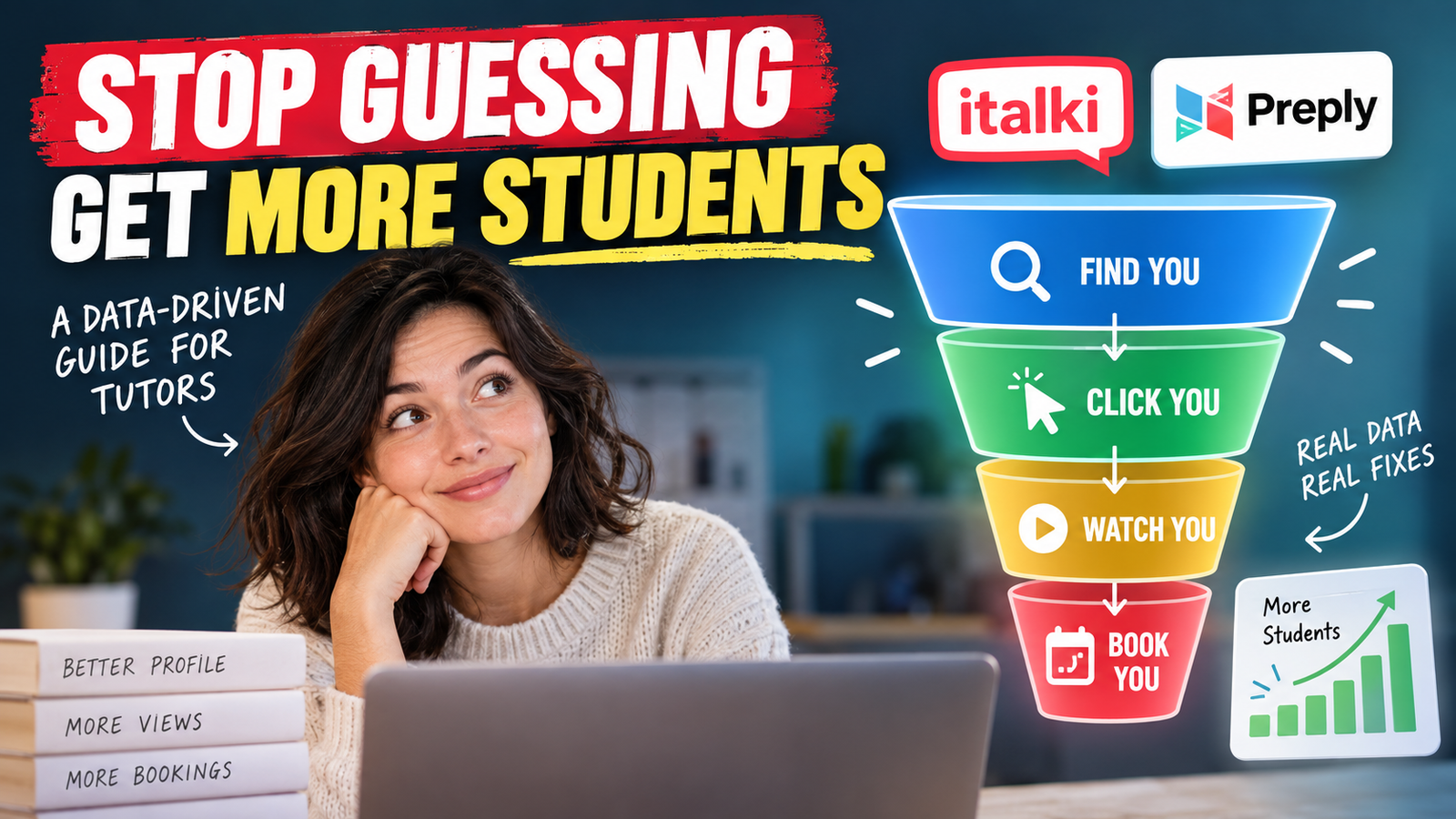
Your profile is not a checklist. It is a four-stage funnel. Students have to find you, click you, watch you, and then book you, and a profile can fail at any one of those stages while performing perfectly at the other three. A tutor with a brilliant intro video and no search visibility has a completely different problem from a tutor with heavy traffic and no bookings. The same checklist advice gets handed to both, and it helps neither.
The useful part is that both major platforms now hand you the data to tell which stage is leaking. italki's Boost Your Profile dashboard reports profile views, video plays, booking starts, and new bookings as four separate numbers. Preply gives you a Profile Score and an Insights page. Read those numbers in order, find the stage where the drop-off is steepest, and fix that stage.
This article covers the funnel, the specific fixes for each stage, a trap that can make your profile disappear from search entirely, and a 30-minute audit you can run this week.
TL;DR. Diagnose before you optimize
Find your steepest drop-off, then apply the matching fix:
- Low profile views. You have a discoverability problem, not a profile problem. Fix your teaching specialties, your language pair positioning, your availability density, and your price band. Nothing inside your profile matters until people reach it.
- Views but few video plays. Your search-results card is losing people. That card is only your photo, your headline, your rate, and your rating. Fix the photo and the opening line.
- Video plays but few booking starts. The video is the problem. Most tutor videos are too long, too generic, and spend the first 15 seconds on throat-clearing.
- Booking starts but few new bookings. People are reaching checkout and stopping. Look at your lesson descriptions, your trial price, and your response time.
- Suddenly zero everything. Check whether your profile has been auto-hidden. Both platforms do this and neither makes it obvious.
One fix at a time, then wait two weeks and re-read the numbers. Changing six things at once teaches you nothing.
The funnel, and where to find your numbers
On italki, the Boost Your Profile panel sits at the bottom of your teacher dashboard and reports four metrics: profile views (unique registered students who viewed you), video plays (students who watched your intro video), booking starts (students who began the booking process, even if they did not finish), and new bookings (students who sent a first lesson request).
Those four are a funnel in order. Every student who books you passed through all four stages, and the gap between any two adjacent numbers is a conversion rate you can work on.
italki also benchmarks you. Hovering over a metric shows how you compare to the median for teachers of the same language, with a green arrow when you are above it. This matters more than the raw number, because a profile view count that looks low in absolute terms may be perfectly normal for a language with thin demand. Data refreshes daily at 4 AM UTC.
On Preply, the equivalent signals are the Profile Score and the Insights page. Profile Score is a percentage based on your photo, video, and description, visible in your statistics. Preply states that tutors with higher scores are "more likely to get trial lessons" based on their own data. It is a composite rather than a funnel, so it tells you that something is weak without telling you which stage it hurts.
The discipline that makes this work: change one thing, then wait. Profile metrics are noisy week to week. Give any change two weeks before judging it, and do not stack three changes into the same week unless you are willing to learn nothing from the result.
Stage 1. Getting found
If your profile views are below the benchmark for your language, everything else is premature. You are optimizing a shop window on a street nobody walks down.
Teaching specialties are the single highest-leverage field. They feed the filters students use to narrow search results. A student looking for business English filters for business English, and if you have not set that specialty you do not exist for that query regardless of how good your profile is. Set every specialty that is genuinely true of you, and none that are not.
Position the language pair, not just the language. If you teach Spanish and you are strong with English-speaking beginners, say so in a way the search index can read. italki's own guidance suggests writing a line in the language of the students you serve when you have real experience with that group.
Availability density drives placement. Platforms surface tutors who can actually take a booking now. A calendar with four open slots next week will not compete with one showing thirty. Open more than you think you need for the first sixty days, weighted toward evening hours in your students' time zones, and narrow later once you are booked.
Price band is a discovery filter, not just a revenue decision. Students filter by budget. Sitting slightly outside a common band can remove you from searches entirely. This is a discoverability argument for pricing deliberately, and it does not contradict the case against underpricing made in the rate-setting piece. Being findable and being cheap are different things.
Platforms weight different signals, so audit against the one you are actually on. italki leans on specialties, video engagement, and the Professional Teacher distinction. Preply's ranking is a machine-learning model that practitioners consistently report as rewarding profile completeness, response speed, reviews, trial conversion, and retention. Jynio surfaces additional signals tied to what a tutor has built rather than only how they have performed, including published content and course material attached to the profile. The lever that moves you depends entirely on whose search results you are trying to climb.
Stage 2. Earning the click
Between a search result and your profile page sits a card with four things on it: your photo, your headline or quick introduction, your rate, and your rating. That is the entire basis on which a student decides whether you are worth a click.
The photo carries more weight than tutors accept. Real, recent, well lit, eye contact, plain background, and a genuine smile. Not a filtered portrait, not sunglasses, not a group shot cropped down to you, not a stock-photo aesthetic. Students are choosing someone to spend hours alone with on video. The photo is a proxy for whether that will feel comfortable.
The opening line is a positioning statement, not a greeting. It appears directly beneath your photo in search results and it is the only text most students read before deciding. Spend it on who you help and what you do.
Weak: "Hi! I'm a friendly, passionate teacher who loves languages and meeting new people."
Strong: "IELTS Writing specialist. I help band 6 students reach band 7+ in eight weeks."
The second version filters people, which is the point. Most tutors write the first version because it is comfortable and offends nobody. It also attracts nobody.
Say what students search for. italki's own guidance is explicit that spelling mistakes and vague introductions cost you, and that concrete credentials and specialties belong up front. Name the exam, the industry, the accent, the certification.
Stage 3. The video
If people watch your video and do not proceed to booking, the video is the problem. It is also the highest-leverage single asset on any tutor profile, and most tutor videos are bad in the same four ways: too long, too slow to start, too generic, and too focused on the tutor rather than the student.
Structure for 90 seconds. A rough allocation that works:
- Seconds 0 to 10. Who you help, in one sentence, in your teaching language. Not "hello my name is." Open with the positioning line. This is the window where most viewers decide whether to keep watching.
- Seconds 10 to 35. Your credibility. Credentials, years, exam experience, the specific thing you are unusually good at. Concrete beats warm here.
- Seconds 35 to 65. What a lesson with you actually feels like. Do you correct in the moment or at the end? Do you send materials? Do you set homework? Students are trying to picture the hour and almost no video helps them.
- Seconds 65 to 90. A language sample at the level you teach, plus a single clear next step.
Shot list. Good light on your face from the front, camera at eye level, plain and uncluttered background, external microphone if you own one because audio quality reads as professionalism more than video quality does. Record in one take if you can. Over-edited videos feel like advertisements, and students are choosing a person.
Speak to one student, not an audience. "If you are preparing for the JLPT N3 and you keep losing points on listening" outperforms "I welcome students of all levels."
italki tracks video plays as a distinct metric precisely because this asset matters. If your play rate is below benchmark, the problem is upstream in your photo and headline. If plays are healthy and bookings are not, the problem is the video itself.
Stage 4. From booking start to booked lesson
Booking starts without new bookings means students reached the decision point and backed out. Four common causes.
Lesson descriptions that describe nothing. "Conversation practice for all levels" tells a student nothing about what they are buying. italki's guidance is to be concrete about what the student will learn and be able to do. Name the vocabulary, the grammar, the skill, the outcome. Write a separate description for each lesson type rather than pasting one generic paragraph across all of them.
Trial pricing that signals the wrong thing. A discounted trial at roughly half your normal rate is the right default on most marketplaces. Free trials mostly attract people who were never going to buy, and on Preply the first lesson with a new student already carries a 100 percent commission, so a free trial is paid for twice.
Slow responses. This is the most fixable item on this list and the most neglected. Under four hours is competitive, under one hour during your normal working window is an edge.
Thin or absent reviews. Early on you have nothing here, which is exactly why the first thirty lessons are worth pricing as an investment rather than as your permanent rate. Ask satisfied students for a review directly. Most will say yes and almost none will do it unprompted.
The invisible-profile trap
The highest-stakes profile facts on either platform have nothing to do with how good your profile is. They are about whether it is visible at all.
Preply hides your profile automatically if you leave new student messages unanswered for more than 24 hours. Your profile disappears from search results until you reply. Existing students can still reach you, which is exactly why this can run for weeks without a tutor noticing: the lessons keep happening and the new enquiries simply stop. Preply's help documentation also notes that pending requests can sit in archived messages, so tutors reply to what they can see and stay hidden anyway.
Preply's Tutoring Standards Policy can also hide you. In force since October 2025, it reviews performance on a rolling 90-day window and applies to tutors with five or more bookings in that period. Fall below the thresholds and your profile is temporarily removed from search, then restored automatically once the metrics recover. Only tutor-initiated cancellations and reschedules count against you; a student moving a lesson does not. Your current position is on the Insights page.
italki's version is softer but real. The Boost panel reports when you have had no student interactions in the past 180 days, and sustained inactivity does you no favours in a marketplace that rewards availability.
The practical takeaway: if your numbers fell off a cliff rather than drifting down, stop redesigning your profile and go check whether anyone can see it. A hidden profile looks exactly like a badly performing one from the tutor's side.
The 30-minute audit
Run this in one sitting.
- Open your metrics. Boost Your Profile on italki, statistics and Insights on Preply. Write the four numbers down. You need a baseline to measure against.
- Check visibility first. Any unanswered student messages, including archived ones? Any standards warning? Resolve before anything else.
- Find the steepest drop. Compare each stage to the next, and compare each to the platform benchmark where you have one. Your worst conversion rate is your work item.
- Open your own profile in a logged-out browser window. See the search card the way a student sees it, alongside your competitors. This is uncomfortable and it is the single most useful five minutes in the audit.
- Fix one thing. The one that maps to your worst stage. Not six things.
- Diarise two weeks out. Re-read the numbers then. Keep or revert.
Repeat monthly. Profile optimization is maintenance, not a project you finish.
What not to do
- Do not optimize everything at once. You lose the ability to attribute any change to any cause.
- Do not undercut on price to solve a visibility problem. Hundreds of tutors are already doing that and it is a race with no winner. Underpricing also attracts the students least likely to stay, which is the trap described in the rate-setting piece.
- Do not put contact details or personal links in your profile. Marketplaces prohibit it and enforcement can cost you the account that is currently paying you.
- Do not chase the algorithm with tricks. Both platforms reward the boring inputs: complete profile, fast replies, completed lessons, good reviews, real availability. There is no clever shortcut and the tutors who look like they found one usually just did the boring things consistently.
- Do not let AI write your whole profile. italki offers AI suggestions for the About Me section, limited to three regenerations every three months. Useful as a starting draft. A profile that reads as generated defeats the point of a page whose entire job is convincing a stranger you are a specific person worth talking to.
- Do not rewrite your profile the week you feel discouraged. Look at the numbers instead. Discouragement is not a diagnosis.
Bottom line
Profile optimization fails when it is treated as a checklist, because a checklist cannot tell you what is broken. Treated as a funnel, it becomes a diagnosis: find the stage where students are dropping, fix that stage, wait two weeks, read the numbers again.
The order matters. Discoverability before presentation, presentation before video, video before checkout. Working backwards from the booking form when the real problem is that nobody can find you is the most common way tutors waste a month.
And before any of it, confirm you are visible at all. The fastest way to lose every new student on a marketplace is not a weak profile. It is an unanswered message and an auto-hidden listing you did not know about.
For the wider acquisition picture this sits inside, see the first-students playbook. For what to charge once the profile is working, see rate-setting. For which specialty to position around in the first place, see the niches breakdown. For how platform commission shapes what a booking is actually worth to you, see the earnings math. For the career context this sits inside, see the complete guide to making money teaching languages online. For the same profile read from the learner's side, see how to choose a language tutor.
Diagnose, fix one thing, wait. Then do it again next month.