Almost every guide to choosing a language tutor hands you a checklist of qualities. Look for qualifications. Check the reviews. Make sure they are a native speaker. Find someone whose teaching style matches your learning style. Book a trial.
All of that is the second question. The first one is what you actually need this person to do, and almost nobody asks it.
A conversation partner, an exam coach, a grammar fixer, and a weekly accountability structure are four different hires. They call for different tutors, different credentials, different prices, and different lesson formats. If you browse profiles before you have decided which one you are hiring, you will pick whoever seems nicest in a thirty-minute call, and you will find out eight lessons later that nice was not the thing you needed.
The tutors who make the biggest difference to people's language learning are almost never the ones who won on charm. They are the ones who were the right fit for a specific job the learner had already defined.
This article covers how to write that brief, how to filter rather than browse, how to read a profile for actual signal, how to run a trial lesson as an interview rather than a performance, the red flags worth walking away from, and the one mistake nearly everyone makes.
TL;DR. Choosing in one screen
Match your situation to the right approach:
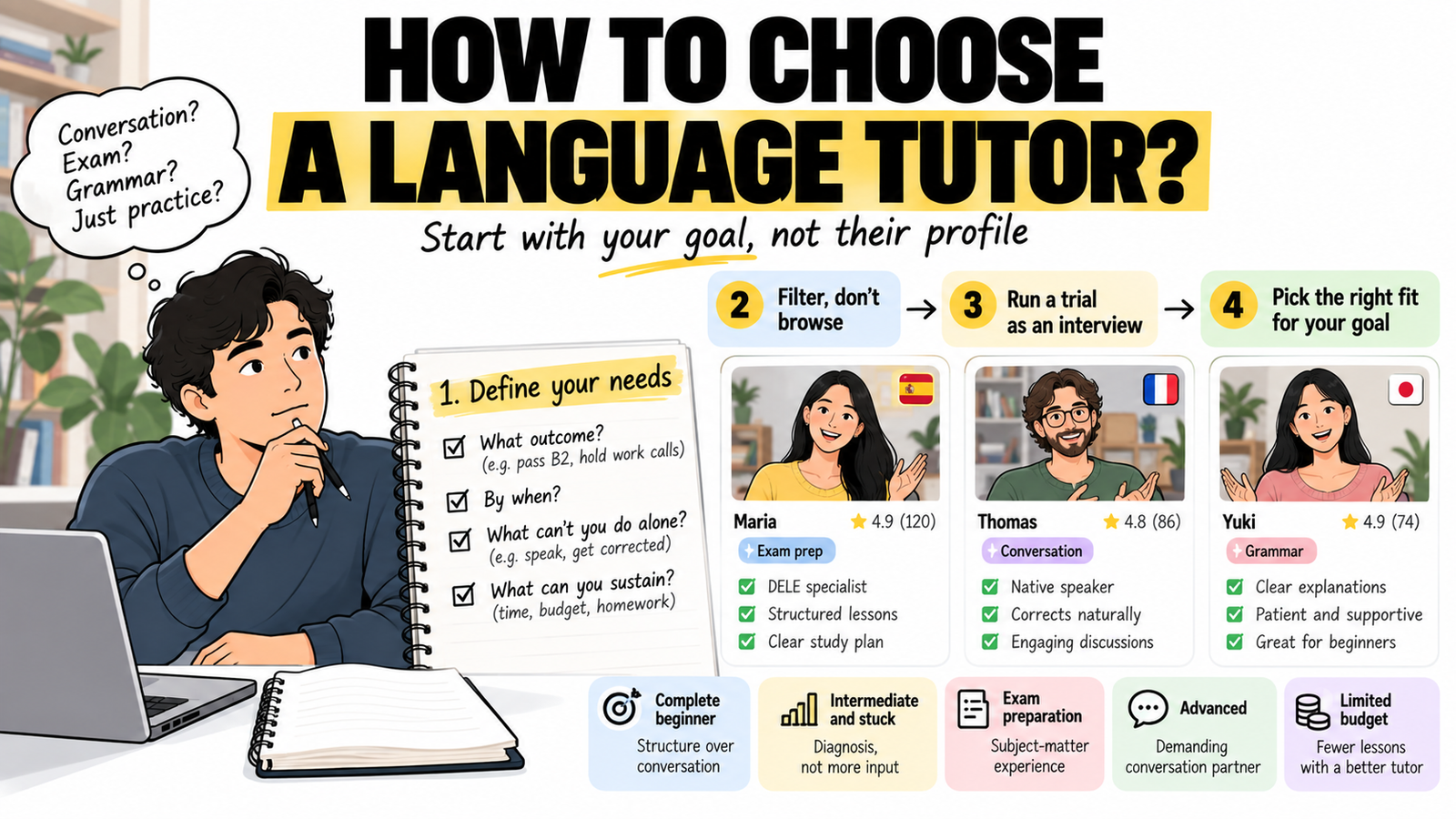
- Complete beginner, first few months. You may not need a tutor yet, and if you do, you need structure more than conversation. Prioritise someone who brings a curriculum rather than someone who is fun to talk to.
- Intermediate and stuck. You need diagnosis, not more input. Prioritise a tutor who can tell you specifically what is holding you back after one conversation, and be suspicious of anyone who cannot.
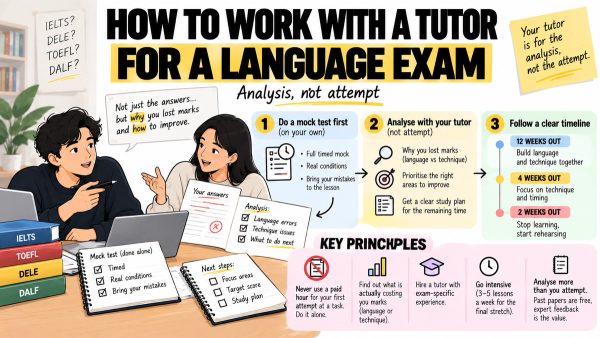
- Preparing for an exam. Prioritise exam-specific experience above everything else, including warmth and price. Ask for evidence of student outcomes.
- Advanced, maintaining or polishing. You need a demanding conversation partner with the judgement to correct selectively. Native-speaker status matters more here than at any other level, and teaching credentials matter less.
- Any level, limited budget. Fewer lessons with a better tutor beats more lessons with a cheaper one. The constraint should hit frequency, not quality.
The first question is not "who is good?" It is "what do I need this person to do that I cannot do alone?"
Step 1. Write the brief before you browse
Four questions, answered in writing, before you open a single profile. This takes fifteen minutes and it is the highest-leverage part of the process.
What outcome, specifically? Not "get better at Spanish." Something you could verify. Hold a thirty-minute work call without switching to English. Pass DELE B2. Understand a film without subtitles. Stop freezing when someone asks an unexpected question. The more concrete the outcome, the more obvious the right tutor becomes, because most tutors are visibly better suited to some outcomes than others.
By when? A deadline changes the hire completely. Twelve weeks to an exam means you need someone who knows that exam and will run a schedule. No deadline at all means you need someone you can sustain for two years, which is a different quality entirely.
What can you genuinely not do alone? This is the question that defines the job. You can build vocabulary alone. You can drill grammar alone. You can get input alone, and there has never been more free input available. What you cannot do alone is speak and be corrected, be diagnosed, and be held to a schedule. Whatever is on your cannot-do-alone list is what you are paying for. Anything else you buy in a lesson is something you could have had for free.
What will you actually sustain? Be honest rather than aspirational. Someone who will genuinely do twenty minutes of homework between weekly lessons needs a different tutor from someone who will do nothing between lessons and needs the hour to carry everything.
Write the answers down. Four sentences is enough. You now have a brief, and every profile you look at is being evaluated against it rather than against your general sense of whether you like the person.
Step 2. Filter, do not browse
Browsing a marketplace is how you end up choosing on photographs. Filter hard first, then read a short list properly.
Filter by specialisation before anything else. Most platforms let you narrow by what a tutor actually teaches: exam preparation, business language, conversation, kids. This maps directly onto your brief. A tutor who has not listed your specialisation will not appear, which is exactly what you want.
Filter by the language you want to be taught in. Being able to fall back on a shared language is valuable for beginners and an active handicap for upper intermediates. Decide deliberately rather than by accident.
Filter by dialect or region when it matters. Egyptian versus Levantine Arabic, Iberian versus Latin American Spanish, Quebec versus metropolitan French. If you have a destination or a workplace in mind, this is not a detail.
Set a price band rather than a price ceiling. Filter out the bottom as well as the top. On most marketplaces the very cheapest tutors are new, unspecialised, or both, and the reason is structural rather than a bargain: rates in this market reflect specialisation and experience far more than they reflect quality of character. The economics behind tutor pricing explain why the cheapest tutor is rarely the cheapest outcome.
On native versus non-native speakers. The honest answer is that it depends on the job, which is why the brief comes first. A non-native tutor who learned your target language as an adult has been exactly where you are, can explain why a construction is difficult, and often teaches grammar better. A native speaker brings intuition, register, and cultural fluency that a non-native rarely matches. For beginners and grammar work, the non-native advantage is real. For advanced polish, accent, and idiom, the native advantage is real. Neither is a general rule.
Step 3. Read the profile for signal
Profiles are marketing documents. Tutors optimise them deliberately, and knowing what they are optimising for lets you read past it. If you want to see the machinery, the tutor-side guide to profile optimisation lays out exactly what a well-built profile is engineered to do.
What actually carries signal:
- Specific lesson descriptions. A tutor who writes "we will work on the grammar and vocabulary you need for medical consultations, with role-play from lesson two" is telling you they have a method. "Conversation practice for all levels" is telling you they do not.
- Specific reviews. "She finally got me to understand the subjunctive" is evidence. "Great teacher, very kind" is noise, however many times it appears.
- Reviews from learners like you. Twenty reviews from beginners tell you little if you are preparing for C1. Look for someone describing your situation.
- The intro video, watched properly. Do they explain who they help and how, or do they talk about themselves? Do they speak at a level you can follow? Would you want to listen to this voice for an hour a week?
- Credentials, weighted to the job. CELTA, DELTA, or a language-teaching degree matter most for beginners and structured work. Examiner experience matters enormously for exam prep and barely at all for conversation.
What carries less signal than people assume:
- Total lesson count alone. Five thousand lessons means they are busy, which usually means they are good, but it can also mean they are cheap. Read it alongside the rate.
- Star ratings. Almost everyone sits between 4.8 and 5.0, so the number cannot separate anyone. The text is where the information is.
- Platform badges. They are a signal of platform compliance, not teaching quality.
- Teaching style matching your "learning style." Skip this one entirely. The idea that learners have visual, auditory, or kinaesthetic styles and learn better when teaching matches them is one of the most persistent myths in education. The specific claim, known as the meshing hypothesis, has been tested repeatedly and has no empirical support. Pashler and colleagues reviewed the literature in 2008 and found no evidence for matching instruction to assessed style, and meta-analyses since have reached the same conclusion. You have preferences. They do not predict what will work. Choose on whether a tutor can deliver your outcome, not on whether they promise to teach the way you like being taught.
Step 4. The trial lesson is an interview
Most learners treat a trial as an audition the tutor performs and they observe. That wastes it. A trial is a two-way interview and you should arrive with questions.
Send something before the lesson. Three or four lines, the day before:
My level is roughly B1. I can handle everyday conversation but I freeze in work meetings. My goal is to run client calls in Spanish by June. I have used apps for a year and my grammar is better than my speaking. For the trial, I would like to talk for most of it so you can hear where I actually am.
A tutor who receives that and prepares something specific has just demonstrated more than any profile could. A tutor who ignores it and runs their standard introductory lesson has also told you something.
Five questions worth asking, in the trial:
- "Based on this conversation, what would you focus on first with me?" The single most revealing question in the process. A good tutor will have been diagnosing throughout and will answer specifically. A weak one will say something general about building confidence.
- "What does a typical lesson with you look like?" You are listening for structure. Warm-up, focus, production, feedback, homework. If the answer is "it depends on the student," push once. Flexibility is good, having no shape at all is not.
- "How do you handle correction, in the moment or at the end?" There is no single right answer, but there should be a deliberate one. A tutor who has not thought about this has not thought about much.
- "What would you expect me to do between lessons?" Tests whether they think about the other 167 hours of your week or only the one they are paid for.
- "Have you worked with someone at my level with my goal? What happened?" Asks for evidence. The answer does not need to be a triumph, and a candid "yes, and it took longer than they expected because of X" is often the best answer you will hear.
What to watch while it happens. Roughly how much of the lesson did you speak? For most goals it should be most of it. Did they adjust when you did not understand, or repeat the same words louder? Did they write anything down? Did they interrupt useful mistakes and let unimportant ones pass, or correct everything indiscriminately?
Trial two or three tutors before committing. The cost of a few discounted lessons is trivial against months with the wrong person, and you cannot calibrate on a sample of one. Most trials are priced deliberately low precisely because the tutor expects this.
What the tutor is doing in that trial
Worth knowing, because it reframes what you are watching.
A good tutor is interviewing you as well. They are establishing your real level rather than your claimed one, working out whether your goal is achievable in your timeline, and deciding whether they are the right person for it. Some are also deciding whether you will actually do the work, because a student who does nothing between lessons is a student whose progress will stall and whose reviews will eventually reflect it.
This is why a tutor who asks you nothing is a genuine warning sign rather than just a missed pleasantry. They cannot plan for a learner they have not diagnosed, which usually means they intend to run the same lesson they run for everyone.
It is also why an honest tutor occasionally tells you they are not the right fit and suggests what to look for instead. That is not rejection. It is the strongest evidence of competence you will see all week, and the tutors who do it are almost always the ones worth going back to later.
Red flags
- They ask you nothing. Covered above and worth repeating, because it is the most reliable single signal.
- They propose a ten-lesson package before understanding your goal. Packages are normal and often good value. Selling one in the first twenty minutes is selling, not teaching.
- They talk more than you do. In a trial, at almost any level, you should be doing most of the talking.
- "We will just chat." Conversation is a method, not the absence of one. Ask what the chat is for and listen to whether there is an answer.
- Everything gets corrected. Correcting every article and preposition in a beginner's speech feels rigorous and reliably produces students who stop speaking.
- Urgency or discount pressure. A tutor whose calendar is healthy does not need to close you today.
- Vagueness about method combined with confidence about results. The combination is the tell, not either part alone.
The likeability trap
Here is the mistake almost everyone makes, including people who did everything else in this article properly.
You can assess whether someone is warm in about five minutes. You cannot assess whether they are effective in fewer than about five lessons. So warmth dominates the decision, because it is the only variable you can actually measure at the moment you have to choose.
Warmth is not irrelevant. You will spend hours with this person, and a tutor who makes you comfortable enough to speak badly in front of them is doing something genuinely important, because fear of sounding stupid is what stops most adults from speaking at all.
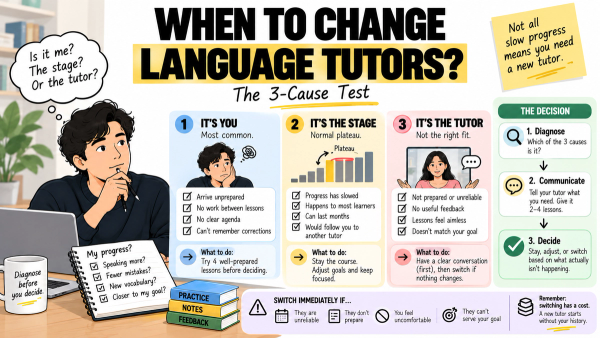
But warm and effective are different axes, and the failure mode is specific: six months of enjoyable conversations with someone you have come to like, no measurable progress, and a reluctance to leave precisely because you like them.
The fix is one question after each trial. Written down, answered honestly: what specifically would this person fix, that I could not fix alone?
If the answer is concrete, you have a candidate. If the answer is "they seem really nice and I felt comfortable," you have a pleasant conversation and no plan.
Bottom line
Choosing a tutor fails when you choose a person before you have defined a job. Write the brief first: what outcome, by when, what you genuinely cannot do alone, what you will actually sustain. Four sentences. Then filter hard, read profiles for specifics rather than sentiment, and run trials as interviews rather than auditions.
Two things are worth more than everything else in this article. Ask "what would you focus on first with me?" in every trial, because it separates tutors who diagnose from tutors who deliver a standard lesson. And after each trial, answer honestly what this person would fix that you could not fix alone. Those two questions will do more than any checklist of qualifications.
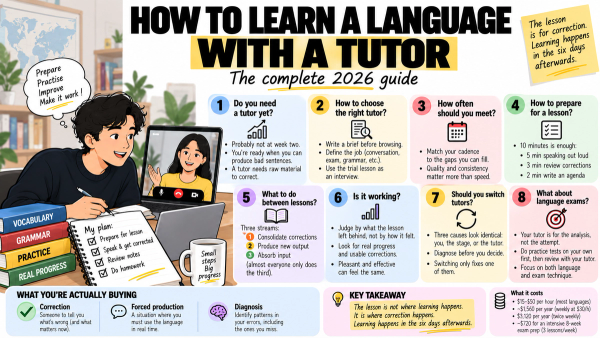
For what specialisations exist and what each one actually involves, see the breakdown of tutoring niches. For why tutors price the way they do, and what the cheapest listings usually mean, see how tutors set their rates. If you are not sure you need a tutor at this stage at all, start here. Once you have chosen, how to prepare for a language lesson covers making the hour count. And for how all of this fits together, see the complete guide to learning a language with a tutor.
Fifteen minutes on the brief. Three trials. Then commit properly, because the tutor is only half of it.