Search this question, and every answer you find was written by someone who sells one of the answers.
App companies publish careful comparisons concluding that apps are the right place to start. Tutoring services publish careful comparisons concluding that apps will never replace a teacher. One of the large tutoring marketplaces has published research finding that most app users would feel more confident with a tutor. None of that is dishonest, and some of it is well argued. But there is not a neutral voice on the page, and the reader is left to average out a set of sales pitches.
We run a tutoring marketplace. We sell the tutor. So here is the version that costs us money, because it is the version we actually believe.
For most people starting a new language from zero, a tutor is a bad first purchase. Not because tutors are not valuable. Because at zero there is nothing yet for a tutor to do that a free resource cannot do better, and you will spend forty dollars an hour on something you could have had for nothing.
The useful question is not whether tutors work. It is when you cross the point where a tutor starts doing something you genuinely cannot do alone. That point is specific, it is identifiable, and most people either hit it months before they hire or hire months before they hit it.
TL;DR. The honest answer by situation
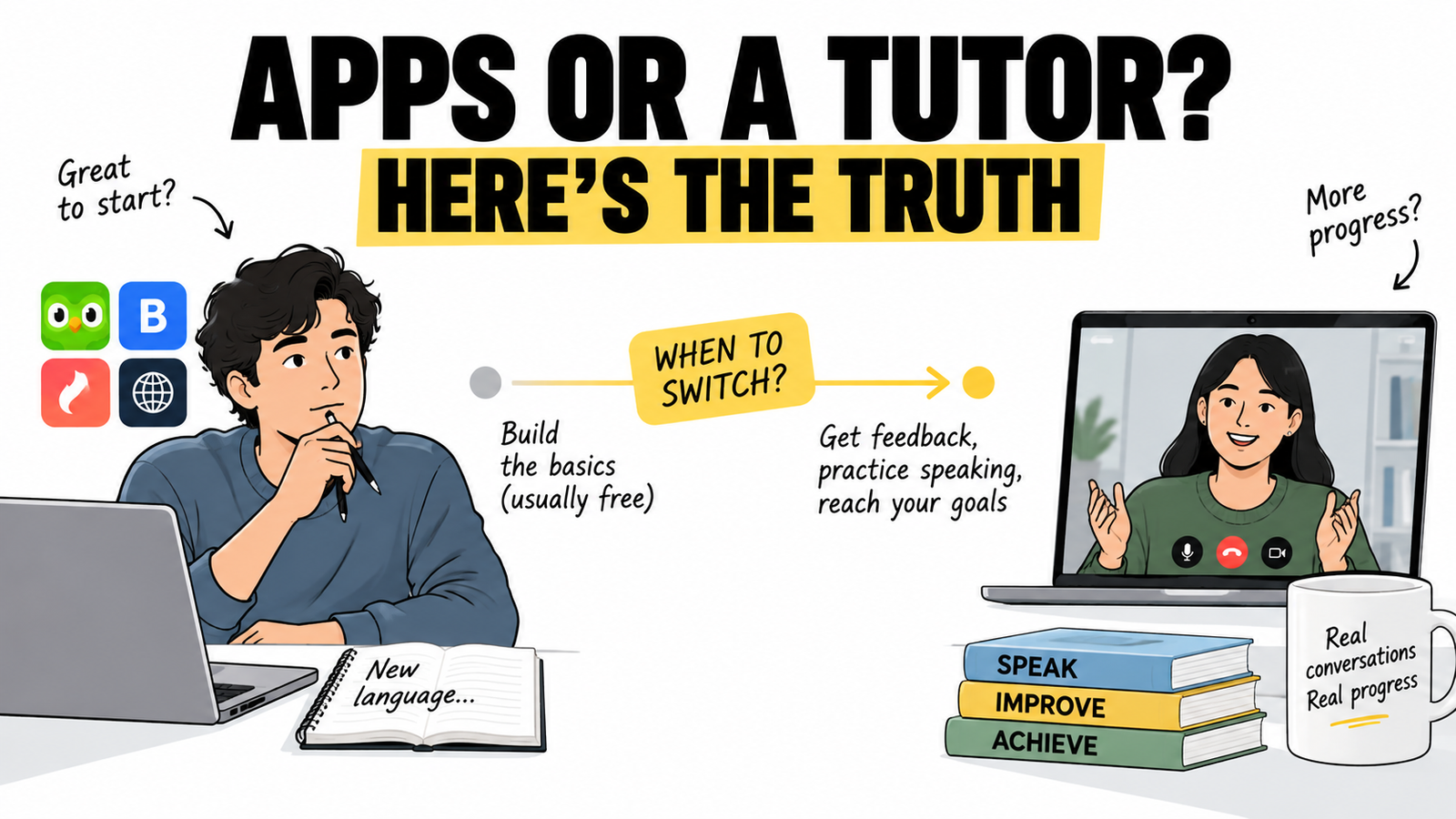
- Absolute beginner, first few weeks, no deadline. You do not need a tutor yet. You need vocabulary, basic structures, and enough input to build something. All of that is free and abundant. Come back when you can make sentences, including bad ones.
- Beginner in a language with hard pronunciation or a new script. Hire early, but sparingly. A handful of lessons to set pronunciation and script habits prevents errors that are expensive to unlearn later.
- Anyone with a deadline. Hire now. Efficiency matters more than cost when there is a date.
- Been using an app for six months and cannot speak. This is the single clearest case in the article. Hire now. You have raw material and no way to activate it.
- Anyone who has repeatedly failed to sustain self-study. Hire now, and be honest that you are buying accountability rather than instruction. It is a legitimate purchase.
- Intermediate and plateaued. Hire now. Plateaus are diagnosis problems, and diagnosis is exactly what you cannot do for yourself.
The threshold in one line: you are ready for a tutor when you can produce bad sentences.
Why nobody's answer is trustworthy, including ours
Worth naming the structure of the problem, because it explains why this question feels so hard to resolve.
The people writing about it fall into two groups. App companies profit when you self-study. Tutoring platforms and tutors profit when you book lessons. Both groups produce content that is reasonable, well-intentioned, and arrives at the conclusion that happens to suit them.
So when an app's blog tells you beginners should start with an app, it may well be right, and it is also exactly what it would say if it were wrong. When a tutoring company publishes research showing learners want tutors, the finding may be accurate, and it is also exactly the research a tutoring company would commission.
You cannot resolve this by reading more of it. You can only resolve it by looking at what a tutor mechanically does, and asking whether you are at a stage where that thing is possible.
We have the same conflict as everyone else. The difference in this article is the direction the conclusion points.
What a tutor is uniquely for
Three things. The rest of what happens in a lesson is available elsewhere for free.
Correction. Someone hearing what you produce and telling you what is wrong with it, with the judgement to know which errors matter and which can wait. Genuinely hard to get elsewhere.
Forced production. A situation where you must construct language in real time, under mild social pressure, with no pause button. Almost impossible to manufacture alone.
Diagnosis. Noticing the pattern behind your errors, including the ones you cannot see. You avoid a tense by rephrasing. You have fossilised a pronunciation error. You understand a structure in reading and never produce it. This is the most valuable and the most invisible.
Now notice what all three have in common. Every one of them requires raw material.
Correction requires something to correct. Forced production requires something to produce with. Diagnosis requires a pattern, and a pattern requires enough output to have a pattern in.
At week two of a new language, you have none of that. A tutor facing a true beginner has almost nothing to correct, diagnose, or push against, so the lesson necessarily becomes vocabulary delivery and basic explanation. Which is real teaching, and which is also the part you could have had from a free video, a textbook, or an app, at three in the morning, for nothing.
What AI has actually changed
No honest version of this question in 2026 can skip it, and most of the articles competing for this search do, presumably because the answer is inconvenient for whoever wrote them.
AI has genuinely taken over part of what a tutor used to be uniquely for. Pretending otherwise would be exactly the self-interested move this article is trying to avoid.
Explanation is gone. A good model will explain why a construction works, generate twenty examples, contrast it with your native language, and answer the follow-up question at two in the morning without getting bored. This was once a real reason to book a lesson and it is no longer a good one. If you are paying a human to explain grammar, you are buying something you can get free.
Written correction is largely gone. Paste in your paragraph, get it corrected with reasons. For accuracy work on text, this is genuinely good and endlessly patient in a way humans are not.
Conversation practice is partly there. Voice modes will hold a conversation, adapt to your level, and let you fail without embarrassment. For pure reps, for warming up, for rehearsing a scenario before you have it for real, this is legitimately useful and it did not exist a few years ago.
Three things it does not do yet.
Diagnosis over time. A model responds to what you put in front of it. It does not notice that you have avoided the subjunctive in every conversation for four months, or that your errors cluster around one structure you learned wrong in month three. Pattern recognition across a relationship is a different thing from answering well in a session.
Real social pressure. You cannot embarrass yourself in front of a chatbot, which is precisely why it is comfortable and precisely why it does less. The mild stakes of a human waiting for your sentence are doing real work. Learners who practise only with AI often report that the first human conversation afterwards is still difficult, which tells you something about what was missing.
Judgement about what not to correct. A good tutor lets errors pass. They decide this one matters now and that one can wait until you are ready. Indiscriminate correction produces learners who stop speaking, and calibrating that is a teaching skill rather than a language skill.
The practical upshot: AI has pushed the production threshold later, not earlier. More of the early stage is now genuinely well served without a human, which strengthens rather than weakens the case for waiting. It has also made the late stage more valuable, because once you need diagnosis and real pressure, the gap between what a model gives you and what a person gives you is wider than it looks from inside a chat window.
The production threshold
Here is the rule, and it is deliberately not about time or level.
You are ready for a tutor when you can produce bad sentences.
Not good ones. Bad ones. The moment you can assemble a wrong sentence in the target language, you have manufactured the raw material a tutor needs. There is something to correct, something to diagnose, and something to push.
Before that point, a tutor is an expensive vocabulary app with a face. After it, a tutor is doing something nothing else can do.
How to tell you have crossed it. You can describe your day, badly. You can ask a question you have not memorised. You can attempt a sentence, fail, and try a different route. You make errors rather than blanks.
How long that takes. For most European languages with a Latin script, somewhere between one and three months of consistent self-study. For Mandarin, Arabic, Japanese, or Korean, longer, and the exceptions below matter more.
The corollary worth noticing. The threshold is about production, not comprehension. Plenty of people can understand a great deal and produce almost nothing, having spent a year on input. Those people are not below the threshold. They are well past it and overdue.
When to hire from day one anyway
The threshold is a default, not a law. Five situations override it, and they are common enough that a meaningful share of readers will be in one.
Hard phonology. Mandarin tones, Arabic consonants, Vietnamese, and to a lesser degree French and Portuguese vowels. Pronunciation errors fossilise fast and are painful to unlearn. A small number of early lessons specifically on sound, before habits set, is money well spent even at week one.
A new script. Arabic, Japanese, Korean, Thai, Greek, Cyrillic. Not because you cannot learn a script alone, but because early handwriting and reading habits are hard to correct later and a few sessions save months of low-grade wrongness.
A deadline. An exam, a relocation, a job starting in four months. When there is a date, efficiency beats economy. Hire immediately and use the tutor to compress the path rather than to enrich it.
You have failed at self-study before, repeatedly. This is the one people are embarrassed about, and it is entirely legitimate. If you have started three languages and abandoned all three, the binding constraint is not instruction; it is accountability. A weekly appointment with a human who remembers what you said last week is a genuinely effective intervention. Buy it deliberately and know that is what you are buying.
You have money and not much time. If a tutor's hour saves you three hours of working out what to study, and your hours are worth more than the lesson, the arithmetic is simple. This is the least romantic reason on the list and one of the most rational.
What to do instead, in months zero to three
If you are below the threshold and none of the exceptions apply, here is the honest alternative. None of it requires a tutor and none of it costs much.
Build a starting vocabulary. The most frequent one to two thousand words carry an enormous share of everyday speech. A spaced repetition system, a frequency deck, twenty minutes a day. This is the single highest-value activity at the beginning and a tutor adds nothing to it.
Get a structural overview. One textbook, one structured course, or one decent YouTube series that explains how the language assembles sentences. You need a map, not a guide.
Get comprehensible input early and constantly. Material slightly above your level, in volume. Graded readers, learner podcasts, slow news, children's content. This is what builds the intuition that later makes production possible.
Start producing before you feel ready. Write three sentences a day. Say them out loud. Record yourself once a week. Badly. The whole point is to manufacture the raw material that makes a tutor worth hiring, and the faster you make bad sentences the faster you cross the threshold.
Set the date. Decide now when you will reassess, in weeks rather than vaguely. "I will look for a tutor when I can describe my weekend without stopping, or in ten weeks, whichever comes first." Open-ended self-study is how people end up in the failure mode below.
The opposite mistake, which is more common
Everything so far argues against hiring too early. The more frequent error among people who actually stick with a language is the reverse.
You use an app for eighteen months. Your streak is enormous. You understand a surprising amount. You have never once had a conversation, and the prospect now feels worse than it did at month two, because you have had time to build up an idea of how badly it would go.
This is the most expensive mistake in language learning, and it is more common than premature hiring because nothing forces the issue. Apps do not ask you to speak to anyone. Input does not push back. You can accumulate passive knowledge for years without ever discovering that you cannot use it.
The signs you are overdue:
- You understand far more than you can say, and the gap is widening rather than closing.
- You have been at roughly the same place for three months and cannot say why.
- You rehearse sentences before saying them, and often abandon them.
- You have a large vocabulary and reach for the same six structures every time.
- You have been "nearly ready" to start speaking for longer than two months.
If three or more of those are true, the threshold is behind you and the question is no longer whether to hire but why you have not. Almost always the answer is that speaking to a stranger in a language you are bad at is unpleasant, which is true, and which is also the exact thing you are paying a tutor to make survivable.
The cost of waiting versus the cost of starting
A brief note on the arithmetic, because it usually runs the opposite way to how it feels.
Lessons feel expensive because the cost is visible and recurring. Waiting feels free because its cost is invisible. But a year of not speaking has a real price: fossilised errors that take longer to fix than they would have taken to prevent, a comprehension-production gap that widens the longer it goes unaddressed, and in many cases abandoning the language entirely because it never became usable enough to be rewarding.
The reverse is also true, which is the whole argument of this article. Two months of lessons at the very beginning, when there is nothing to correct, buys you vocabulary you could have had free and a set of explanations available on any number of websites.
Neither error is cheap. They are simply expensive in different directions, and the threshold is what separates them. For context on what lessons actually cost and why rates vary so widely, see how tutors set their rates.
Bottom line
For most people starting from zero, a tutor is a bad first purchase, and we would rather tell you that than sell you eight lessons you are not ready to use.
The threshold is production, not time or level. When you can make bad sentences, you have the raw material a tutor needs, and everything a tutor uniquely provides becomes available to you. Before that, you are paying premium rates for vocabulary and explanations that are free.
Override the threshold when the language has hard sounds or a new script, when you have a deadline, when you have repeatedly failed to sustain self-study alone, or when your time is worth more than the lesson.
And watch the opposite failure harder than you watch this one. Hiring three months early costs you a few hundred pounds. Waiting three years costs you the language.
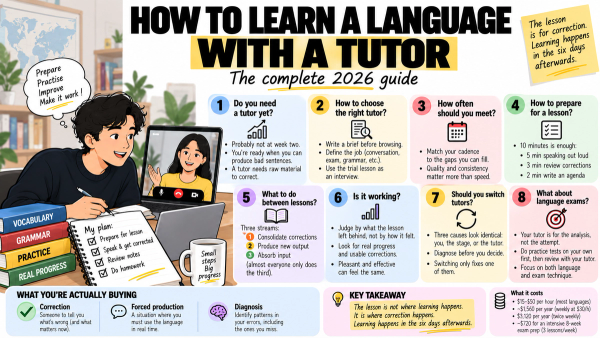
When you do cross the threshold, how to choose a language tutor covers picking the right one, and how to prepare for a language lesson covers making the hour count. For how often to book once you have crossed the threshold, see how often should you have language lessons. For how all of this fits together, see the complete guide to learning a language with a tutor.
Make bad sentences. Then hire someone to fix them.