Exam preparation is the clearest case in this whole cluster for hiring a tutor. There is a date, a score, a format, and a standard, which means there is an objective thing to be wrong about and an expert who knows what wrong looks like. Almost everything that makes tutoring hard to justify elsewhere disappears when there is a deadline.
It is also where paid hours get wasted most predictably, and always in the same way.
People book a tutor and spend the lesson doing practice tests. An hour of Reading Part 3, marked at the end, with ten minutes of going over the wrong answers. It feels productive because it looks exactly like the exam. It is also the single most expensive way to do something you could have done alone, for free, at the kitchen table.
The exam paper is not the scarce resource. Past papers are freely available for every major exam in the world. What is scarce is somebody who can look at your attempt and tell you why you lost the marks, which of your errors are language and which are technique, and what to do in the six weeks remaining.
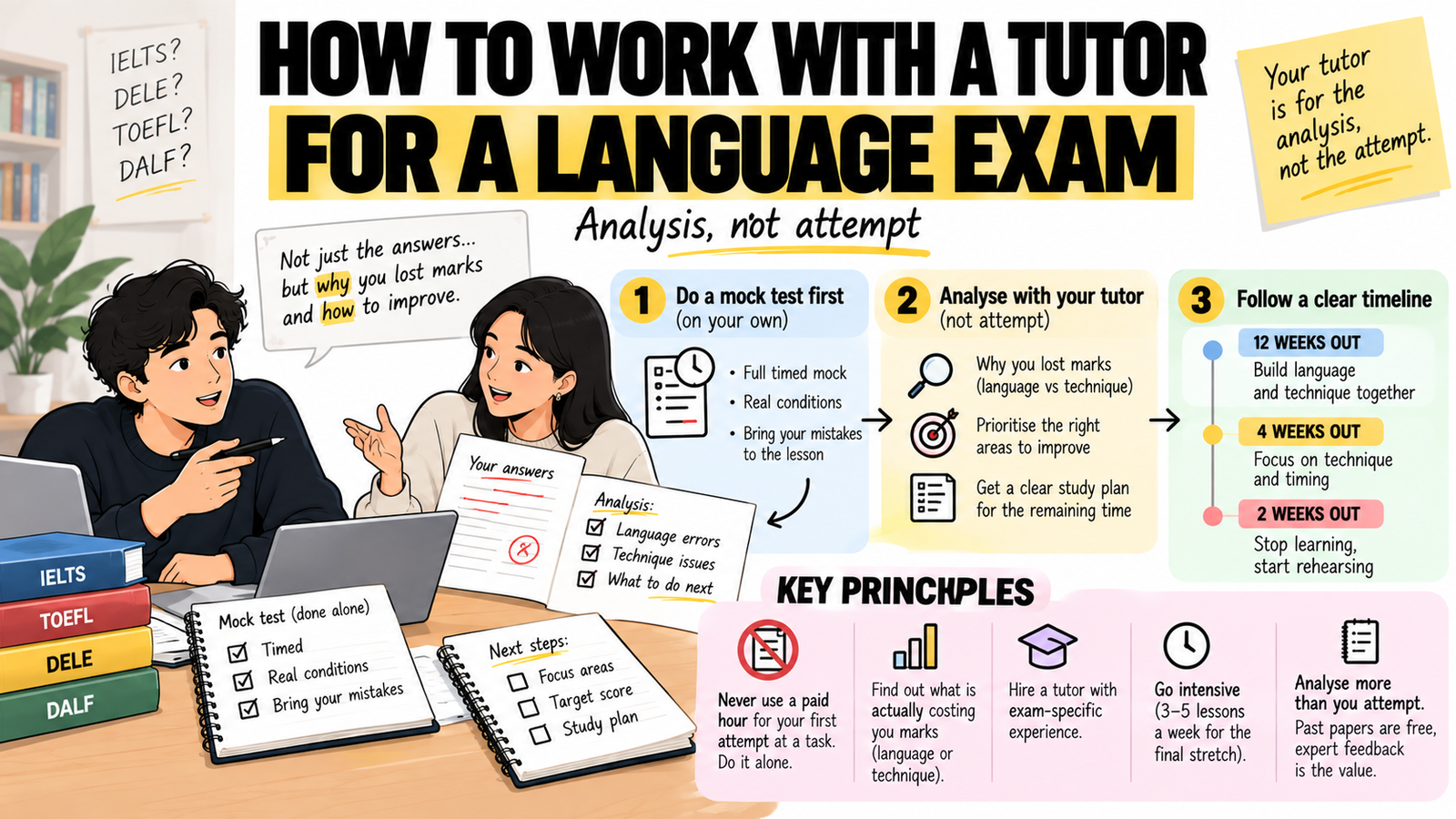
Your tutor is for the analysis, not the attempt.
This article covers the two separate problems exam candidates confuse, what to do before your first exam-prep lesson, how to brief a tutor properly, what the timeline should look like at twelve weeks and at two, and how to split work between the lesson and your own time.
TL;DR. Exam prep in one screen
- Never use a paid hour for your first attempt at a task type. Do it badly alone, then bring the wreckage.
- Work out what is actually costing you marks. Language ability and exam technique are different problems with different fixes, and most candidates assume it is the first when it is often the second.
- Take a full timed mock before your first lesson. Cold, unprepared, properly timed. It is the best possible brief you can hand a tutor.
- Hire for exam-specific experience above everything else. Warmth, price, and general teaching quality all rank below whether they know this exam.
- Twelve weeks out: build language and technique together. Four weeks out: technique and timing only. Two weeks out: stop learning, start rehearsing.
- Go intensive. Deadlines override the usual cadence advice; three to five lessons a week for the final stretch is a reasonable shape.
- Analyse more than you attempt. The ratio most candidates run is backwards.
The two problems people confuse
Every mark you lose falls into one of two categories, and the fix for each is completely different.
Language problems. Your actual ability is below what the exam requires. You do not have the vocabulary range, your grammar breaks under pressure, you cannot follow speech at that speed. No amount of technique fixes this. You need more language.
Technique problems. Your ability is adequate but you are losing marks on how the exam works. You misread what the writing task asked for. You spent nineteen minutes on Task 1 and rushed Task 2. You answered the speaking question you expected instead of the one you got. You did not know the reading section is designed so that nobody finishes comfortably.
Why this matters: a solid B2 speaker can fail a B2 exam on technique alone, and this happens constantly. A B1 speaker cannot pass a C1 exam on technique at all, and no tutor can change that in eight weeks.
How to tell which you have. Take a full mock, timed. Then look at your errors and ask of each one: did I not know this, or did I know it and still get it wrong?
Did not know it, repeatedly, across sections: language problem. Knew it but ran out of time, misread the task, or panicked: technique problem. Most candidates have both, in a ratio they have never measured, and that ratio should determine how the next eight weeks are spent.
Ask your tutor directly: what proportion of my lost marks is language and what proportion is technique? A tutor who knows the exam will have a view after seeing one mock. A tutor who cannot answer probably does not know the exam well enough.
The rule: analysis, not attempt
The single most common way to waste exam-prep money is to use lessons for doing the exam rather than for understanding what went wrong.
Why it happens. Practice tests feel like the most exam-relevant activity available, and they are easy to schedule. Sitting in silence doing a reading paper while someone watches also requires no preparation from either party, which is convenient for a tutor without a plan.
Why it is wrong. The attempt is free and infinitely available. Every major exam publishes past papers, sample tasks, and official practice materials. You can sit them alone, timed, for nothing. What you cannot get alone is a person who has seen four hundred candidates make the same mistake and can tell you that your Task 2 essays are losing marks on coherence rather than grammar, which is invisible to you and obvious to them.
The correct pattern. Attempt alone, analyse together. Write the essay at home under time pressure, send it before the lesson, spend the lesson on what it revealed. Do the listening section on Tuesday, bring your wrong answers on Wednesday.
The exception that proves it. Speaking is different, because the attempt itself requires a human. Speaking practice under exam conditions, with a tutor playing examiner, is a legitimate use of paid time, and it is the one section where doing the thing in the lesson is correct. Even then, the analysis afterwards is where the marks come from.
The ratio to aim for. Roughly a quarter of lesson time on attempting things (mostly speaking), three quarters on analysis, targeted fixing, and technique. Most candidates run this the other way round.
Before your first exam-prep lesson
Do one thing, and it changes everything downstream.
Take a complete mock exam, timed, under realistic conditions, before you book.
Not a section. The whole thing, in one sitting, with the clock running and no dictionary. It will be unpleasant and your score will be lower than you hoped. Both of those are the point.
Why this matters more than anything else you could do. A tutor meeting you cold spends two or three lessons working out where you are. That is two or three lessons of a finite budget spent on diagnosis you could have handed them on day one. A full mock, with your answers and your score, compresses that into five minutes of reading.
It also tells you whether you need a tutor at this level at all. If you are scoring well above the band you need, you may need a few technique lessons rather than a twelve-week programme. If you are scoring far below it, you may need general language lessons for a few months before exam preparation makes any sense, which is a genuinely different purchase.
Then send it. The paper, your answers, your score, and the conditions you took it under. A tutor who receives that before lesson one will arrive with a plan. A tutor who receives nothing will spend lesson one asking you questions.
How to brief a tutor on an exam goal
Five things, in one message, before you start.
The exam and the exact level. Not "I want to improve my French." DELF B2, sitting in March.
The score you need and why. A university requiring an overall 6.5 with no band below 6.0 is a different problem from someone who needs a general pass. Minimum-per-section requirements change strategy completely, because they mean your weakest section governs everything.
The date. Fixed, and non-negotiable. Everything about the plan follows from how many weeks remain.
Your mock result, by section. The single most useful item in the brief.
What happens if you fail. Blunt, and worth saying. Retaking in six weeks at modest cost is a different situation from a visa deadline with no second attempt. It changes how much risk the plan should carry.
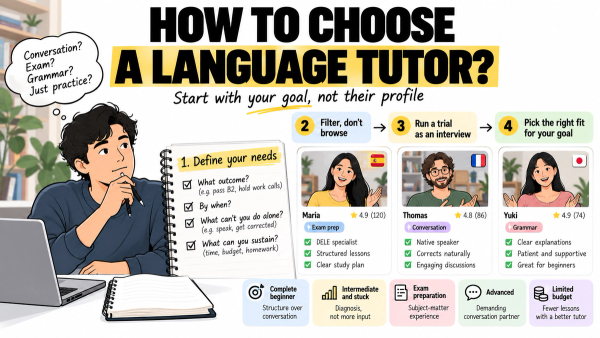
One more thing worth asking in the trial: have you prepared students for this exam at this level, and what happened? Exam preparation is the one niche where specific experience outranks almost everything else, and the guide to choosing a tutor covers how to evaluate the answer.
The timeline
What should be happening, by how much time remains. Assumes you are starting somewhere near the required level.
Twelve weeks out
Build language and technique together.
This is the only phase where general language work belongs in an exam plan. Vocabulary range, grammar accuracy under pressure, listening speed, reading stamina. Alongside it, learn the format properly: what each section actually asks, how marks are allocated, what examiners reward.
Two to three lessons a week. Full mock every three weeks, taken alone, analysed together.
Eight weeks out
Shift the weight toward technique and weak sections.
By now you know your weakest section from the mocks. Most of your lesson time goes there. General language work continues in your own time and largely leaves the lessons.
This is where the language-versus-technique ratio pays off. If your losses are mostly technique, this phase can move your score considerably. If they are mostly language, expect slower movement and consider whether the date is realistic.
Three lessons a week. Full mock every two weeks.
Four weeks out
Technique and timing only.
Stop trying to acquire new language. There is not enough time for anything new to become reliable under pressure, and the attempt takes attention away from converting what you already have.
Everything now is about executing: timing per section, task interpretation, standard structures you can deploy without thinking, the speaking formulas that buy you three seconds to plan.
Three to five lessons a week. Full mock weekly.
Two weeks out
Rehearse, do not learn.
Full timed mocks under exam conditions. Speaking simulations with the tutor as examiner. Reviewing your own recurring errors rather than discovering new ones.
The goal in the final fortnight is consistency and calm, not improvement. Candidates who are still cramming vocabulary in the last week usually perform worse than those who spent it rehearsing what they already had.
The week of
Almost nothing. Light review, one speaking rehearsal, sleep. Cramming in the final days reliably costs more in fatigue and anxiety than it adds in knowledge, and exam performance is unusually sensitive to both.
Splitting lesson and homework
The general principle from what to do between language lessons applies with more force here, because the deadline makes waste expensive.
Alone, between lessons: full mocks and timed sections, vocabulary and grammar drilling, listening and reading volume, writing tasks under time pressure, recording yourself answering speaking prompts.
In the lesson: analysis of everything above, speaking practice under exam conditions, task interpretation, the errors you cannot see, and strategy decisions about where to spend remaining time.
The test for any exam-prep activity: could I have done this alone? If yes, and you are doing it in a lesson, you are paying premium rates for something free.
On cadence. Exam preparation is the one case where the usual advice about gaps and consolidation is overridden, as noted in how often should you have language lessons. You will consolidate less per lesson at three to five a week than you would at one. That is the correct trade when there is a date, and you are explicitly buying speed at the cost of efficiency.
What exam tutors see
Three patterns worth knowing, because they explain what a good exam tutor is reacting to.
Candidates overestimate the value of practice volume. Someone who has done thirty practice tests and analysed none of them is usually scoring exactly what they scored on test three. Repetition without analysis rehearses the same errors until they are permanent.
Missing sessions is worse in exam prep than anywhere else. A gap of two weeks in an eight-week programme is a quarter of the plan, and it forces the tutor to re-cover ground rather than advance. Exam plans are sequenced; they do not tolerate holes well.
Anxiety shows up in specific sections. Speaking and writing, because both require production under observation. A tutor who knows the exam will treat this as a technical problem with technical fixes, such as timed rehearsal, memorised openings, and a plan for what to do when your mind goes blank, rather than as something to be reassured about.
On choosing an exam tutor specifically. Exam preparation is among the most in-demand tutoring niches, which means the supply is large and the variation is wide. A tutor listing "IELTS" has not necessarily prepared anyone for it. Ask for specifics: which levels, how many candidates, what their scores did. The economics behind why this niche is crowded are covered in the breakdown of tutoring niches, and the short version is that everybody lists it because it pays.
What not to do
Do not use lessons for first attempts. The article's central point and the most expensive mistake available.
Do not do practice tests without analysing them. Thirty unanalysed papers move your score less than five analysed ones.
Do not book exam prep when you need language. If your mock is two bands below your target, you have a language problem and a tutor cannot technique you across that gap. Build the language first, then come back.
Do not learn new material in the final month. It will not be reliable under pressure and the attempt costs attention.
Do not skip the speaking rehearsals because they are uncomfortable. Speaking is where technique gains are largest and where unpractised candidates lose most.
Do not let the tutor drive without a plan. Ask in lesson one what the plan is between now and the exam. A good exam tutor will already have one. A tutor who improvises weekly is fine for general learning and wrong for this.
Bottom line
Exam preparation is the strongest case for hiring a tutor and the easiest situation in which to waste one.
The attempt is free. Past papers exist for every exam in the world and you can sit them alone, timed, tonight. The scarce thing is somebody who can look at what you produced and tell you why the marks went, which errors are language and which are technique, and how to spend the weeks you have left.
So do the exam alone and bring the wreckage. Take a full mock before your first lesson. Ask what proportion of your losses is language and what proportion is technique, because the answer determines everything else. Go intensive as the date approaches, and stop learning new material a month out.
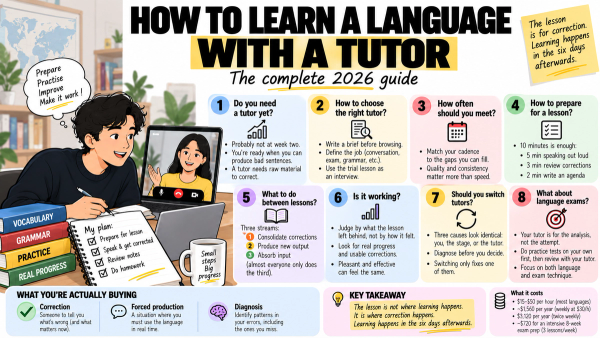
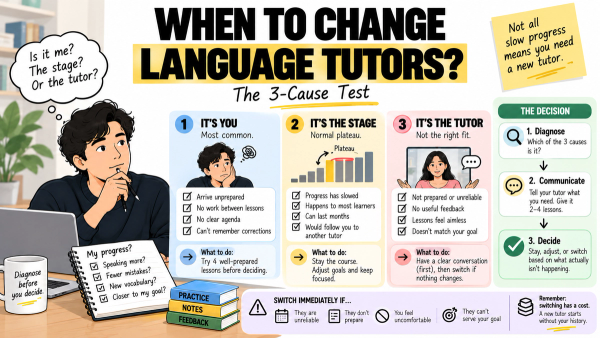
For choosing a tutor with genuine exam experience, see how to choose a language tutor. For making each lesson count, see how to prepare for a language lesson. For the work between them, see what to do between language lessons. For how all of this fits together, see the complete guide to learning a language with a tutor.
Attempt alone. Analyse together. That is the whole method.