Search for what to do between lessons, and you get a study routine. Set a fixed time each day. Twenty minutes of vocabulary. A podcast on the commute. Block it in your calendar. Treat it like an appointment with yourself.
All reasonable, and all of it would be identical advice if you had no tutor at all.
That is the problem. Between-lesson work is not a general study habit that happens to sit near your lessons. It is the second half of the lesson. What you should be doing on Tuesday is determined by what happened on Monday, and a routine that ignores what your tutor actually showed you is just self-study with a coincidental appointment attached.
The distinction matters because of where the value sits. A lesson surfaces things: a correction, a structure you keep getting wrong, a word you reached for and could not find. None of that becomes ability during the lesson. It becomes an ability in the days that follow, when you use it, fail with it, and slowly make it automatic. Skip that, and you have paid for a diagnosis you never acted on.
This article covers why generic routines underperform here, the three streams your between-lesson time should be divided into, the one almost everyone skips, how to allocate a realistic amount of time, and the forty-eight-hour window that decides whether any of it sticks.
TL;DR. The gap in one screen
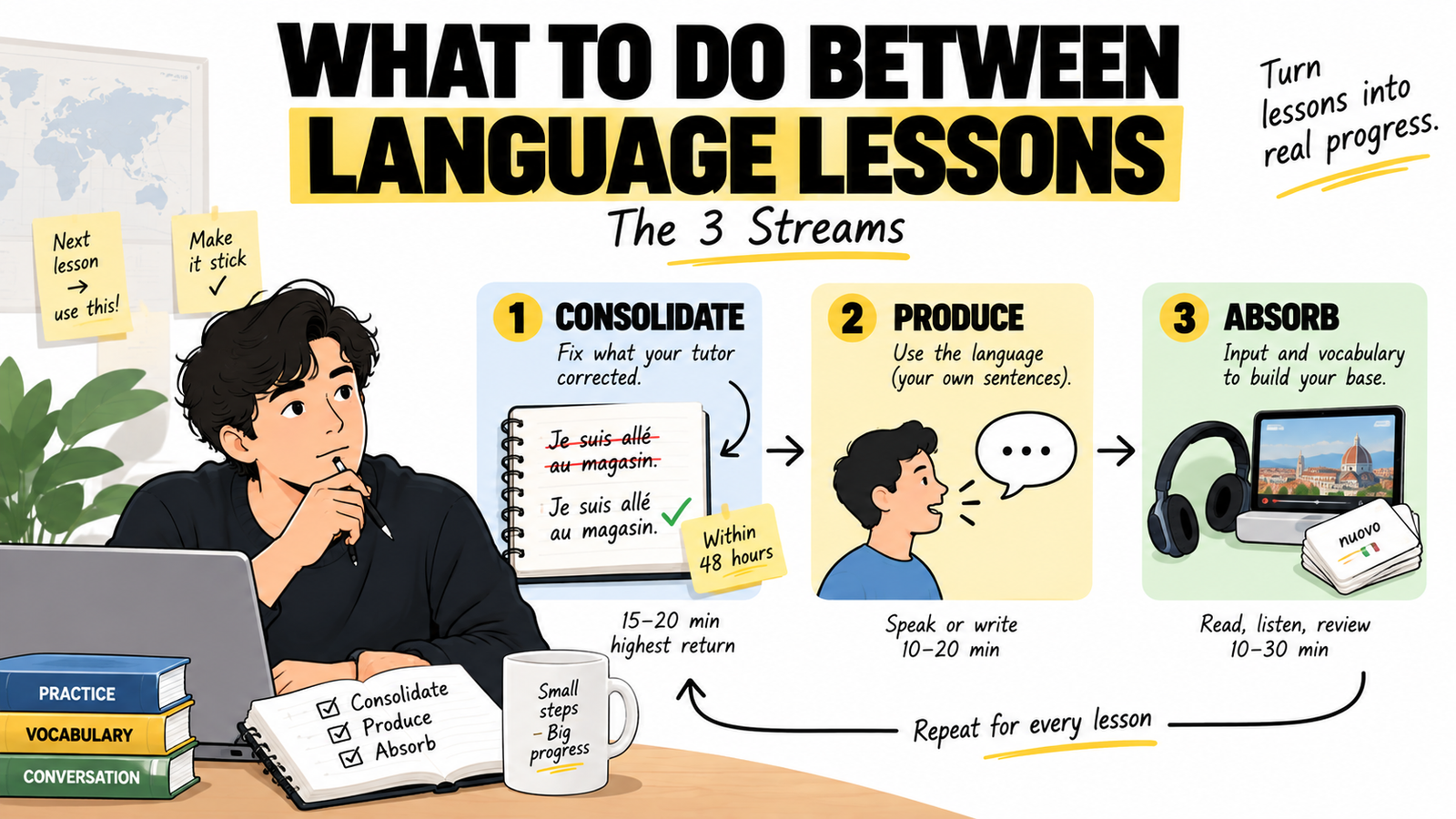
- Three streams, in priority order. Consolidate what the last lesson corrected. Produce new output that will fail. Absorb input and vocabulary.
- The one people skip is Produce. Almost everyone does input and flashcards, because both are comfortable. Production is uncomfortable, which is exactly why it is the bottleneck.
- Consolidate within forty-eight hours. Lesson notes decay fast. After a few days, you are reading a fragment whose context has gone.
- Beginners lean toward Absorb. You need raw material before you have much to consolidate.
- Intermediates lean hard toward Produce. If you are plateaued, this is almost always the missing stream.
- Advanced lean toward Consolidate and harder input. Your errors are subtle now and will not fix themselves through volume.
- Twenty minutes a day beats two hours on Sunday. For reasons covered in the article on lesson frequency.
If you do one thing: write or say five sentences using whatever your tutor corrected last time, within two days of the lesson.
Why routine advice underperforms here
The standard advice is not wrong. Consistency genuinely matters, fixed times genuinely help, and daily contact genuinely beats weekend cramming.
It just answers a different question. "How do I build a language habit" and "what should I do between my lessons" are not the same problem, and the second one has an input the first does not: you have just spent an hour with someone who told you specifically what is wrong with your language.
That is an enormous amount of personalised information, and most learners let it evaporate. They close the tab, open an app, and do the same twenty minutes of vocabulary they would have done anyway.
The test for any between-lesson activity: would you be doing this identically if you had never had the lesson? If yes, it is fine, but it is not gap work. It is background study, and it belongs in the third stream rather than the first.
For why the gap matters as much as the lesson itself, see how often should you have language lessons.
The three streams
Divide your between-lesson time into three, in this order of priority. Note that priority is not the same as time allocation; the highest-priority stream takes the least time.
Stream 1. Consolidate
What it is: working directly on what the last lesson surfaced. The corrections, the structure you kept getting wrong, the word you could not retrieve.
What it looks like: rewrite the sentences you got wrong, correctly, from memory. Say them out loud. Take the structure your tutor explained and build five new sentences with it, about your own life rather than from a textbook. Review the vocabulary that came up in conversation, not vocabulary from a list.
Time: fifteen to twenty minutes, within forty-eight hours of the lesson. Small, urgent, highest return per minute of anything in this article.
Why it is first: this is the only work that is genuinely personalised to you. Everything else in your week is available to any learner of your language. This is not.
The practical obstacle is that lesson notes are usually unusable by the time people look at them. "Word order, careful" meant something during the lesson and means nothing on Thursday. Writing full corrected sentences immediately after the lesson, rather than fragments, is what makes this stream possible at all. Spaced repetition is the natural home for the review half: Anki is the standard tool, and some tutoring platforms, Jynio among them, now generate decks from the material that actually came up in your lessons, which removes the step where good intentions meet a blank card template.
Stream 2. Produce
What it is: generating new output in the target language, on your own, that nobody is correcting.
What it looks like: write a paragraph about your day. Record two minutes of yourself speaking. Narrate what you are doing while you cook. Write the email you would send if you had to. Argue with something you read.
Time: twenty to forty minutes across the week, more if you are intermediate.
Why it matters more than it seems: production is how passive knowledge becomes active. You can recognise a structure for months without ever producing it. The act of reaching for it, failing, and reaching again is what moves it across. It also manufactures next week's lesson agenda, because the places you get stuck are precisely what your tutor should be looking at.
The counterintuitive part: this work is valuable because nobody corrects it. You are not practising accuracy here. You are practising retrieval under mild pressure, and the errors you make are data rather than damage.
Stream 3. Absorb
What it is: input and vocabulary. Reading, listening, watching, flashcards.
What it looks like: graded readers, learner podcasts, shows with subtitles in the target language, frequency decks, whatever you were going to do anyway.
Time: the majority of your available minutes, and the least urgent of the three.
Why it is last in priority and first in volume: you need a great deal of it, it works passively, it is enjoyable enough to sustain, and it is entirely uncoupled from your lessons. It is the fuel. It is also, importantly, the stream that most learners treat as the whole tank.
The stream everyone skips
If this article has one argument, it is this.
Almost every learner between lessons does Stream 3 and nothing else. They open an app, do their flashcards, listen to a podcast, feel productive, and stop. Streams 1 and 2, which are where the actual conversion happens, get skipped entirely.
There are two reasons, and neither is laziness.
Stream 3 is comfortable. Recognition feels good. You see a word, you know it, you get a tick. Production feels bad. You reach for a sentence, it comes out wrong, and nobody tells you what the right version was. The activity that feels worst is the one doing the most work, which is a deeply inconvenient property.
Stream 3 is prepackaged. Apps tell you what to do next. Input is infinite and requires no decisions. Consolidation requires finding your notes and deciding what to do with them, and production requires inventing your own task. Friction beats intention nearly every time.
The practical fix is to make Streams 1 and 2 as small and as scheduled as possible. Fifteen minutes of consolidation and twenty minutes of production, at a fixed time, is enough to change the trajectory. It is also, for most people, less time than they already spend on Stream 3.
If you are intermediate and stuck, this is almost certainly your problem. Not insufficient lessons, not insufficient vocabulary, not the wrong app. A comprehension-production gap that will not close through more input, because input is not what closes it.
What to actually do, by the time you have
Three realistic budgets. Each assumes one lesson a week.
Fifteen minutes a day. Day one after the lesson: consolidation, the full twenty minutes; this is the one non-negotiable. Days two to four: ten minutes of production, five of review. Days five to six: input only, whatever you enjoy. Day seven: the ten-minute pre-lesson protocol from how to prepare for a language lesson.
Thirty minutes a day. Same shape, with the additional time going to production early in the week and to input later. The useful principle is front-loading: do consolidation and production in the first three days after the lesson, while the material is warm, and let the back half of the week be input.
One hour, twice a week, and nothing else. More common than people admit. Session one, within two days of the lesson: twenty minutes consolidation, twenty production, twenty input. Session two, before the next lesson: twenty minutes production, twenty input, twenty preparing the agenda. Not ideal, considerably better than nothing, and the structure matters more here than in the daily version because you have fewer chances to make contact.
The shape to avoid: everything on the day before the next lesson. Cramming a week's work into one panicked evening produces worse retention than half the work spread out, for reasons covered in the article on lesson frequency, and it makes the consolidation window useless because the notes are already cold.
Allocation by level
The three streams stay constant. Their weighting does not.
Beginner. Roughly 20 percent consolidate, 20 percent produce, 60 percent absorb. You need raw material more than anything, and there is not yet much to consolidate. Do produce a little anyway; the habit of attempting sentences badly is worth starting early and gets harder to start later.
Intermediate. Roughly 20 percent consolidate, 50 percent produce, 30 percent absorb. This is the inversion most people never make. You have enough input. What you lack is the reps of effortful retrieval that turn recognition into speech.
Advanced. Roughly 40 percent consolidate, 30 percent produce, 30 percent absorb, with the absorb portion being genuinely difficult material rather than comfortable material. Your remaining errors are subtle, stable, and will not be dislodged by volume. They need direct attention.
Percentages are illustrative rather than precise. The point is the direction of the shift: as you improve, the balance moves away from absorbing and toward consolidating, because what limits you stops being what you have not met and starts being what you have met wrongly.
The forty-eight hour rule
One specific timing point, because it decides whether Stream 1 happens at all.
Do your consolidation within forty-eight hours of the lesson.
The reason is practical rather than neurological. Lesson notes are compressed. During the hour, "word order after time expressions" is a complete thought because you have the whole conversation in your head. Three days later, it is a label attached to nothing, and you cannot reconstruct what you actually got wrong.
Two things make the window workable.
Write full sentences, not labels, immediately after the lesson. Five minutes, while it is fresh. Not "past tense of venir" but the entire sentence you got wrong and the corrected version. This is the single highest-leverage five minutes in the whole cycle, and it is covered in more detail in how to prepare for a language lesson.
Book the consolidation slot when you book the lesson. Twenty minutes, the day after, in the calendar. Treating it as the second half of the appointment rather than as optional homework is the framing that makes it survive a busy week.
If you genuinely cannot do it within two days, do it anyway when you can. Cold consolidation beats none. But the difference in usefulness between day one and day five is larger than most people expect.
What tutors see
Worth knowing, because the difference is visible from the other side within about two minutes.
A tutor can tell immediately whether the gap was filled. Not from what you say about it, but from whether the correction from last week has landed. The student who worked on it produces the structure, hesitantly, correctly. The student who did not makes the identical error, and the tutor has to teach the same thing again, which is the least valuable use of a paid hour that exists.
That repetition is the quiet cost of an empty gap. Over a year, a learner who consolidates spends their lessons on new ground. A learner who does not spends a meaningful fraction of every lesson re-covering the same territory, and progress looks slow for reasons that have nothing to do with the tutor's quality.
There is also a compounding effect on how much you get. A tutor who can see that corrections stick tends to push harder and correct more candidly, because the feedback is clearly being used. A tutor whose corrections evaporate weekly gradually stops offering the difficult ones, not out of pique but because there is no point. Neither party usually notices this happening.
What not to do
Do not treat app streaks as gap work. A daily streak is Stream 3 with good marketing. It is fine; it is not consolidation, and it is not production.
Do not study new material instead of consolidating. Moving on feels like progress. Returning to the thing you got wrong feels like going backwards. The second one is the work.
Do not save it all for the night before. Covered above, and it is the single most common pattern.
Do not make production a performance. Recording yourself for two minutes and deleting it is useful. Writing a perfect paragraph with a dictionary open and three revisions is a different activity, closer to Stream 3, and much less useful for speaking.
Do not skip the gap because you missed a day. The usual way one missed session becomes three weeks. Consolidation four days late is worth doing.
Do not do this forever without checking it is working. Gap work is a means, not a ritual. If you have been doing all three streams consistently for three months with no change, something upstream is wrong.
Bottom line
Between-lesson work is not a study routine. It is the second half of the lesson, and the test of any activity is whether it would look identical if the lesson had never happened.
Three streams. Consolidate what was corrected, within forty-eight hours, in fifteen to twenty minutes. Produce new output that nobody will correct, because retrieval under pressure is what converts knowledge into speech. Absorb input, in volume, as the fuel underneath both.
Most learners do only the third, because it is comfortable and prepackaged, and then conclude that lessons are not working. The lesson was working. It surfaced exactly what needed attention, and then nothing happened to it for six days.
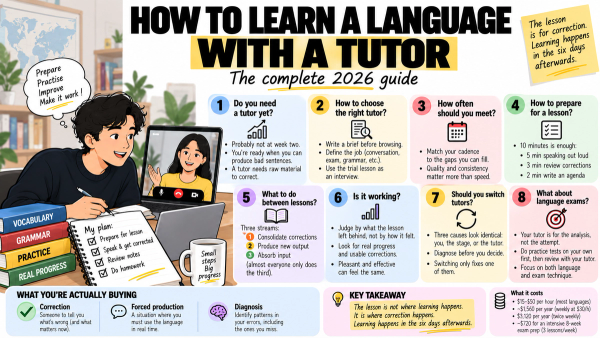
For how this affects how often you should book, see how often should you have language lessons. For the ten minutes immediately before a lesson, and the five immediately after, see how to prepare for a language lesson. For whether you should be booking lessons at this stage at all, see do you actually need a language tutor. For judging whether the lesson itself was any good, see what makes a good language lesson. For how all of this fits together, see the complete guide to learning a language with a tutor.
Fifteen minutes, within two days, on what your tutor actually corrected. Everything else is optional by comparison.